
In short
- EUDR binds by role in the chain, not by company size. Size only changes the timing.
- Since the December 2025 amendment, downstream operators and traders do not file due diligence statements at all.
- The commodity list is closed: cattle, cocoa, coffee, oil palm, rubber, soya and wood, plus the products in Annex I.
EUDR reaches you through what you do with a product, not through how large you are. If your business places on the EU market, makes available on it, or exports from it anything containing cattle, cocoa, coffee, oil palm, rubber, soya or wood, you are inside the regulation somewhere. The question that decides your workload is which role you hold. Whoever first puts the product on the EU market is an operator and carries the whole due diligence obligation. A business buying inputs a supplier has already covered is a downstream operator, and owes far less.
EUDR is Regulation (EU) 2023/1115. It is a market access rule rather than a reporting rule: covered goods may only be placed on, made available on, or exported from the EU market where they are deforestation-free, were produced in accordance with the law of the country of production, and are covered by a due diligence statement.
What is the exact test?
Three questions, in order, and you can run them in about a minute.
One: is the commodity on the list? Cattle, cocoa, coffee, oil palm, rubber, soya and wood. That list is closed. If none of the seven appears anywhere in the product, EUDR does not reach it. If one does, keep going.
Two: is your specific product in Annex I? The commodity list is the headline, but the legal scope is the product list in Annex I of the regulation, which sets out the relevant goods made from those commodities. A commodity being present is not automatically enough; the product code has to be listed.
Three: what do you do with it in the EU? This is the question that sets your obligation, and it is the one most summaries skip past.
Which role are you in, and what does each one owe?
The roles are defined by position in the chain. Read the row that describes what your business actually does.
| Your role | What that means | What you owe |
|---|---|---|
| Operator | You are the first to place the relevant product on the EU market, or you export it from the EU | Full due diligence, and a due diligence statement filed in the EU information system |
| Downstream operator | You place on the market products made using relevant products that are already covered by a due diligence statement | No due diligence statement. Not required to ascertain that due diligence was exercised |
| Downstream operator or trader, not an SME | Same as above, but above SME size | Registration in the EU information system before placing products on the market |
| First downstream operator or trader in the chain, SME or not | You are the first such party after the operator | Collect and keep the due diligence statement reference numbers or the declaration identifiers |
The middle two rows are new. Regulation (EU) 2025/2650 of 19 December 2025 created the downstream operator category and stated expressly that downstream operators and traders are not required to submit due diligence statements or to ascertain that due diligence was exercised. That single change moves a large share of EU manufacturing off the heavy obligation.
The practical consequence for food and drink: a producer buying cocoa, coffee or palm oil inputs from an EU supplier who has already covered them is a downstream operator. A producer that imports the commodity itself is an operator. Same factory, same product, different obligation, decided by where the goods cross into the EU.
Which date applies to you?
Two dates, and which one you get depends on size rather than role.
For everyone who is not a micro or small operator, the obligations apply from 30 December 2026. For operators who are natural persons or micro or small undertakings within the meaning of Article 3(1) or 3(2) of Directive 2013/34/EU, and who were established as such by 31 December 2024, the date is 30 June 2027.
Two conditions sit inside that deferral and both are routinely dropped. The undertaking has to have been micro or small already by 31 December 2024, so growing into the category later does not buy time. And the deferral excludes products that were covered by the Annex to Regulation (EU) No 995/2010, the old EU Timber Regulation: for those, micro and small operators start on 30 December 2026 with everybody else.
If you have read a different date, you have probably read a stale one. The application date has been amended twice, from 30 December 2024 to 30 December 2025 and then to 30 December 2026, and most published guidance predates the second amendment.
What do you do if you are in?
Work out your role first, because everything else follows from it, and the answer is a supply chain question rather than a legal one. Trace one covered input back to the point at which it entered the EU. If that point is you, you are an operator. If somebody upstream of you did it and can hand you a due diligence statement reference number, you are downstream of them.
If you are an operator, the substance of the work is geolocation of the plots of land where the commodity was produced, evidence that production complied with the law of the country of production, a documented risk assessment and risk mitigation, and the statement itself.
If you are a downstream operator, the work is smaller and mostly administrative: check whether you are the first in the chain and therefore have to collect and keep reference numbers, and check whether you are above SME size and therefore have to register.
What do you do if you are out?
Write down why, with the date you checked it, and check again after any change to your sourcing. Scope here is not stable in the way a turnover threshold is stable. Switching a supplier from an EU intermediary to a direct import turns a downstream operator into an operator without any change in what the company sells.
One more reason to date your conclusion: a Commission delegated regulation amending the Annex I product list was adopted on 13 July 2026 and had not cleared the Parliament and Council scrutiny period as of 28 August 2026. It is not in force, nothing on this page depends on it, and no responsible answer treats it as settled either way. If your product sits near the edge of Annex I, that is the file to watch.
Is this a carbon rule?
No, and treating it as one wastes money.
EUDR asks for geolocation, legality and a due diligence statement. Nowhere in the operative articles is there a request for a tonne of CO2e. Greenhouse gases appear in the recitals as the policy rationale and nowhere else. It creates no greenhouse gas accounting obligation of any kind.
What is true is that the two jobs land on the same desk and run off the same dataset. A food producer's scope 3 category 1 footprint and its EUDR file are both built from ingredient purchase data at supplier and origin level. Traceability built for one improves the emission factors you can defend in the other. That is an efficiency argument about sequencing, not a compliance argument, and anyone selling it to you as compliance is overselling.
If the scope 3 half of that is what you are actually behind on, that is scope 3 consulting rather than a deforestation project. If the pressure is arriving as a customer questionnaire instead of a regulator's date, the value chain cap on ESG questions is worth reading before you agree to anything, and the VSME standard is the answer-once format.
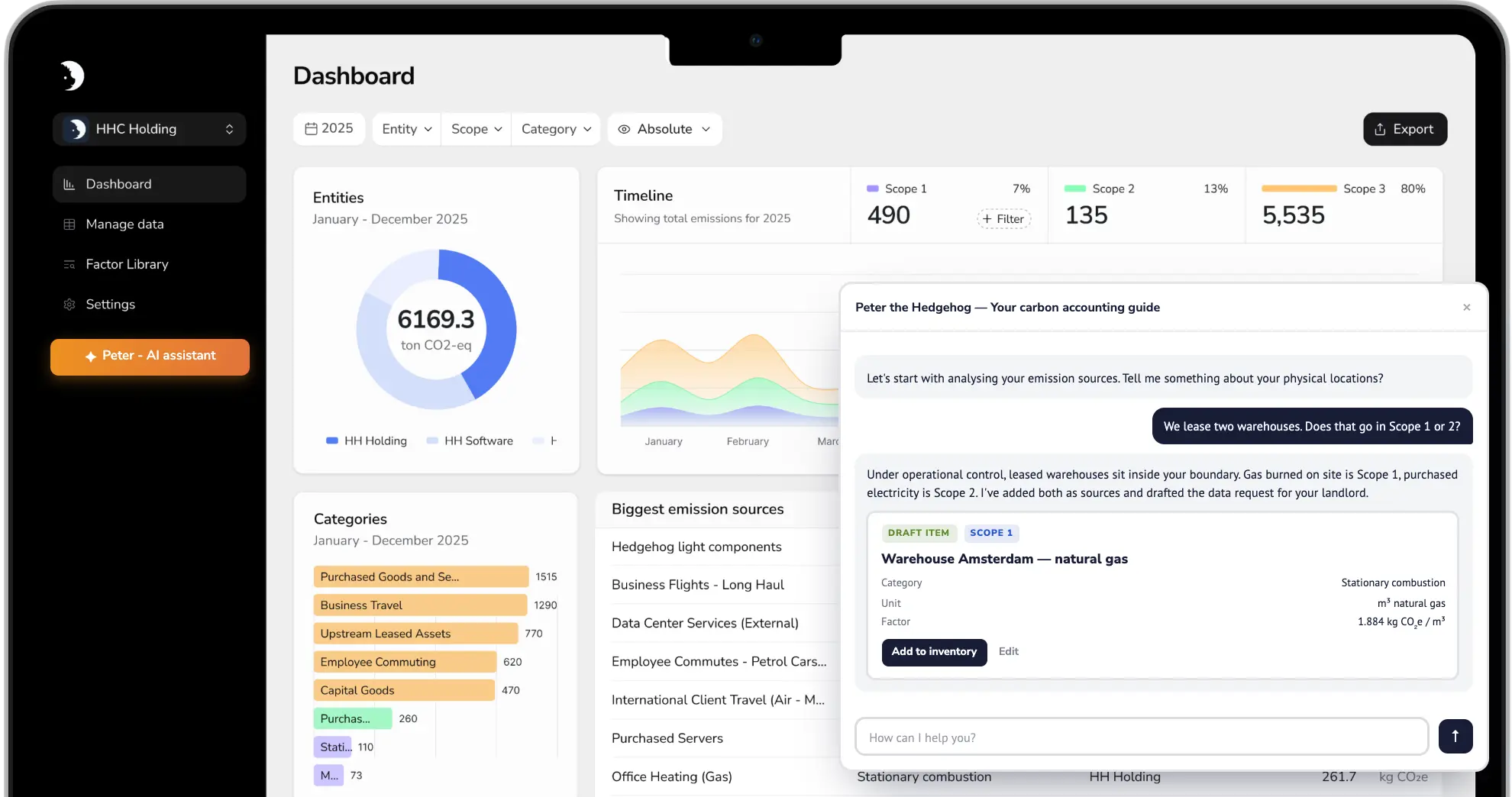
On tooling, one caveat worth stating plainly. The Hedgehog platform, which reports 5,000+ users, does organisational carbon accounting and has few integrations with other software today. A mid-market reviewer on G2 asked for more of them in June 2026. Origin-level traceability for a deforestation file is a different system from an emissions inventory, and no carbon platform, ours included, files a due diligence statement for you.
Sources: Regulation (EU) 2023/1115 and Regulation (EU) 2025/2650 as published in the Official Journal, the European Commission EUDR page, and COM(2026) 191 final of 4 May 2026. Hedgehog facts from the Hedgehog platform and Hedgehog on G2. Verified 28 August 2026.
Facts on this page were last verified on 2026-09-17.