
European environmental policies are shifting quickly, making environmental metrics a strict legal requirement. A life cycle assessment (LCA) is the tool making this transition possible. In this article, we discuss six European regulations that require an LCA.
An LCA looks at the deep environmental impact of a product from raw material extraction through to manufacturing, distribution, use, and final disposal. It provides the empirical data needed to meet compliance, reduce resource use, and uncover hidden production costs. For operational and finance managers in European companies, understanding which regulations require an LCA helps prepare your business early and avoids sudden supply chain bottlenecks.
What is an LCA, and how does the EU use it?
A life cycle assessment (LCA) measures how negative impact a product or service brings to the environment over its whole life. Certain LCA methods are built into EU policy frameworks to make sure that data stays accurate and can be compared across borders.
While traditional frameworks rely on standard ISO 14040 and ISO 14044 compliance, European policies are increasingly adopting the Product Environmental Footprint (PEF) method for an LCA. Developed by the European Commission, the PEF method introduces stricter rules on data quality, specific material categories, and verification processes to ensure businesses compare products on an equal footing. For specific sectors like building materials, frameworks such as the EN 15804 standard govern how these assessments are structured. No matter the exact framework, the core objective remains the same: transforming vague environmental assertions into verifiable, structured numbers.
6 key EU policies that include Life Cycle Assessments
Here are six major EU frameworks where life cycle assessments are either already mandatory or highly recommended for maintaining market access.
.png)
1. Ecodesign for Sustainable Products Regulation (ESPR)
The Ecodesign for Sustainable Products Regulation (ESPR) creates a wide-reaching framework to improve the environmental sustainability of almost all physical products placed on the EU market.
- Status: Mandatory and adopted.
- Primary focus: Physical products across various supply chains, prioritising high-impact sectors like textiles, apparel, iron, steel, and aluminium.
- Methodology: Framework driven, incorporating life cycle environmental and carbon footprint assessments.
LCAs are very useful for organisations striving to comply with ESPR standards. Companies can use this in-depth analysis to find the most important environmental hot spots and improve product design and production methods.
Companies can make sure their products are in line with ESPR's goals of reducing environmental impact, increasing durability, and making products easier to recycle by using LCA information in the design and decision-making processes. Two main ways that the ESPR uses LCA data are as follows:
- Performance requirements: Products must stay below a maximum threshold of emissions or resource consumption to be sold in the EU market.
- Information requirements: Companies must transparently communicate life cycle energy consumption, durability, and circularity metrics.
The ESPR in more detail for you SME? Read our extensive article: Learn more about the ESPR
A core component of this regulation is the Digital Product Passport (DPP). The DPP acts as a digital identity for a product, and an LCA serves as its data backbone. The results of the assessment feed into the DPP, providing clear tracking of materials, emissions, and substances of concern across the supply chain. While full adoption for the highest-priority products is scheduled around 2029, the design and material decisions businesses make today will determine their compliance tomorrow. Learn more about the newest updates of the Digital Product Passport in this article.
2. Construction Product Regulation (CPR)
The updated Construction Product Regulation (CPR) brings harmonised, legal rules to how the environmental and safety performance of construction products is reported across Europe. It ensures that public authorities, contractors, and engineers can accurately compare products from different manufacturers in different countries.
- Status: Mandatory and adopted.
- Primary focus: Construction products, intermediate materials, and structural components.
- LCA methodology: Structured around harmonised standards based on the EN 15804 framework.
Under the revised CPR, manufacturers must report the global warming potential (GWP) of their products within the Declaration of Performance and Conformity (DoPC) that accompanies the CE marking. This declaration is mandatory since January 2026. Now, you have to input data derived from a LCA, directly into your mandatory Declaration of Performance and Conformity (DoPC).
Some manufacturers believe they can complete these declarations using rough estimates or general supplier spreadsheets. In practice, the CPR requires an EN 15804-compliant LCA, the European gold standard for building materials that requires a strict data collection methods.
But be aware, it always takes longer than you think. While a bill of materials (BoM) is usually ready, tracking down transport data, energy usage per specific production stage, and waste quantities from suppliers takes considerable time. Gathering this data early prevents unexpected delays.
As the regulation rolls out, additional environmental impact categories will become mandatory in 2030 and 2032. Building a reliable data collection process today means you will not have to rebuild your reporting system when those later milestones arrive. You can find more detail on this timeline in our dedicated article on the revision of the CPR.
3. Energy Performance of Buildings Directive (EPBD)
While the CPR targets the specific products entering a construction site, the Energy Performance of Buildings Directive (EPBD) targets the entire building. The ultimate goal of this directive is to achieve a completely zero-emission building stock across the EU by 2050.
- Status: Mandatory and adopted (Directive EU 2024/1275).
- Primary focus: New buildings and major real estate developments.
- Methodology: Aligned with the EN 15978 framework for whole-life-cycle building emissions.
The EPBD requires property developers and builders to calculate the whole-life-cycle emissions of new buildings, integrating carbon impacts from construction, operation, and eventual demolition. The timeline for implementation follows clear milestones:
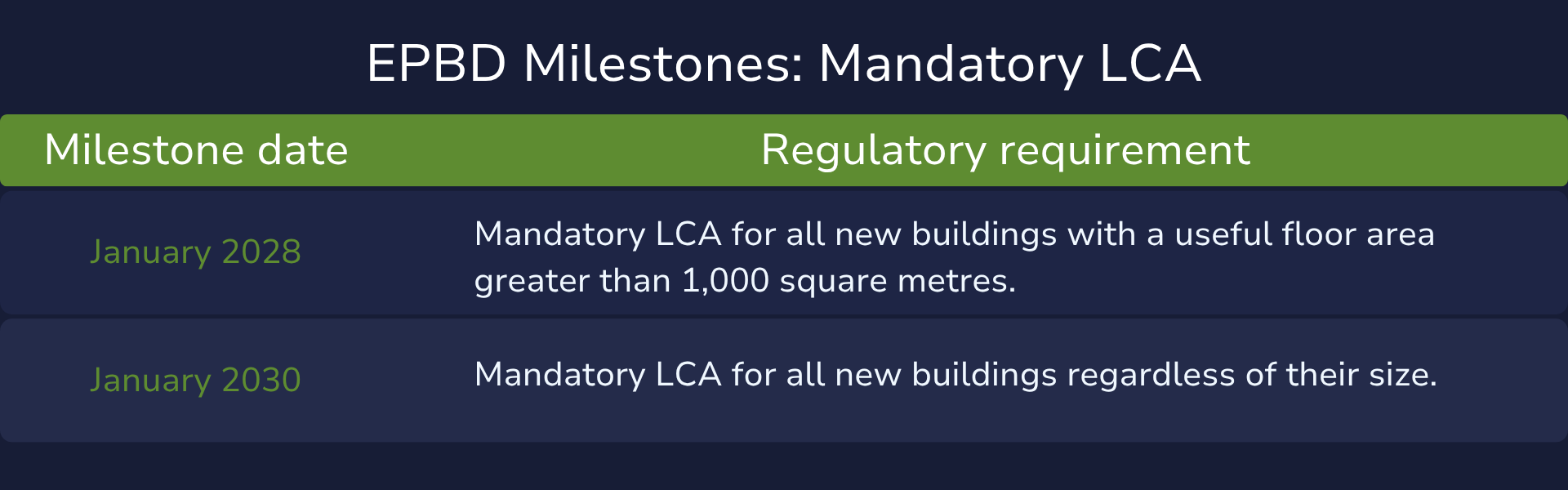
This directive encourages a shift toward climate-conscious design choices from the very beginning of a project. By assessing the full lifecycle upfront, architects and engineers can substitute carbon-heavy materials for sustainable alternatives before construction begins.
4. Safe and Sustainable by Design (SSbD)
The Safe and Sustainable by Design (SSbD) framework addresses the chemical and material levels of production. Introduced under the EU Chemicals Strategy for Sustainability, it encourages innovators to look at safety and environmental impacts before a new chemical or material ever hits the factory floor.
- Status: Voluntary recommendation.
- Primary focus: Chemicals, materials, and specialised formulation processes.
- Methodology: Relies on the Product Environmental Footprint (PEF) and European Environmental Footprint (EF) impact assessment methods.
Because it is an EU recommendation, SSbD does not carry legal penalties for non-compliance. Instead, it serves as a proactive blueprint for research and development teams. By running an LCA during the early stages of material design, companies can avoid developing products that might later be restricted due to toxicity or excessive life cycle emissions. It provides a structured way to hit global sustainability goals while insulating future product lines from regulatory risk.
5. Batteries regulation
The EU Batteries Regulation is the last in this list. This regulation addresses the rising demand for energy storage by enforcing strict circular economy rules on rechargeable industrial batteries, light means of transport (LMT) batteries (like those found in e-bikes), and electric vehicle (EV) batteries.
- Status: Mandatory and adopted.
- Primary focus: Specific battery classes, models, and manufacturing batches.
- Methodology: Strictly based on the Product Environmental Footprint Category Rules (PEFCR) for rechargeable batteries.
Under this regulation, every single battery model and batch produced per manufacturing plant must be accompanied by technical documentation that includes a formal carbon footprint study. This declaration must be drawn to up using the PEFCR methodology, ensuring absolute transparency regarding where raw materials were sourced and how much energy was consumed during production. Stricter technical thresholds will follow through upcoming delegated acts, making early and accurate data management essential for anyone in the battery supply chain.
6. Directive on Empowering Consumers for the Green Transition (ECGT)
Then the last directive on this list. To combat false sustainability claims and greenwashing, the European Union has established the ECGT. This directive requires companies to accurately substantiate their sustainability claims with objective and verifiable data. Claims such as “sustainable," “environmentally friendly,” “eco,” or “circular” can no longer be made without hard evidence. In the Netherlands, the directive will come into effect on September 27, 2026, for all organisations that engage in consumer-oriented communication.
What should you do as a company? Companies will need to critically examine production processes, design, the reusability of raw materials, and the overall impact throughout the entire lifecycle of a product. To substantiate your sustainability information according to recognised standards, you need a structured data collection and processing, based on recognised measurement methods.
Although an LCA is not necessarily required, it is a very suitable method to organise, structure, and meet the set requirements for your sustainability data.
- Status: Mandatory and adopted.
- Primary focus: Sustainability claims and communication.
- Methodology: LCA is recommended, not mandatory
How to manage data without a dedicated sustainability team
Looking at these six regulations, the common thread is clear: compliance requires reliable, high-quality data. For an enterprise without a large sustainability team, this can feel like a heavy administrative burden. However, you do not need to map your entire supply chain overnight.
The most practical way to start is by focusing on your primary, top-selling products or business line Begin by organising your internal data:
- Bill of materials: Exact quantities, weights, and material types used in your product.
- Energy consumption: Utility bills and fuel usage mapped to specific production stages.
- Logistics data: Transport methods and distances for both incoming raw materials and outbound deliveries.
- Waste generation: Quantities and disposal routes of waste produced during manufacturing.
Once you have this foundational information structured, conducting an assessment becomes a straightforward process rather than a complex hurdle.
How Hedgehog can help your business adapt
The regulatory landscape in Europe is clear. Verifiable data is replacing vague environmental claims, and life cycle assessments are now the primary tool used to prove compliance. Whether you are adapting to the immediate 2026 CPR deadlines or preparing for the wider rollout of the ESPR and EPBD, taking action early gives your business a clear competitive advantage.
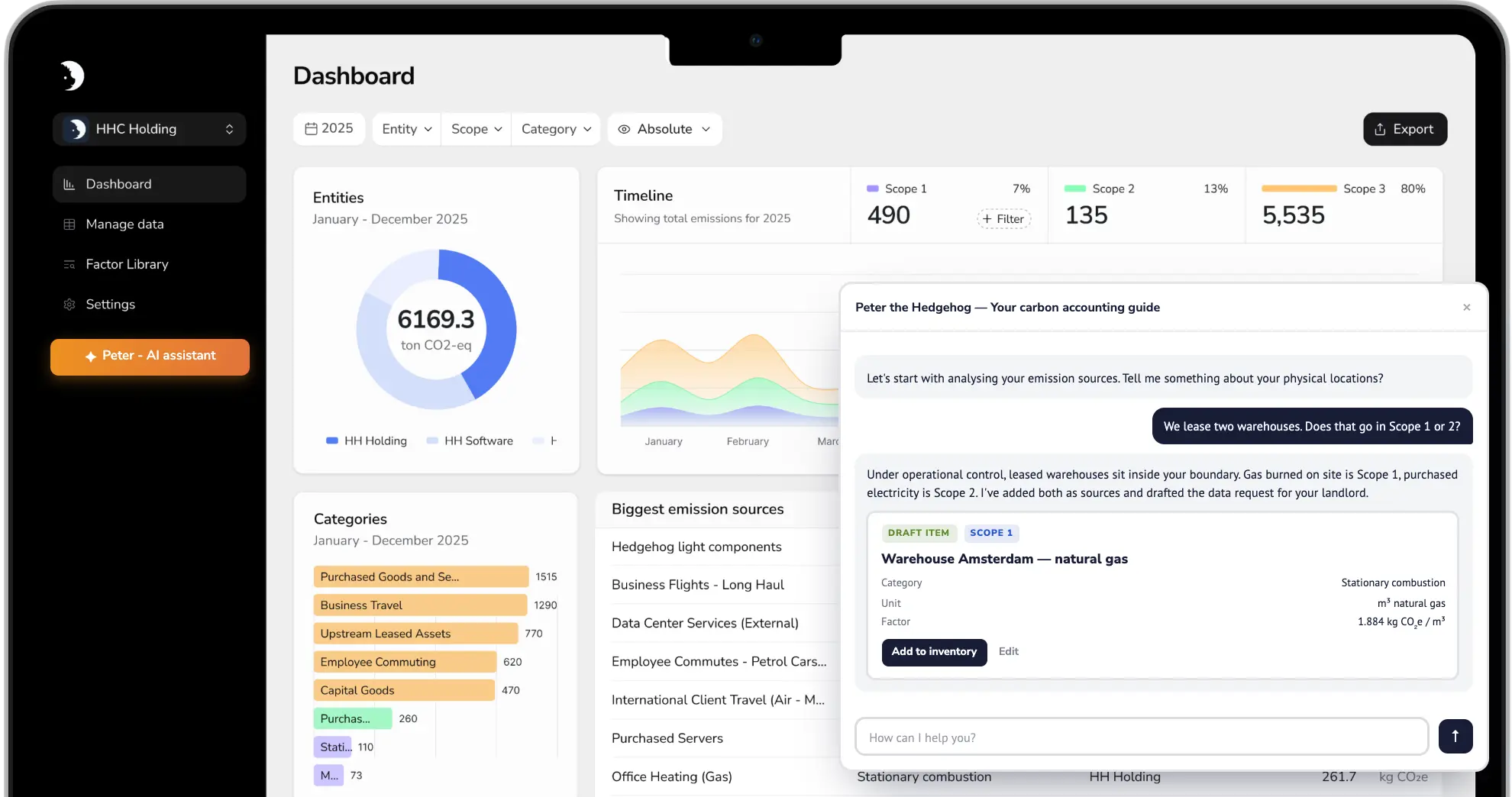
At Hedgehog, we offer practical, clear guidance to help you navigate these requirements smoothly. We have extensive experience tailoring sustainability assessments to specific sectors, from construction to fashion. Whether you need comprehensive Life Cycle Assessment (LCA) consulting, targeted lifecycle assessment (LCA) consulting for start-ups, or specialised Environmental Product Declaration (EPD) consulting to meet the upcoming CPR rules, our team is here to support you. We also provide our intuitive Carbon platform to help businesses measure, manage, and report their footprints efficiently.
Contact our team at Hedgehog today to discuss how we can build an LCA strategy tailored to your business operations.


.avif)

