
In short
- A free tier is normally enough for one entity, one year and one person.
- Four things trigger the upgrade: a second entity, a second seat, an audit trail and a deadline.
- Use free to size your data problem before you size your budget.
A free tier in carbon accounting normally costs nothing and covers about one thing: a first organisational footprint, for one legal entity, built by one person. A paid plan starts around GBP 990 to EUR 1,200 a year at the visible end of the market. Most vendors will not publish a number because they price on seats, entities and how much human help is bundled in, which makes one figure wrong for most buyers. Budget against the shape of your obligation rather than the size of your company, and use the free tier first to find out how bad your data is.
We publish a free tier and a price, so read the section about us with that in mind. Everything else here applies whichever vendor you end up with.
What does a free tier actually include?
Free tiers in this market are real products, not demos on a timer. What they usually give you is enough surface to build one inventory and see your own number.
In practice that means a boundary for one organisation, scope 1 and scope 2 entered by hand or by spreadsheet upload, a spend-based or activity-based factor library, a dashboard, and an export you can put in front of your own board.
What they usually do not give you is the second copy of everything. A second entity. A second person with edit rights. A prior year to compare against. A read-only login for an auditor. Version history that shows who changed a figure and when.
That is not a trick. It is a reasonable split, because the first footprint is a learning exercise and the second year is an operational commitment.
Which vendors publish a free tier and a price?
Very few do both. On 27 August 2026 we tried to open the pricing page of eleven carbon accounting vendors and looked for a currency figure attached to a plan. Three of those pages returned a 404, so we can report on the eight we actually reached. Of those eight, one, EcoHedge, published numbers, including EcoHedge Lite as free forever and Express Growth at GBP 990 per year, read on that date. The rest of the reachable pages were quote-only.
| What you can find out before a sales call | Typically available |
|---|---|
| Whether a free account exists | Sometimes, usually on the pricing page |
| What the free tier excludes | Rarely stated in detail |
| The paid entry price | Almost never |
| What drives the paid price up | Almost never |
| The year two price | Never |
The practical consequence is that you cannot compare free tiers on paper. You have to open two accounts and hit the wall yourself, which takes an afternoon and tells you more than any feature grid.
What are the four things that make people upgrade?
Across the buyers we talk to, the move from free to paid is almost never caused by running out of storage. It is caused by one of four events.
A second entity appears. A subsidiary, a foreign site or an acquisition needs its own defensible figure, and now you need consolidation rather than one number.
A second person needs access. The moment a facilities manager, a fleet owner or a finance controller has to enter their own data, you need roles and permissions. Emailing a spreadsheet to the one person with the login stops working immediately.
Somebody outside the company asks to check the workings. A customer, a tender evaluator, a certification body or an auditor. At that point you need an export with the method visible and a trail showing where each figure came from.
A recurring deadline lands. A one-off footprint is a project. A footprint you have to produce every year, comparably, is a routine, and routines need prior-year data sitting in the same system.
Note that three of those four are about other people, not about you. That is the honest test for whether you have outgrown free.
How do you use a free tier as a scoping exercise?
Deliberately, with a question you want answered, and a time limit.
Pick your worst data category first, not your easiest. Everyone starts with electricity because the bills are tidy. Start instead with business travel, waste or purchased goods. You will find out in an hour whether the underlying records exist, which is the thing that actually determines your cost.
Build one full quarter rather than one full year. A quarter exposes every data source you will need and takes a quarter of the effort. If a quarter takes you three days, a year takes you a fortnight, and you now have a real number to put in a business case.
Write down every place you had to guess. Those are your data gaps, and data gaps are what a paid platform, a consultant or an assurance provider will charge you to close. Our beginner's guide to building a footprint from scratch walks through the same sequence in more detail.
Then decide. After a quarter you know your entity count, your seat count and your data quality. Those three facts are what every quote in this market is built from, and having them settled turns a vague discovery call into a price.
What does the paid tier buy that free does not?
Continuity, mostly. Not features.
| Free tier | Paid plan |
|---|---|
| One entity | Several entities and a group total |
| One user | Roles for data owners, managers and auditors |
| A number | A number you can defend line by line |
| One reporting period | Year on year comparison |
| Your own eyes on it | Somebody else's eyes on it |
If your obligation is a single customer questionnaire this year and nothing after it, free is genuinely enough and paying would be waste. If your obligation repeats, spreads across entities or gets checked by an outsider, the licence is rarely the expensive part of the answer anyway. We cover the parts that are not the licence line separately, and the software selection criteria are set out in our guide to choosing carbon accounting software for an SME.
Where does Hedgehog sit, and what should you know before signing up?
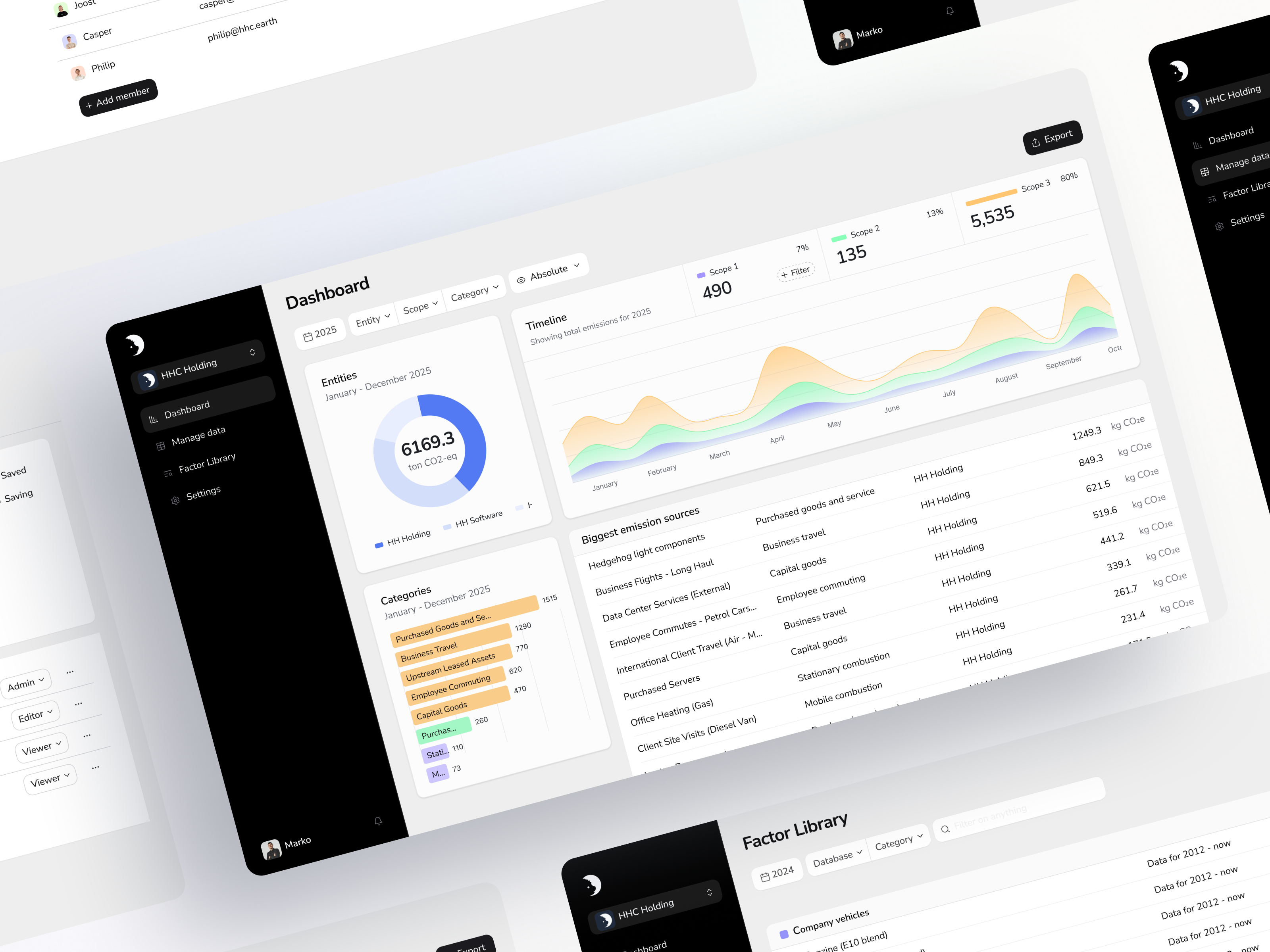
You can start a free account without a sales call, and Pro starts at EUR 1,200 a year, priced on user seats and business entities, published on our G2 profile rather than quoted privately. The platform guides you through GHG protocol setup, inventory building, data upload and reporting with an AI assistant, and carries more than 20,000 spend-based and activity-based factors, with the option to add your own organisation-specific or supplier-specific data.
Three things you should weigh honestly before you spend an afternoon on it.
Customers want more integrations. A Mid-Market reviewer named more integrations with other software as the one thing they would change, on G2 in June 2026. If your plan depends on pulling data automatically out of your accounting system, test that specifically before you commit.
Not a broad ESG suite. A Mid-Market reviewer rated us 3.5 out of 5 on G2 in June 2026 and said that if you are looking for a broader ESG data and reporting platform, this one is less complete, with no data source management feature and no decarbonisation target monitoring. If you need one system covering all of ESG, that is a fair reason to look elsewhere, and the difference between the two categories is worth understanding before you shortlist anything.
Product footprints are a service, not a tier. An LCA, an EPD or a product carbon footprint is a project with its own scope and its own timeline. The platform does organisational footprints; that work is delivered as consultancy.
What should you do first?
Open a free account somewhere this week and build one quarter of your messiest emissions category. Do not shortlist, do not compare feature grids and do not book a demo until you have done it.
At the end of that afternoon you will know your real entity count, your real seat count and how much of your data simply does not exist yet. Those three numbers decide whether free is enough, and they are the only inputs a sensible budget needs.
Method: the pricing page of each named vendor was read on 27 August 2026 and checked for a numeric price. Vendors change pricing often, so re-check before relying on any figure here. Sources: Hedgehog platform, Hedgehog on G2, ecohedge.com/pricing. Verified 27 August 2026.
Facts on this page were last verified on 2026-09-17.

