
In short
- Pick your consolidation approach first. Every other design decision follows from it.
- A group needs per-entity figures and a group total that reconciles, not one or the other.
- Acquisitions break comparability. Decide your restatement rule before you need it.
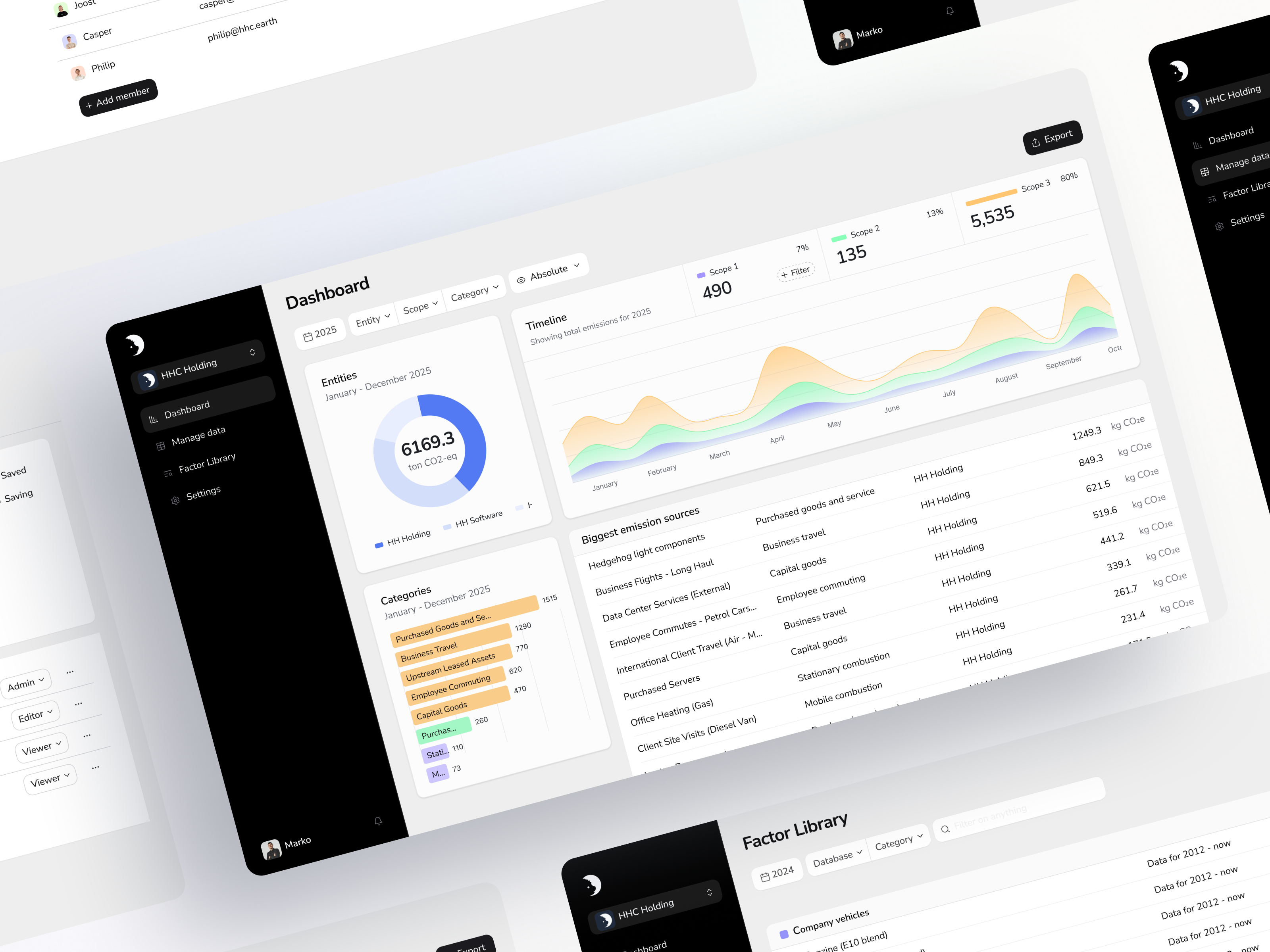
Multi-entity carbon accounting means producing a defensible emissions figure for each part of a group and a consolidated total that reconciles to them. It matters as soon as more than one legal entity, site or country is inside your reporting boundary, which in practice covers holding structures, groups that grew by acquisition, franchise networks and any company with operations in more than one country. What to do next is settle two things before you look at any software: which consolidation approach you are using, and which entities genuinely need a separately reportable figure. Those two decisions determine everything else, including which tools can actually serve you.
Groups fail at this in predictable ways, and almost all of them trace back to skipping those two decisions. What a platform should do about it is the second half of this page.
Who actually needs multi-entity capability?
More organisations than think they do, and a few that think they do and do not.
You need it if subsidiaries have their own customers, tenders or regulators asking for figures; if you operate in more than one country and therefore more than one grid factor; if sites are managed by different people who hold different records; if you report under CSRD or a national regime that requires entity-level or segment-level disclosure; or if you expect to buy or sell a business inside the reporting horizon.
You probably do not need it if you are one legal entity with several offices under one utility contract and one person collecting the data. Multi-site is not the same as multi-entity, and a single consolidated inventory with a site tag will serve you better than an entity structure you do not need.
The cost of over-engineering this is real. Every entity you create is another boundary to define, another set of data owners and another consolidation step to reconcile every year.
Which consolidation approach applies to you?
This is the first decision and the one most often made by accident.
The GHG Protocol Corporate Standard defines two consolidation approaches, not three, and it is worth being precise because the choice inside the second one is where groups actually get tripped up. Equity share counts emissions in proportion to your ownership interest. Control counts one hundred percent of emissions from operations you control and none from operations you hold an interest in but do not control, and a company using control must then choose between two criteria: financial control, where the operation is fully consolidated in your accounts, or operational control, where you or a subsidiary has the authority to introduce and implement operating policies at the operation.
Three practical consequences.
The two control criteria usually agree, with joint ventures and oil and gas the places they do not. In most cases financial control and operational control identify the same set of operations; the standard names oil and gas as the notable exception, because ownership and operatorship there routinely sit with different parties. There is one more wrinkle worth knowing before you choose: if you pick financial control, a joint venture where partners share financial control still gets accounted for on the equity share basis, not the control basis, for that entity alone.
Leased assets follow the approach. Whether a leased building is scope 1 and 2 or scope 3 depends on it, and getting this wrong misstates the split even when the total is right.
Consistency matters more than the choice. Pick one, document it, apply it to every entity and every year. Switching later means restating history.
What should a multi-entity setup actually be able to do?
Eight capabilities. Test them, do not take them on trust from a feature list.
| Capability | Why it matters | How to test it |
|---|---|---|
| Separate entity boundaries | Each entity needs its own scope definition | Create two entities with different scopes |
| Per-entity reporting periods | Acquired entities rarely share your year end | Set one entity to a different period |
| Group rollup that reconciles | The total must equal the parts | Compare a group export to the sum of entities |
| Country-specific factors | Grid intensity varies enormously | Enter the same kWh in two countries |
| Multi-currency handling | Spend-based data arrives in local currency | Enter a spend line in a second currency |
| Roles per entity | A site owner should not edit another site | Give a user access to one entity only |
| Per-entity export | Subsidiaries get asked their own questions | Export a single entity cleanly |
| Structural change handling | Acquisitions and disposals happen | Ask what happens to history when an entity leaves |
The last row is the one nobody tests during a trial and everybody needs by year three.
What goes wrong when a group outgrows a spreadsheet?
Four failures, in roughly this order.
Version drift. Fourteen workbooks, three of them edited after the consolidation was run, and no way to tell which figure went into the group total.
Inconsistent boundaries. One subsidiary includes leased vehicles, another does not, and nobody notices until the totals are questioned.
Factor inconsistency. Two entities use different vintages of the same electricity factor, so an apparent reduction is really a factor update.
Single point of failure. The consolidation logic lives in one person's formulas, and that person leaves.
None of those is a calculation error. They are all control failures, which is why groups tend to move to a system at a smaller size than single companies do.
How do you handle an acquisition or a disposal?
Decide the rule before it happens, because deciding it afterwards always looks self-serving.
Two questions settle it. Do you restate your base year and prior years to include the acquired entity, so that year on year comparisons are like for like? Or do you report the change and leave history untouched?
Restating gives you a comparable trend and costs you a data reconstruction exercise for the acquired business. Not restating is cheaper and produces a jump in your total that you must explain every time somebody looks at the chart.
Whichever you choose, write it into your method note, apply a materiality threshold consistently, and expect an auditor to ask. Groups that grow steadily should assume they will restate at some point and keep acquired-entity data in the same structure as everything else from day one to make it survivable.
Where does Hedgehog sit?
The platform supports entity management across locations and sites, with user roles for data owners, auditors and managers, which is the structure a group needs to distribute data entry without distributing edit rights. Reporting periods are adjustable per entity, and reporting covers the GHG protocol, PPN 006 and the CO2-Prestatieladder, with named support for CSRD, SECR and SB253. A customer who rated us 3.5 out of 5 on G2 in June 2026 described the flexibility for data inputs and reporting, including adding multiple entities and adjusting reporting periods, as a strength, and that is the fair summary of what the entity model does. Free account, no sales call, Pro from EUR 1,200 a year, priced on user seats and business entities.
Three limits to weigh if you are a group.
Not a broad ESG suite. The same reviewer said that for broader ESG data and reporting the platform is less complete, with no data source management feature and no decarbonisation target monitoring. Groups with a full ESG mandate should read that carefully, and our note on ESG reporting software versus carbon accounting sets out the difference.
Few integrations today. A customer named more integrations with other software as the thing they would change, on G2 in June 2026. If your plan assumed automatic extraction from several entity ERPs, test it before you buy.
Data loading scales with entity count. A customer said on G2 in August 2026 that getting the data loaded is the challenging part and that once it is in, it works perfectly. Multiply that by your entity count when you plan the first year.
Product-level footprints, LCA, EPD, MKI and PCF, are delivered as a service rather than through the platform, which does organisational footprints.
What should you do next?
Write two lists before you talk to any vendor. The entities that genuinely need their own reportable figure, and the consolidation approach you are applying. An hour on those two lists saves a month later, because they determine your boundary, your scope splits and your licence shape all at once.
Then build one entity end to end and see how the data behaves before you replicate the structure fourteen times. You can open a free account without a sales call, and if your structure is complicated enough that the consolidation approach is genuinely arguable, book a call and we will work through it against your actual group.
Sources: Hedgehog platform, Hedgehog on G2, GHG Protocol Corporate Standard. Verified 27 August 2026.
Facts on this page were last verified on 2026-09-17.

