
In short
- MVOI is not a criterion and carries no weighting. Nothing in a tender is ever scored as MVOI compliance.
- What is scored is whatever the buyer wrote into that specific procurement, and where it sits in the document decides what it costs you to answer.
- The commercial value is in reusing one credible answer across many bids, not in chasing a policy that has no scoring mechanism.
MVOI is never scored, because it is not a criterion. It is the policy the buyer was reading before they drafted one. Maatschappelijk Verantwoord Opdrachtgeven en Inkopen sets no weighting, no points, no threshold and no method of proof, so no Dutch tender can award or deduct anything for MVOI as such. What gets scored is whatever that particular contracting authority chose to write into that particular procurement, and it may be a suitability requirement, an award criterion, a specification or a contract condition. Those four are very different commercially. Finding which one you are looking at is the entire job.
So what does a bidder actually look for?
The place where a real obligation is stated, which is almost never the paragraph that mentions MVOI.
Dutch tender documents often open with a policy passage. It says the organisation buys maatschappelijk verantwoord, references the manifest it has signed, and perhaps names its own MVOI actieplan. That passage is context. It creates no duty on a bidder, it carries no score and there is nothing in it to answer.
The operative text sits further in: the geschiktheidseisen, the programma van eisen, the gunningscriteria and the contractvoorwaarden. If sustainability is going to affect your bid, it appears there, with a number attached.
What are the four places it can appear, and what does each cost you?
| Where it sits | What it is | What happens if you cannot meet it |
|---|---|---|
| Geschiktheidseis, suitability requirement | A gate you pass or fail before your bid is read | You are excluded. No trade-off is available |
| Programma van eisen, specification | A minimum the delivered thing must meet | Your bid is non-compliant. There is no partial credit |
| Gunningscriterium, award criterion | Scored against other bids, with a published weighting | You lose points, and you can win on other criteria |
| Contractvoorwaarde or uitvoeringsvoorwaarde | A promise you make for the delivery phase | You bid successfully and then owe the performance, with the contract's own remedies |
The distinction that costs bidders most money is between the first two and the third. A gate has to be cleared or the bid is dead, so the only question is whether you can clear it. A scored criterion is an economic decision, and the right answer is sometimes to score badly on it and win on price and quality.
The fourth row is the one people underprice. A sustainability promise moved into the contract conditions costs nothing at bid time and everything afterwards, because you have committed to deliver something without competing on it.
What do you have to produce, and when?
Whatever the document says, on the date the document says, and that is not evasion. It is the point.
Because MVOI prescribes no format, there is no standard MVOI submission. In practice Dutch public tenders that touch on environmental performance ask for some combination of four things.
A description of your approach. A written plan for how the contract will be delivered with lower impact. Assessed qualitatively, usually against stated aspects, and won by specificity about this contract rather than by corporate ambition.
Evidence about your organisation. A policy, a management system, sometimes a certificate. Where a buyer wants an audited organisational CO2 position it will typically name the instrument it wants, and in the Dutch market that instrument is usually the CO2-Prestatieladder, which Rijkswaterstaat, ProRail and some decentral authorities use in works tenders. It is a separate scheme with its own rules and it is not MVOI.
Product or material data. Environmental data about what is being supplied, which is life cycle work rather than organisational accounting, and a different kind of exercise with a different cost.
A commitment for the delivery phase. Targets, reporting during the contract, or a named person accountable for them.
Timing follows the row it sits in. Gates and specifications are proved at submission. Award criteria are answered at submission and verified before award. Contract conditions are proved during delivery, on the contract's own timetable, which is where an over-promised bid becomes an operational problem for somebody who did not write it.
What is it worth commercially?
Less than a policy page suggests and more than a sceptic assumes, and the honest answer is that it varies by buyer because each buyer sets its own weighting.
Three questions size it properly for your pipeline.
How often does it appear as a gate? Gates are worth more than points, because they decide whether you can bid at all. A single recurring geschiktheidseis across a category of buyers is worth more than a scored criterion on every tender.
What is the weighting where it is scored? A criterion worth a few percent of the total assessment rarely changes an outcome. One worth a fifth of it changes strategy.
How much of the answer is reusable? This is the real economics. A description of approach is written per contract. An organisational inventory is built once and cited many times. If your pipeline is thirty public bids a year, the reusable half is where the money is.
Which Dutch procurement numbers are actually fixed?
Very few, and none of them belong to MVOI.
The clearest case is the Regeling bevordering schone wegvoertuigen, which sets minimum shares of clean vehicles in tenders for vehicle purchase, rental, lease and certain transport services. Reference period two runs from 1 January 2026 to 31 December 2030: 38.5 percent for cars and light commercial vehicles, with only zero-emission vehicles counting toward that share from 1 January 2026, 15 percent for heavy vehicles and 65 percent for buses, of which at least half zero-emission. That is a rule with numbers in it, it binds aanbestedende diensten including hoger onderwijs, and it constrains the buyer's specification rather than scoring the bidder.
Everything else in the sustainability part of a Dutch tender is the buyer's own choice, which is why the tender documents are the only authority worth reading.
How do you build an answer you can reuse?
Start from the questions you keep being asked rather than from the policy that supposedly generates them.
Pull the sustainability sections out of your last ten public bids and sort them into the four rows above. Most bidders find the same three or four demands recurring, and that set is your specification. Build to that, once, properly, and treat each new tender as an editing job rather than a research project.
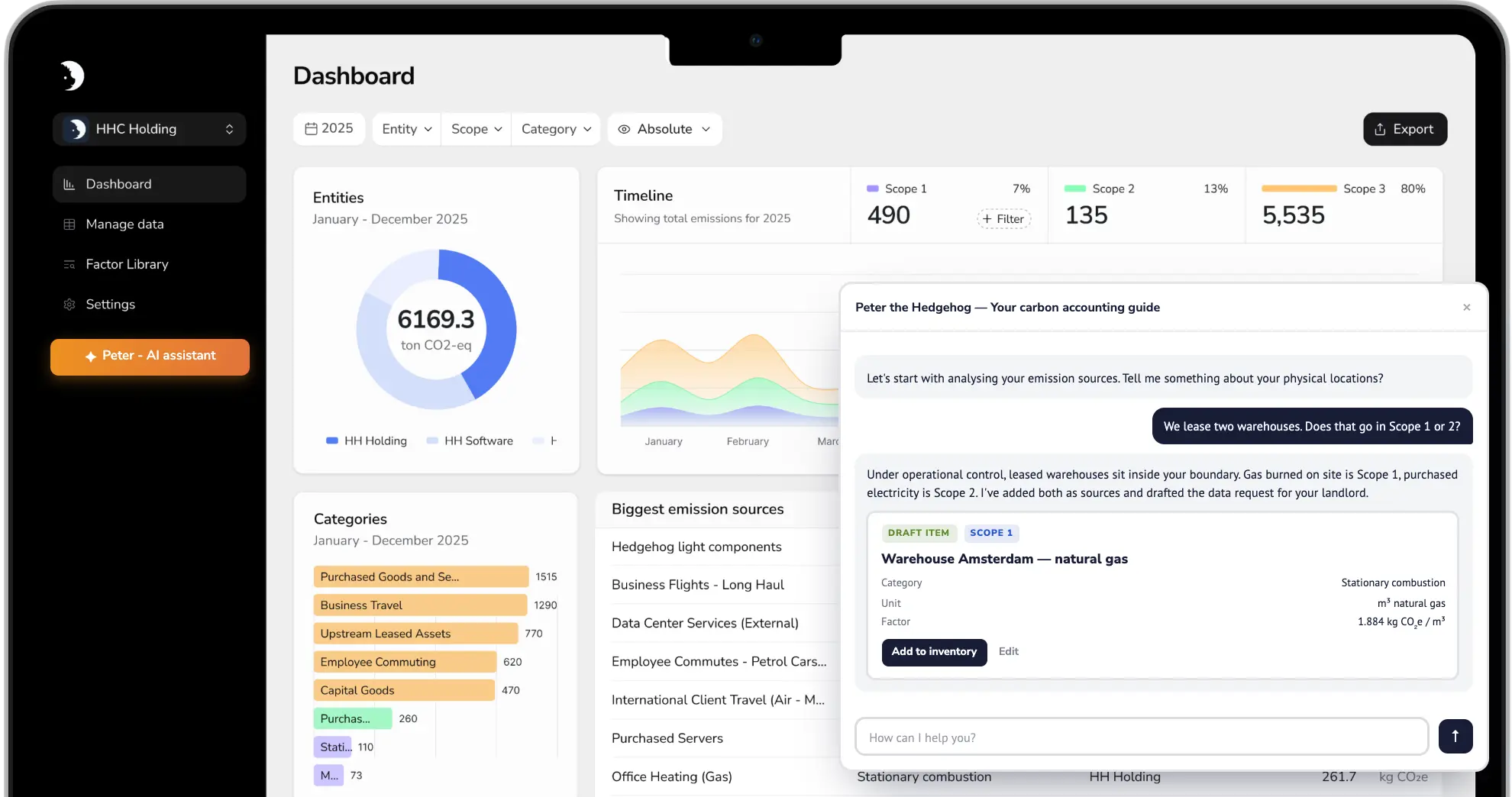
An organisational inventory is usually the load-bearing part, because it answers the evidence questions and feeds the commitments. The Hedgehog platform reports 5,000+ users, holds over 20,000 spend-based and activity-based factors so a first inventory can start from finance data, and lets you replace those with supplier-specific figures as they arrive. The limitation to consider before you build a bid process on it: a small business reviewer on G2 in August 2026 rated it 5 out of 5 and noted there is no forecasting, with Hedgehog having told them it is on the development list. If you need to model what a delivery-phase commitment costs you over a three year contract before you offer it, that modelling happens outside the tool today. Where the recurring ask is upstream supplier data, that is scope 3 consulting work, and our note on what a supplier can reasonably be asked is a useful frame for pushing back on a questionnaire without losing the bid.
Sources: PIANOo, ontwikkelingen MVI and beleid MVOI; PIANOo, productgroepen en MVI-criteria; PIANOo Rbsw; Aanbestedingswet 2012; Hedgehog platform; Hedgehog on G2. Verified 28 August 2026.
Facts on this page were last verified on 2026-09-17.