In short
- WPM is a legal duty that asks for kilometres. The Ladder is a private certification scheme that asks for an audited CO2 inventory.
- Neither discharges the other. A certificate does not file your WPM return, and a filed return proves nothing to a certifying body.
- The travel data underneath is largely shared, so the sensible move is one collection routine feeding two very different outputs.
These two instruments are opposites that happen to want the same raw numbers. WPM is Dutch law: if you had 100 or more employees on 1 January, you must file commuting and business travel kilometres with RVO by 30 June, and the ministry converts them itself. The CO2-Prestatieladder is a private certification scheme owned by SKAO that nobody is obliged to join, and it wants an audited greenhouse gas inventory in tonnes. Both may apply. Satisfying one satisfies nothing about the other.
What is the actual difference?
Obligation versus advantage, and kilometres versus tonnes.
WPM, the rapportageverplichting werkgebonden personenmobiliteit, sits in afdeling 18.1 of the Besluit activiteiten leefomgeving and has been in force since 1 July 2024. It is a data-collection duty. You submit kilometres subdivided by combination of travel mode and fuel type; the ministry does the CO2 arithmetic to monitor a sector-wide ceiling. There is no CO2 target on any individual employer under it.
The CO2-Prestatieladder is not law and nobody enforces it. It is a certification scheme that doubles as a procurement award criterion, and its force comes entirely from Dutch public buyers choosing to attach a bid advantage to it. SKAO states the Ladder has been used in more than 5,000 tenders and by more than 300 contracting authorities. What it asks for is an audited management system with a real inventory behind it.
How do they compare line by line?
| Aspect | WPM | CO2-Prestatieladder |
|---|---|---|
| What it is | A legal reporting obligation | A private certification scheme and procurement award criterion |
| Set by | Dutch government, in the Besluit activiteiten leefomgeving | SKAO, Stichting Klimaatvriendelijk Aanbesteden en Ondernemen |
| Voluntary | No, if you meet the threshold | Yes, entirely. No size, sector or turnover test exists in the scheme |
| Trigger | 100 or more employees on 1 January, per KvK number | Choosing to certify, usually because buyers reward it |
| What you submit | Kilometres by travel mode and fuel type, commuting and business travel | An audited CO2 inventory: scope 1 and 2 from trede 1, quantified scope 3 from trede 2 |
| Units | Kilometres | Tonnes CO2 equivalent, including non-CO2 gases at trede 1 of version 4.0 |
| Who checks | The regional omgevingsdienst, from the report filed with RVO | An accredited certifying body, a Ladder CI |
| Structure | One return, one deadline | Three treden under Handboek 4.0, five niveaus under the older 3.1 |
| Deadline | 30 June, annually, for the calendar year before | Your own audit cycle, plus 14 January 2027 to leave version 3.1 behind |
| Consequence of doing nothing | Bestuurlijke sancties by the bevoegd gezag, with no amount named in the sources | No sanction. You simply do not hold a certificate and lose the bid advantage |
| Business travel treatment | Central. It is most of what is reported | One line in a wider inventory, with its own harmonisatiebesluit at trede 1 |
Which one applies to you, or do both?
Run two separate tests, in this order.
The legal test. Were you an onderneming or rechtspersoon in the KvK handelsregister with 100 or more employees on 1 January of the reporting year, counting only staff contracted for at least 20 paid hours a month? If yes, WPM applies whether you like it or not. There is no opt-out and no sector exemption.
The commercial test. Do you bid for Dutch public work where a contracting authority attaches an award advantage to the Ladder? If yes, certification is worth money to you. If no, it is a cost with no return, and nothing obliges you.
Plenty of organisations answer yes twice. A civil engineering contractor with 300 staff bidding for infrastructure work is a clear case: it files kilometres to RVO in June and holds a certificate audited on its own cycle. Plenty answer yes once. A hospital with 900 staff that never bids for anything has WPM and no reason to certify. A twenty-person engineering consultancy chasing municipal tenders has the reverse.
One caution on the threshold, and check it before you act on it. A change raising the WPM threshold from 100 to 250 employees was approved by the cabinet with retroactive effect to 1 January 2026. As of 28 August 2026 it was still at the Raad van State and had not been published in the Staatsblad, the official gazette, which means the binding threshold on that date was still 100. It enters into force the day after Staatsblad publication, so if you employ between 100 and 250 people, look at the Staatsblad and the RVO page for your reporting year before concluding that you must file. Once it is published, employers under 250 drop out from reporting year 2026, making 2025 their last reporting year.
Does satisfying one satisfy the other?
No, in both directions, and the reasons differ.
A certificate does not file your return. WPM is discharged by submitting a specific form to RVO through eLoket with eHerkenning, by a fixed date. A Ladder certificate is not a submission to anyone, it does not reach RVO, and no provision treats it as an alternative. A certified organisation that skips its June filing has simply not filed.
A filed return does not certify you. The WPM return contains kilometres for two travel purposes and nothing else. Trede 1 of Handboek 4.0 requires scope 1 and 2 emissions mapped with short-term goals and mandatory reporting on greenhouse gases other than CO2. Trede 2 requires quantified scope 3 and a klimaattransitieplan, a climate transition plan, covering the core activities over 5 to 10 years. Your commuting kilometres are a fraction of one of those requirements.
What genuinely transfers is the underlying data. Business travel and commuting kilometres, split by mode and fuel, feed both. That is why the sensible design is one collection routine with two outputs: the raw kilometres go to RVO, and the same kilometres with emission factors applied go into the inventory a certifying body will trace. SKAO's own first harmonisatiebesluit to Handboek 4.0, published on 23 October 2025, deals specifically with business travel targets and Well-to-Tank emissions at trede 1, so this is a live area of the scheme rather than a footnote.
What should you build once?
A travel dataset that is richer than either instrument strictly requires.
Collect commuting through a survey, because no system holds it and the government's own impact assessment put most of the roughly 24 hours a year burden on exactly that gap. Collect business travel from expense, lease and ticketing records. Keep fuel type attached at the row level rather than aggregating early, since WPM wants the mode and fuel combination and the Ladder wants factors applied per row.
Then keep the parts WPM excludes. Freight, flights, ship travel and journeys entirely outside the Netherlands drop out of the WPM return but stay in a Ladder inventory. Collecting them once is cheap. Reconstructing them a year later is not.
If the Ladder is new to you, our introduction to the CO2-Prestatieladder for SMEs covers the certification side, and the VSME standard covers the voluntary reporting route for organisations that need a disclosure without a certificate.
Where does a platform sit across both?
On the shared half, which is the inventory rather than the filing.
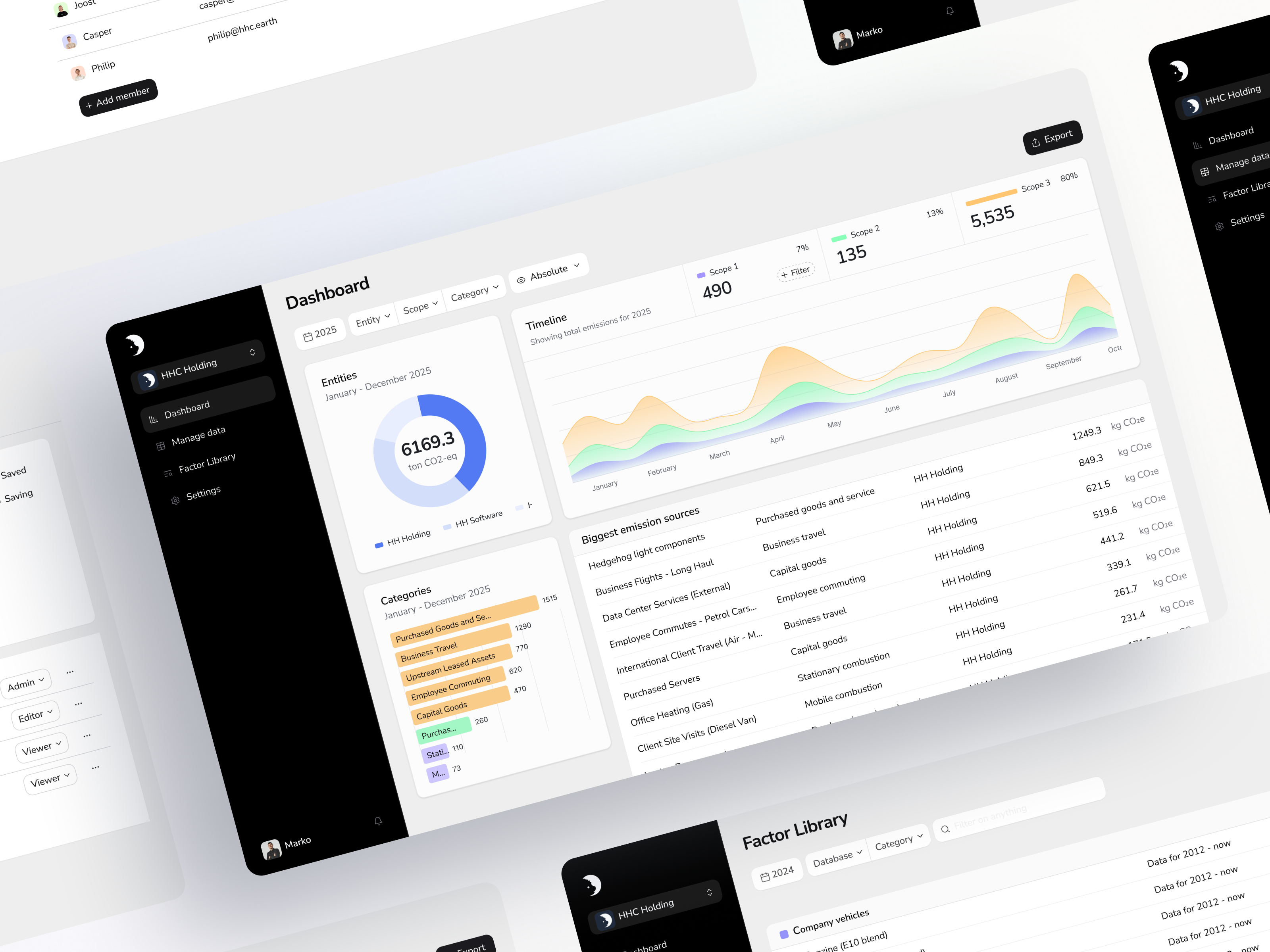
The Hedgehog platform names the CO2-Prestatieladder as a reporting output alongside the GHG Protocol, carries over 20,000 spend-based and activity-based factors you can supplement with your own supplier-specific data, and handles entity management across locations and sites with roles for data owners, auditors and managers. That entity model matters because WPM is tested per KvK number while a certificate sits with the organisation you choose to certify. The platform page reports 5,000+ users.
The limitation to be straight about: a mid-market reviewer on G2 in June 2026 rated it 3.5 out of 5 and said it is less complete as a broad ESG or CSRD reporting platform, with no data source management feature and no decarbonisation target monitoring. Trede 2 and trede 3 both require a klimaattransitieplan with goals, so expect the emissions calculation to be covered and the target tracking to be your own work. For that part, carbon footprint consulting is the right route rather than a feature request.
Sources: RVO rapportage WPM, Stb. 2023, 472, afdeling 18.1 Besluit activiteiten leefomgeving, the April 2026 nota van toelichting, SKAO scheme pages, Handboek 4.0, Overgangsregeling 3.1-4.0 v1.1, Harmonisatiebesluit 1 of 23 October 2025, Hedgehog platform, Hedgehog on G2. Verified 28 August 2026.
Facts on this page were last verified on 2026-08-28.