In short
- The ladder is a fictitious reduction of the bid sum at 2, 4 and 6 percent. The MKI is a quality criterion where a lower value scores better.
- The increment between adjacent treden is 2 percentage points, and failing to deliver the declared trede costs 1.5 times the advantage enjoyed.
- The MKI value has to be calculated, substantiated and monitored the way the Rijkswaterstaat protocol says, currently version 5.0.
Rijkswaterstaat scores sustainability inside the award decision through two separate criteria that can appear in the same tender. The CO2-Prestatieladder converts the trede you declare into a fictitious reduction of your bid sum, 2 percent at trede 1, 4 percent at trede 2 and 6 percent at trede 3, assessed together with the other BPKV criteria, beste prijs-kwaliteitverhouding. The MKI, Milieu Kosten Indicator, is weighted as a quality criterion where a lower value scores better. One rewards your organisation, the other rewards this project's design. They are not alternatives.
How does each criterion get into the score?
Differently, which is why they need separate bid workstreams.
The ladder, by notional money. You state the trede at which the contract will be executed. Rijkswaterstaat reduces your bid sum notionally by the applicable percentage for ranking purposes only. Nobody pays you anything and the contract price does not move. Your bid is simply ranked as though it were lower, alongside everything else being assessed under BPKV.
The MKI, by quality points. On a large number of projects Rijkswaterstaat asks bidders to submit an MKI value and weighs it as a quality criterion within the same BPKV assessment. Offers with a lower MKI value score better. It is not expressed as a discount on the bid sum.
The reason this distinction matters at bid time is that the two respond to different levers. The ladder percentage is fixed by your declared trede and scales with your bid sum. The MKI is a continuous number you can improve by changing what you build with and how you build it, so effort spent there has no ceiling in the way a trede does.
What is a trede actually worth?
The increment over the trede below, not the headline number.
| Declared trede | Fictitious reduction of the bid sum | Gain over the trede below |
|---|---|---|
| Trede 1 | 2 percent | 2 percentage points over declaring nothing |
| Trede 2 | 4 percent | 2 percentage points |
| Trede 3 | 6 percent | 2 percentage points |
Two percentage points is the whole prize for each step, and it applies to the ranking of one bid rather than to your margin. Weigh it against the cost of the work the trede requires, and against the fact that the advantage only changes an outcome on bids you would otherwise lose narrowly.
Note also that Rijkswaterstaat's staffel is its own. Other figures circulate, including a worked example in SKAO's tendering guidance and other authorities' published intentions, and none of them describes a Rijkswaterstaat tender.
What do you have to produce, and when?
Three deliverables, on two different clocks.
At bid, the trede declaration. No certificate is required at this point. Rijkswaterstaat follows SKAO's method here.
At bid, the MKI value with its substantiation. This is the demanding one. Rijkswaterstaat fixes how an MKI value must be calculated, substantiated and monitored in the Protocol Berekenen en aantonen MKI waarde, currently version 5.0, in force since 1 July 2026 and issued with the tender documents of new projects. DuboCalc, developed by Rijkswaterstaat and maintained by Netcompany, is one of the validated calculators that turn an LCA into a single monetised MKI value by the shadow-price method.
After award, the proof of the trede. The offered trede becomes part of the contract and must be realised during execution. Proof by certificate or projectverklaring is due after the project finishes, or one year after award on longer projects.
What does protocol 5.0 change about the number you submit?
Enough that an MKI value built on an older protocol is the wrong answer rather than an approximate one.
Contractually prescribed end-of-life scenarios and values now lead, so released materials are no longer counted separately as a positive contribution. MKI values for inland and sea transport have been updated across several energy carriers. Proof rules are simplified where equipment contributes little, and there are extra proof requirements for zero-emission equipment. And the protocol states explicitly that category 1 and 2 LCAs from the Nationale Milieudatabase do not automatically satisfy Rijkswaterstaat's contract requirements.
That last point is the one that catches bid teams. A dataset being in the national database is not the same as it being acceptable evidence in this contract, and discovering the difference after submission is expensive.
What happens if you do not deliver the trede you declared?
It costs 1.5 times the fictitious advantage you enjoyed.
That multiplier is what makes over-declaring the wrong strategy rather than an aggressive one. The upside of one trede higher is 2 percentage points on the ranking of a single bid. The downside is calculated on the advantage received across the contract, on top of the cost of the work you promised and did not do.
Rijkswaterstaat did build in room to recover. When it announced its switch to Handboek 4.0 it noted that contractors have up to a year after award to show the certificate and that there would be time to execute a herstelplan if a first audit fell short. That is a repair route, not a reason to declare a trede you have no plan to reach.
What is it worth commercially, taken together?
Two percentage points per trede on the ranking, plus an MKI criterion whose weight varies by tender, minus an exposure of 1.5 times whatever advantage you took.
There is a third factor arriving. From 2027 the European A2 weegset applies to projects published on TenderNed, taking the MKI calculation from 11 to 19 environmental impact categories. Rijkswaterstaat expects MKI values to become on average roughly twice as high and says A1 and A2 results are not comparable one to one. That does not make a design worse; it makes the number bigger. Any internal target or benchmark carried over from A1 work needs restating before you bid against A2 numbers, or a perfectly competitive offer will read internally as a failure.
Which deliverable does carbon accounting software actually cover?
Only one of the two, and being clear about that saves a procurement cycle.
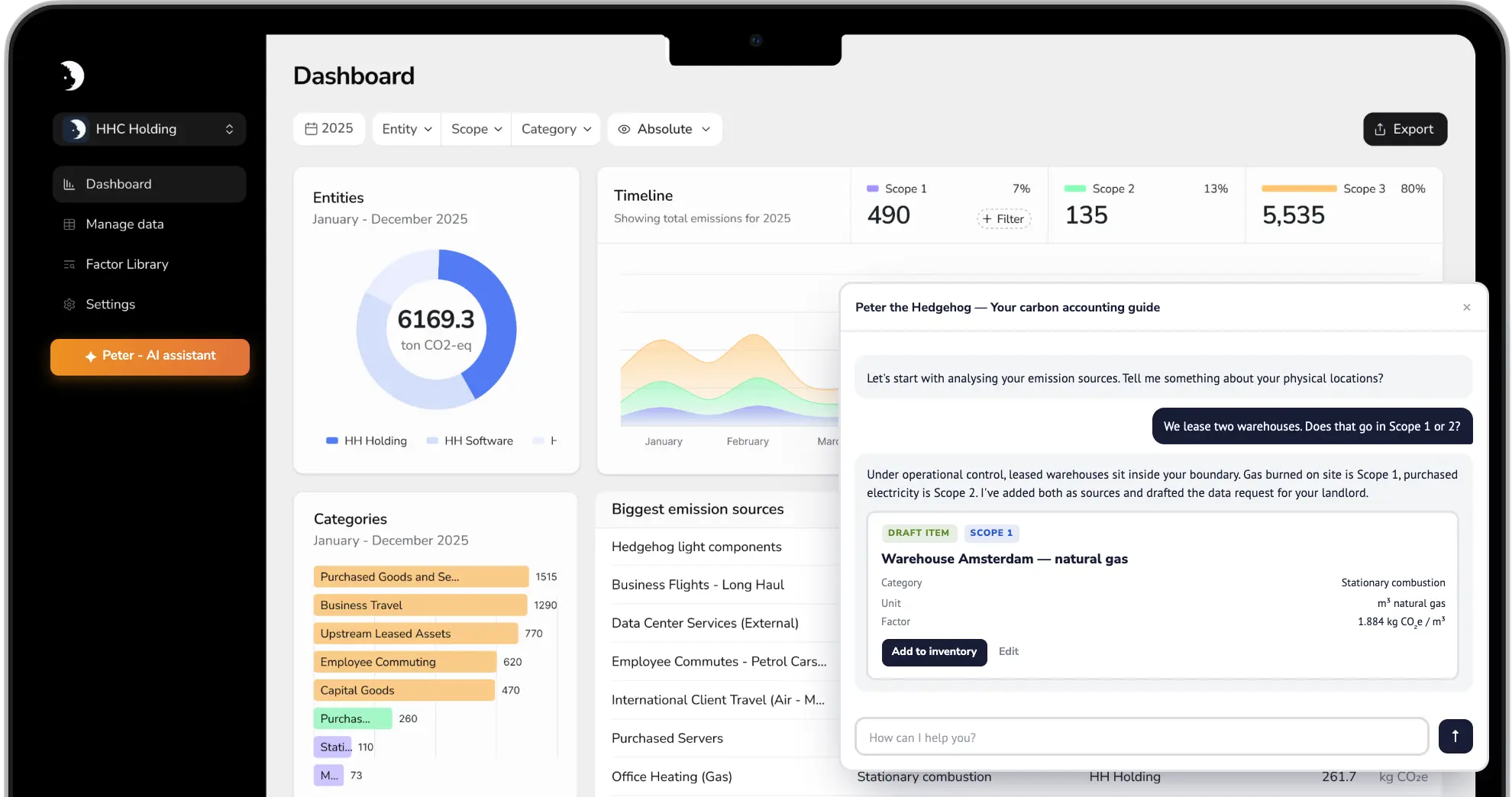
The trede rests on an audited organisational greenhouse gas inventory: scope 1 and 2 with non-CO2 gases at trede 1, quantified scope 3 and a klimaattransitieplan at trede 2. The Hedgehog platform names the CO2-Prestatieladder among its reporting outputs, carries over 20,000 spend-based and activity-based factors you can supplement with your own supplier-specific data, and reports 5,000+ users on its platform page. The limitation to weigh before you build a bid strategy on it: a small business reviewer on G2 in August 2026 rated it 5 out of 5 and noted there is no forecasting, with Hedgehog having said it is on the development list. Modelling what a trede costs across a three-year contract before you declare it happens outside the tool.
The MKI value is a different product. It comes from an LCA in a validated calculator against the Rijkswaterstaat protocol, on a specific design, with product-grade data behind it. If your constraint is supplier-specific material data rather than the calculation itself, that is scope 3 consulting work with a long calendar, and our introduction to the CO2-Prestatieladder for SMEs covers the organisational side from scratch.
Sources: Rijkswaterstaat news of 18 March 2026 and 21 May 2026, Rijkswaterstaat duurzaam inkopen and DuboCalc pages, Protocol Berekenen en aantonen MKI waarde, SKAO Handreiking Aanbesteden 4.0, Hedgehog platform, Hedgehog on G2. Verified 18 September 2026.
Facts on this page were last verified on 2026-09-18.