In short
- There is no size threshold. What decides is whether you bid on a Rijkswaterstaat GWW procurement and which instruments that tender uses.
- The CO2-Prestatieladder and the MKI are two different criteria that can appear in the same tender and need two different deliverables.
- The publication date of the procurement on TenderNed decides which handbook and which MKI protocol you are scored under.
If you bid on a Rijkswaterstaat GWW contract, grond-, weg- en waterbouw, then one or both of these criteria can reach you, and nothing about your company size changes that. Rijkswaterstaat names three standard sustainability instruments in that domain: sustainability requirements in the contract, the CO2-Prestatieladder and the Milieu Kosten Indicator. Two of them carry award weight, they answer different questions, and the test for whether either applies to a given bid is in that tender's documents rather than in a general rule. The one-minute version: open the aanbestedingsleidraad and look for both.
What is the test, stated exactly?
Three questions in sequence.
Are you bidding, directly or as part of a combination, on a Rijkswaterstaat procurement in the GWW domain? If not, nothing here applies to you as a criterion, though it may still reach you through a main contractor.
Does that tender include the CO2-Prestatieladder as an award criterion? Rijkswaterstaat describes it as one of three standard sustainability instruments in GWW and does not publish a rule that it appears in every tender. Read the documents rather than assuming.
Does that tender ask for an MKI value? Rijkswaterstaat's own page says the MKI is used on a large number of projects, not on all of them. There is no published contract value or threshold that switches it on, and you should not assume one.
What is not part of the test: your turnover, your headcount, whether you already hold a certificate, and whether you have ever calculated an MKI value before.
What are the two criteria actually asking for?
| Aspect | CO2-Prestatieladder | MKI |
|---|---|---|
| What it scores | Your organisation's CO2 management | The environmental performance of this project's design and execution |
| What you declare | The trede, 1, 2 or 3, at which the contract will be executed | An MKI value for the offer |
| How it is scored | A fictitious reduction of the bid sum: 2 percent at trede 1, 4 percent at trede 2, 6 percent at trede 3, assessed with the other BPKV criteria | A quality criterion inside the BPKV assessment. A lower value scores better |
| What produces it | An audited organisational greenhouse gas inventory | A life cycle assessment in a validated calculator such as DuboCalc, against the Rijkswaterstaat protocol |
| When you prove it | After the project, or one year after award on longer projects | In the bid, substantiated as the protocol requires |
| Does the other one substitute? | No | No |
The last row is the one that costs money when it is misread. They are separate criteria that can appear in the same tender, and a strong MKI value does not stand in for a trede.
Do you need a certificate to bid?
No. You declare the trede at which the contract will be executed and prove it later.
Rijkswaterstaat follows SKAO's method here: proof by certificate or projectverklaring is due after the project finishes, or one year after award on longer projects. When Rijkswaterstaat announced its move to Handboek 4.0 it said explicitly that an early audit was therefore unnecessary, because the closing dates of post-July tenders were expected to fall in 2027 or later and there would be time to run a herstelplan if a first audit fell short.
That is an opportunity and a trap in one sentence. You can bid at a trede you do not yet hold, and then you have a contractual deadline to build the evidence. Whether it is the first or the second depends on whether the accounting work is realistic on that timetable.
Which version and which protocol are you scored under?
The publication date of the procurement on TenderNed decides, not the date you bid.
Rijkswaterstaat switched to Handboek 4.0 of the CO2-Prestatieladder on 1 July 2026, and applies it only to procurements published on TenderNed after that date. Anything published before then stays under Handboek 3.1, and a 4.0 certificate offered under the scheme transition arrangement is still scored against the 3.1 niveaus. MKI protocol 5.0 took effect on the same date and is issued with the tender documents of new projects.
So two live tenders can be running under different rules at the same moment, and the way to tell is the publication date rather than anything in your own certificate.
What if you are a subcontractor rather than the bidder?
Then the criteria do not bind you, and the requirement arrives anyway.
The declared trede becomes a contract obligation on the main contractor after award, and failing to deliver it costs 1.5 times the fictitious advantage enjoyed. A main contractor carrying that exposure pushes evidence requests down its chain. On the MKI side the effect is sharper still, because an MKI value is built from the materials and equipment actually used, so the data has to come from the people supplying them.
The practical read for a supplier: you will be asked for product-level environmental data by a contractor who has already promised a number, which is a worse negotiating position than being asked before the bid.
What do you do if you are in?
Split the work, because it is two projects rather than one.
For the ladder. You need an audited organisational inventory: scope 1 and 2 at trede 1 with non-CO2 greenhouse gases included, quantified scope 3 and a klimaattransitieplan at trede 2. Decide the trede against the increment it earns you rather than against the headline percentage, because the gap between adjacent treden at Rijkswaterstaat is 2 percentage points.
For the MKI. You need an LCA in a validated calculator against the Protocol Berekenen en aantonen MKI waarde, currently version 5.0. That is design and materials work, and carbon accounting software does not produce it. Conflating the two is the most common and most expensive error in this area.
What do you do if you are out?
Check the adjacent buyers before you conclude anything, because the instruments are the same and the numbers are not.
Rijkswaterstaat's 2, 4 and 6 percent staffel is its own. Other Dutch contracting authorities set their own, and SKAO's published worked example is different again, so a percentage you read somewhere else does not describe an RWS tender. Our introduction to the CO2-Prestatieladder for SMEs covers the scheme itself if this is your first look at it.
Where does each piece of work actually sit?
The organisational half is a software problem. The project half is not.
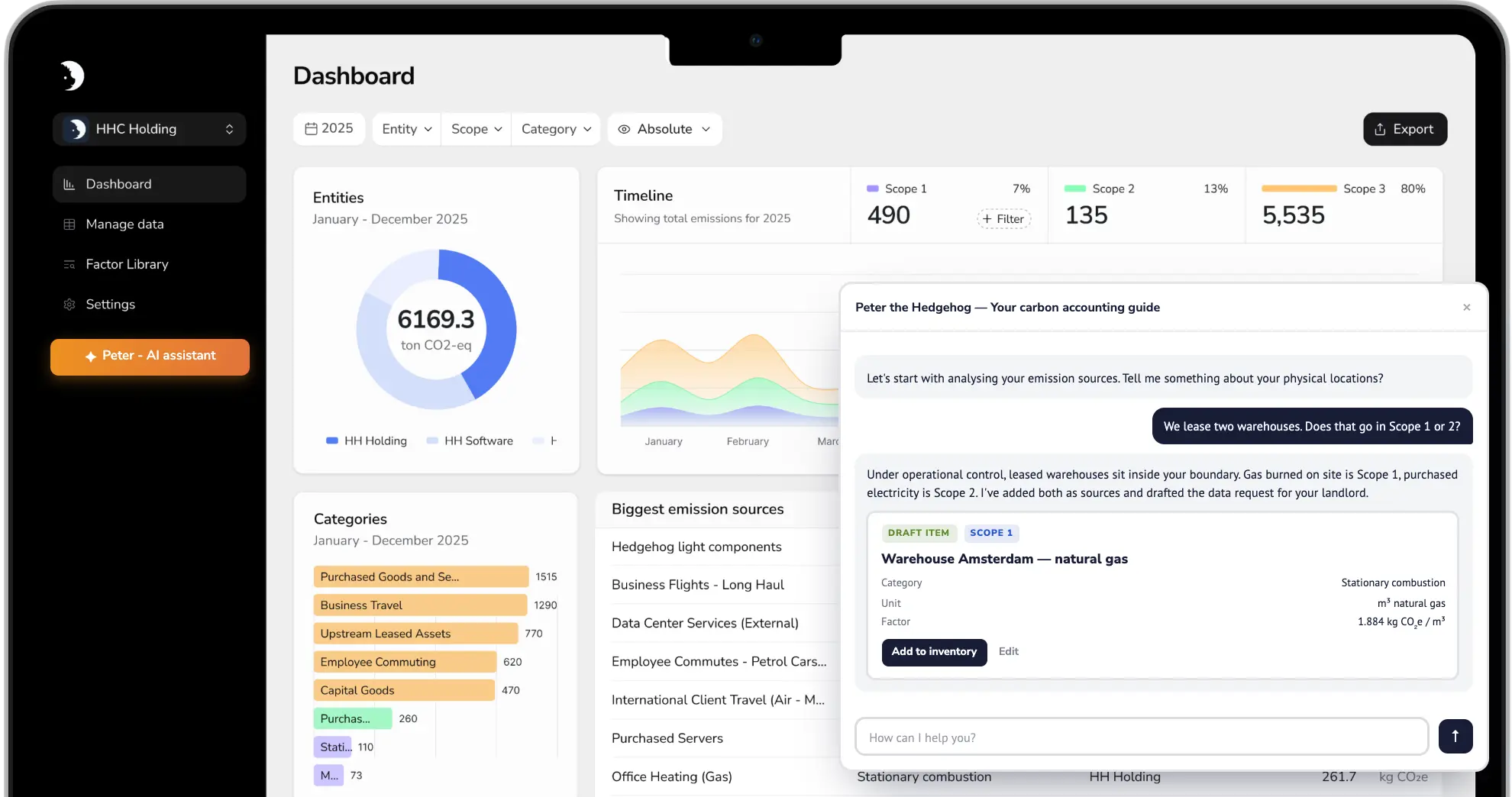
The Hedgehog platform names the CO2-Prestatieladder among its reporting outputs, handles entity management across locations and sites with roles for data owners, auditors and managers, and reports 5,000+ users on its platform page. The limitation to know before you plan a bid calendar around it: a small business reviewer on G2 in August 2026 rated it 5 out of 5 and noted there is no forecasting, with Hedgehog having said it is on the development list. Modelling what a trede costs you across a multi-year contract happens outside the tool today.
MKI and EPD work is a different deliverable entirely, and where scope 3 quantification for trede 2 is the blocker, that is scope 3 consulting territory rather than a bid-week task.
Sources: Rijkswaterstaat news of 18 March 2026 and 21 May 2026, Rijkswaterstaat duurzaam inkopen and DuboCalc pages, Protocol Berekenen en aantonen MKI waarde, SKAO Overgangsregeling 3.1-4.0 v1.1, Hedgehog platform, Hedgehog on G2. Verified 28 August 2026.
Facts on this page were last verified on 2026-09-17.