In short
- A spend-based figure moves when prices move. That is the limitation, not the accuracy.
- Auditors accept spend-based data. What they reject is a method nobody wrote down.
- Changing method mid-series is a restatement. Recalculate the base year or the trend is fiction.
Spend-based means multiplying money spent with a supplier by an average emission factor per unit of currency for that sector. Activity-based means multiplying a physical quantity, litres or kilograms or tonne-kilometres, by a factor for that thing. Both are permitted under the GHG Protocol and both appear in assured reports. The choice matters less for accuracy than for what the number can be used for: a spend-based figure responds to prices and purchasing decisions, an activity-based figure to what your business physically did.
What is the real difference, beyond accuracy?
What makes the number move. A spend-based figure changes when prices change. Negotiate a discount with the same supplier for the same goods and your reported emissions fall while nothing physical has changed. Inflation runs the mechanism in reverse: a year of rising input prices produces an increase you did not cause. An activity-based figure changes when volumes, routes, fuels or specifications change, which is what you can act on and what a reader assumes a reduction represents.
A second consequence people miss: a spend-based factor is a sector average, so it cannot reflect anything about a specific supplier. If your steel supplier switches to an electric arc furnace, your number is unchanged. Supplier engagement and spend-based accounting are structurally incompatible, because the method is blind to the outcome you are asking for.
| Aspect | Spend-based | Activity-based |
|---|---|---|
| Input | Currency amount by category | Physical quantity |
| Usual source | General ledger | Meters, invoices, carrier data |
| Moves when | Prices, volumes or supplier mix change | Physical activity changes |
| Reflects supplier improvement | No | Only with supplier-specific factors |
| Effort per category | Low, once codes are mapped | High, and repeats annually |
| Best used for | Screening, long tail, non-physical categories | Material categories, targets, claims |
| Main weakness | Confounds price with emissions | Data often belongs to somebody else |
When is spend-based genuinely defensible?
More often than purists suggest. Four cases where it is right, not a compromise.
Screening. Spend-based across the ledger is the fastest way to find where the mass sits. Nobody should collect activity data for fifteen categories to learn that two matter.
The long tail. Small categories do not repay physical data collection. Spend-based there, disclosed, concentrates effort where it changes the answer.
Where no physical unit exists. Legal fees, insurance, audit, software, marketing. No meaningful quantity to count, so spend is the activity data.
The first cycle. A complete, disclosed, spend-based inventory published on time beats a partial activity-based one still in progress. Improve it in year two, deliberately, with a restatement.
The common thread is disclosure. Spend-based is defensible when labelled, and stops being defensible when presented as something else.
When does spend-based stop being defensible?
When somebody uses the number for a claim or a decision it cannot support.
Reduction claims. A published reduction has to survive the question of whether it was procurement or decarbonisation, and a spend-based series cannot answer it. Be precise about what the law does here, because it is widely overstated. Since 27 September 2026 the Empowering Consumers directive, Directive (EU) 2024/825, has applied through national law to business-to-consumer commercial practices, and it does not oblige you to substantiate every claim on request. It prohibits named practices, among them these three: a generic environmental claim unless you can demonstrate recognised excellent environmental performance relevant to it, any claim that a product is neutral, reduced or positive on greenhouse gases based on offsetting, and a future performance claim without clear, objective, publicly available and verifiable commitments set out in a detailed and realistic implementation plan. A reduction you cannot separate from a price movement is thin evidence for the first of those and no evidence at all for the third. The working list is in our claims checklist.
Target setting. A target on a metric that moves with prices produces a trajectory nobody can manage against. If validated targets are the destination, settle the method before the target, which is a large part of science-based target work.
Questions about specific goods. A customer asking for the footprint of what they bought from you, or a mechanism such as CBAM, is asking about physical goods. A sector average per euro does not answer that. The same applies to supplier engagement, for the reason above.
Material categories. If one category dominates, leaving it on sector averages makes your total an estimate of your industry, not your company.
What does an auditor actually look at?
Not the method label. Assurance providers routinely accept spend-based data. What gets challenged is the absence of a trail. Five things, roughly in the order they are asked for.
The chain from source document to reported figure. Take one line in the report, walk back to the invoice or export, and show every step in between, including any currency conversion or unit change.
Factor provenance and vintage. Which factor, from which database, from which year, on which line. An unnamed factor set is not evidence.
Consistency. One category treated the same way across every entity and month. Mixed treatment inside a category is a worse finding than a coarse method applied consistently.
The mapping rules. In spend-based work, the mapping from ledger codes to emission categories is the method. It must be written down and reproducible by somebody else.
Labelled estimates. A disclosed estimate is a limitation. An estimate presented as measurement is a finding.
How do you switch method without breaking the baseline?
This is the part most guides skip. Changing calculation method mid-series is a restatement, not an improvement in the trend. Move a category from spend-based to activity-based, publish the new number next to last year's old one, and you have shown the difference between two methods and called it progress. Five steps.
One: scope the change. A whole category at a time, at a period boundary. Half-converted categories are the hardest thing to explain later.
Two: recalculate the base year on the new method. Same category, same boundary, base year activity data. If that data no longer exists, say so and use the earliest year where both methods run.
Three: run both methods in parallel for one year. The most useful step here. It isolates the size of the method effect from any real change, and that difference is what the restatement note explains.
Four: apply your significance threshold. Your recalculation policy should already state the size of change that triggers a restatement. Apply it consistently rather than case by case.
Five: disclose the bridge. Prior year as published, effect of the method change, real change, current year. Four lines, and the change reads as declared rather than absorbed.
Which categories should you convert first?
Rank by share of the total multiplied by feasibility, not by share alone. Feasibility means: does a physical quantity exist, does somebody already record it, and can you get it annually without a new process? Freight scores well because carriers hold weight and distance already. Purchased goods often scores badly despite being large, because the data sits with suppliers who owe you nothing.
Hybrid is the normal end state and a legitimate one: activity-based or supplier-specific for your largest and most engaged suppliers, spend-based for the rest, with the split disclosed. Aim for a stated proportion of spend covered by primary data that rises each year rather than a binary conversion. The route there is scope 3 work aimed at suppliers who can actually answer.
What does Hedgehog do here, and what does it not?
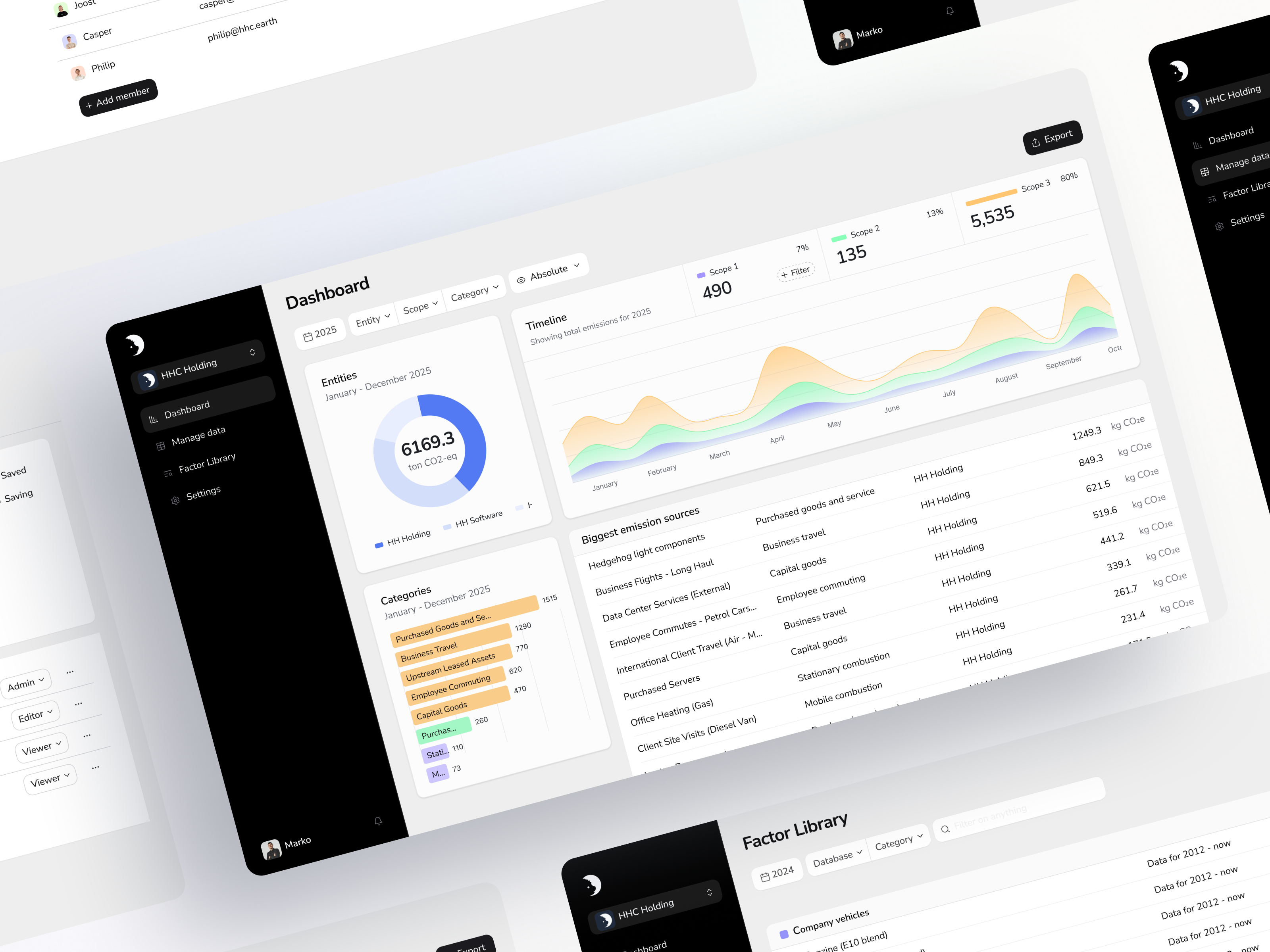
The platform carries more than 20,000 spend-based and activity-based factors in one library, which is what makes the hybrid end state practical: screen a category on spend, then move it to activity data without rebuilding around it. You can add your own organisation-specific or supplier-specific CO2 data as suppliers start providing it. Reporting covers the GHG Protocol, PPN 006 and the CO2-Prestatieladder. Free account, no sales call, Pro from EUR 1,200 a year.
Two limits, both relevant to this topic specifically.
Traceability is not fully exposed today. A Mid-Market customer rated us 4 out of 5 on G2 in July 2026 and asked to see the conversion factor applied to their input, citing a currency conversion and a distance calculation. If the audit trail above is your reason for buying, test it on your own data first.
Loading is manual. A Small Business customer said on G2 in August 2026 that getting the data in is the challenging part, while everything works once it is there. Activity-based conversion is where that cost lands, which is why the ranking above matters.
One boundary: this is organisational accounting. A product-level figure is LCA work, delivered as a service.
What should you do first?
Run a spend-based pass over a full year of ledger data and rank your categories. Then take the top three and answer one question for each: does a physical quantity exist, and who holds it. That is a conversion roadmap in an afternoon, and it will be shorter than you expect. Do it on a free account, and write the recalculation policy the same week while the method choices are fresh.
Sources: the GHG Protocol Corporate Value Chain (Scope 3) Standard and its Technical Guidance for the two calculation methods, and the Corporate Standard for the inventory requirements behind them. Hedgehog platform and Hedgehog on G2, both read on 27 August 2026. Claims rules from Directive (EU) 2024/825: Article 4 for the 27 September 2026 application date, Annex I points 4a and 4c and Article 6(2)(d) for the prohibited practices. Page verified 17 September 2026.
Facts on this page were last verified on 2026-09-17.