
In short
- Regulation (EU) 2025/2650 replaced Article 38 in full and moved application to 30 December 2026, the second postponement in twelve months.
- The bigger change is structural: a new downstream operator category that does not file due diligence statements.
- Delegated Regulation (EU) 2026/2102 took leather off the product list in September 2026 and adds soluble coffee and palm oil derivatives from 30 December 2027.
Three things changed, and the one everybody reports is the least important. Regulation (EU) 2025/2650 of 19 December 2025 moved the application date to 30 December 2026, the second postponement in as many Decembers. The same act created a new category of business, the downstream operator, which does not file due diligence statements at all. And in September 2026 a delegated regulation changed the product list. For most EU manufacturers buying already-covered inputs, the downstream operator category decides how much work the regulation is, and it has barely reached the guidance.
Which acts did the changing?
Four legal acts and one report, in order.
Regulation (EU) 2023/1115 is the original text, adopted in 2023, with an application date of 30 December 2024 written into Article 38(2). Regulation (EU) 2024/3234 of 19 December 2024 was the first postponement, to 30 December 2025. Regulation (EU) 2025/2650 of 19 December 2025 is the main amending act: it replaced Article 38 in full, set 30 December 2026, and made the substantive changes below. COM(2026) 191 final, published 4 May 2026, is the Commission's simplification review, which changed nothing but settled the question of whether another delay was coming. Commission Delegated Regulation (EU) 2026/2102 of 13 July 2026, published in the Official Journal on 17 September 2026, amended Annex I, the list of covered products.
What is the downstream operator category, and why does it matter more than the delay?
Because it moves a large population of companies from the heavy obligation to a light one.
Before the amendment, the working assumption in most of the market was that any business placing a product containing a covered commodity on the EU market carried due diligence and filed a statement. Regulation (EU) 2025/2650 separated out a distinct role: a downstream operator is a business that places on the market products made using relevant products that are already covered by a due diligence statement.
Downstream operators and traders are expressly not required to submit due diligence statements, and are expressly not required to ascertain that due diligence was exercised. What remains is administrative and narrow. Downstream operators and traders that are not SMEs must register in the EU information system before placing products on the market. The first downstream operator or trader in a chain, SME or not, must collect and keep the reference numbers of the due diligence statements or the declaration identifiers.
The commercial reading: most EU food and drink manufacturers buying already-covered cocoa, coffee or palm oil inputs from an EU supplier are downstream operators. A manufacturer that imports the commodity itself is an operator and carries the full weight. Which side of that line a company sits on is decided by where the goods enter the EU, not by what it makes.
What changed, line by line?
| What it said before | What it says now | Which act changed it |
|---|---|---|
| Application from 30 December 2024 | Application from 30 December 2026 | Reg. (EU) 2024/3234, then Reg. (EU) 2025/2650 |
| Deferred start for micro and small operators from 30 June 2026 | Deferred start from 30 June 2027, for those established as such by 31 December 2024 | Reg. (EU) 2025/2650 |
| No separate downstream category. One operator obligation | Downstream operators and traders file no due diligence statements and need not ascertain that due diligence was exercised | Reg. (EU) 2025/2650 |
| No registration duty stated for this group | Non-SME downstream operators and traders must register in the EU information system before placing products on the market | Reg. (EU) 2025/2650 |
| No reference-number retention duty stated for this group | The first downstream operator or trader in a chain must collect and keep DDS reference numbers or declaration identifiers | Reg. (EU) 2025/2650 |
| EU Timber Regulation repealed 30 December 2025 | Repealed 30 December 2026, with a run-off to 31 December 2029 for timber produced before 29 June 2023 | Reg. (EU) 2025/2650, new Article 37 |
| Separate impact-assessment obligations on the Commission | Folded into a general review by 30 June 2030 and at least every five years thereafter | Reg. (EU) 2025/2650 |
| No simplification review mandated | New Article 32(1a) required a report by 30 April 2026. It was published 4 May 2026 | Reg. (EU) 2025/2650 |
| Cattle hides, skins and leather in Annex I | Removed. The tyre entry is narrowed to tyre treads | Delegated Reg. (EU) 2026/2102 |
| Soluble coffee, frozen cattle tongues and many palm oil derivatives not covered | Covered from 30 December 2027 | Delegated Reg. (EU) 2026/2102 |
Did the deferral for small companies get better or worse?
Both, depending on which small company you are.
Better on the date: the deferred start moved from 30 June 2026 to 30 June 2027, a full extra year. Worse on the qualifying test, or at least tighter than most summaries admit. The deferral runs to operators who are natural persons or micro or small undertakings within the meaning of Article 3(1) or 3(2) of Directive 2013/34/EU and who were established as such by 31 December 2024. That cut-off is fixed in the past, so it cannot be met by any company that was not already there.
The second restriction is the one that catches timber and wood products businesses. The deferral does not apply to products covered by the Annex to Regulation (EU) No 995/2010. For those, micro and small operators start on 30 December 2026 with everyone else. Anyone reading the 30 June 2027 date as a general small-company grace period is reading it too broadly.
What changed in the product list?
One delegated act, and it is now law.
Commission Delegated Regulation (EU) 2026/2102 was adopted on 13 July 2026, published in the Official Journal on 17 September 2026, and entered into force the day after. It amends Annex I, the list of products made from the seven commodities.
It removes cattle hides, skins and leather from the list. It narrows the rubber entry for retreaded or used tyres to tyre treads, and it drops a few other entries, such as conveyor belts of vulcanised rubber. It also adds products: soluble coffee, frozen cattle tongues and a list of palm oil derivatives. Those additions apply from 30 December 2027, a year after the main date.
For a leather business, that means cattle leather is no longer a covered product. For a soluble coffee or oleochemicals business, it means one extra year of lead time, not an exemption. If your notes still describe this act as pending, they were written before September 2026.
Should you expect a third postponement?
Nothing in the file suggests one, and there is now a document that says so.
The May 2026 review was itself a creature of the December 2025 amendment: new Article 32(1a) required the Commission to report by 30 April 2026. It reported on 4 May 2026, did not reopen the regulation, and did not move the application dates. That is the natural moment at which a third delay would have originated, and it passed. On 22 November 2026 the Commission's EUDR page still gave 30 December 2026 and 30 June 2027.
The practical consequence is about lead time rather than legal risk. An operator's file rests on plot geolocation and evidence of legal production in the country of production, which comes from counterparties in growing seasons you do not control. Two postponements have already consumed the runway that made a wait-and-see position defensible.
Did any of this change the carbon question?
No, and it is worth saying because the amendments are often summarised as if EUDR were tightening a sustainability reporting duty.
Nothing in Regulation (EU) 2025/2650 added, removed or altered a greenhouse gas obligation, because there was never one to alter. The regulation asks for geolocation of plots, evidence of legal production, a documented risk assessment and mitigation, and a statement. Emissions appear in the recitals as the policy rationale and nowhere in the operative articles.
What did change, quietly, is where the data burden falls. Pushing statement-filing back to the operator concentrates origin-level traceability at the point of import. If you are downstream of that point, you now have a realistic prospect of receiving supplier and origin information you previously would have had to chase yourself, which is exactly the information that upgrades a spend-based ingredient footprint into an activity-based one. That is a sequencing opportunity, not an obligation, and the honest way to treat it is as a reason to time your scope 3 work after your supplier conversations rather than before.
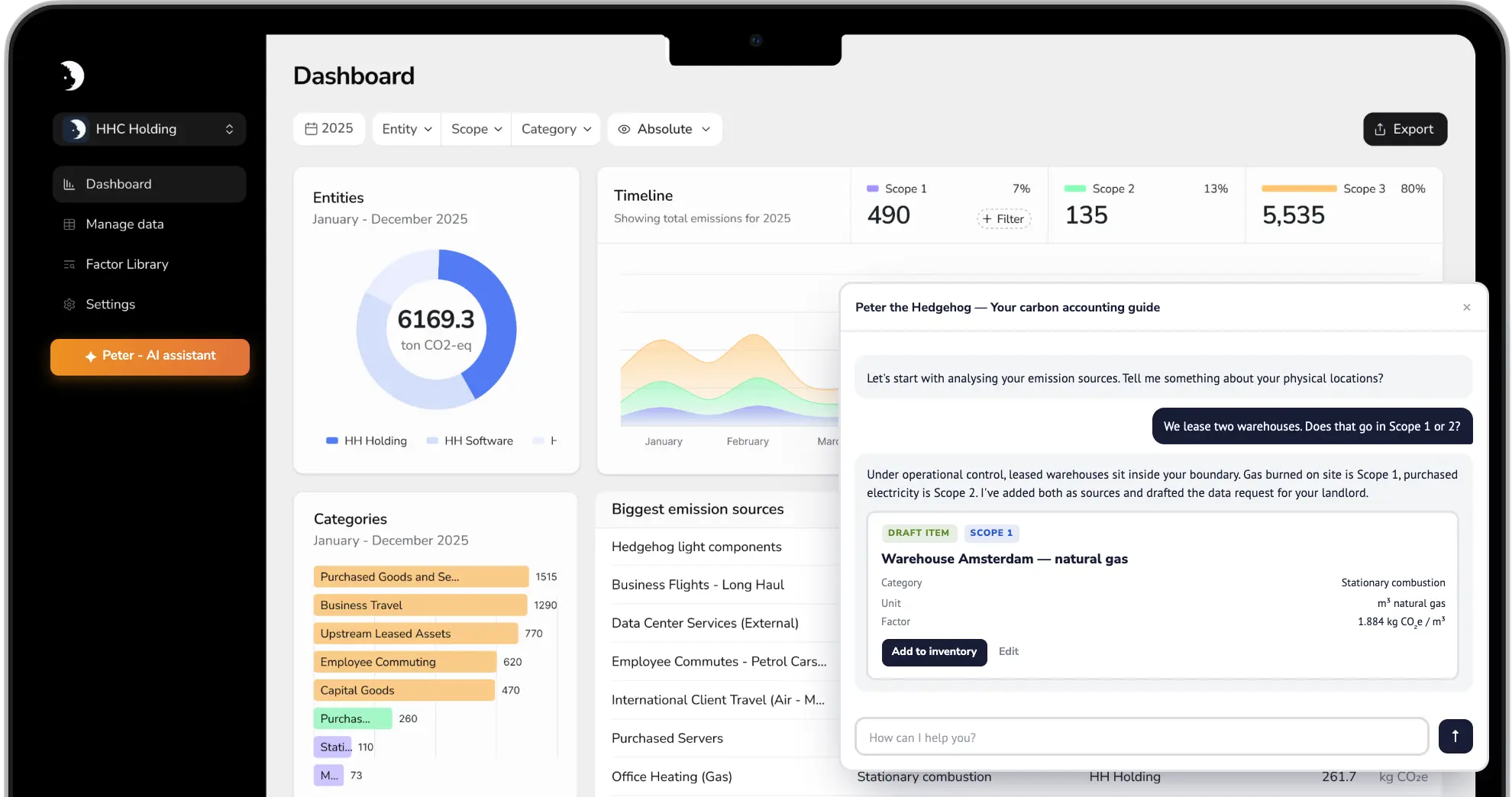
If that inventory work is the actual job, it is scope 3 consulting, or a first build on the Hedgehog platform, which reports 5,000+ users. Two caveats before anyone plans around it: a small business reviewer on G2 in August 2026 noted there is no forecasting, and that Hedgehog had told them it was on the development list. So if your plan involves modelling a sourcing switch before you make it, check that capability rather than assuming it. If the pressure is coming from customers rather than dates, the value chain cap on ESG questions is the piece to read.
Sources: Regulation (EU) 2023/1115, Regulation (EU) 2024/3234, Regulation (EU) 2025/2650 and Commission Delegated Regulation (EU) 2026/2102 as published in the Official Journal, COM(2026) 191 final of 4 May 2026, and the European Commission EUDR page. Hedgehog facts from the Hedgehog platform and Hedgehog on G2. Verified 22 November 2026.
Facts on this page were last verified on 2026-11-22.

