In short
- Scope 2 is two numbers, not one. Location based and market based, both gross, with the total presented on both bases.
- The boundary is your financial consolidation scope, then operationally controlled entities at 100 percent for greenhouse gases.
- Missing value chain data is not a reason to omit. The standards require estimation with sector averages and proxies.
For the greenhouse gas half of a CSRD statement, Disclosure Requirement E1-6 asks for gross scope 1, gross scope 2, gross scope 3 and a total, all in tonnes of CO2 equivalent, plus an intensity figure per net revenue reconciled to your financial statements. Underneath those four lines sit the details that decide whether the data you already hold is usable: scope 2 twice, on location based and market based bases; scope 3 only for significant categories; and a boundary that starts with your financial consolidation and then adds operationally controlled entities at 100 percent. Missing value chain data must be estimated, not skipped.
Which version of the standards is this list built on?
The one in force when we checked, and you should know that a new one is close.
Every paragraph number on this page comes from the European Sustainability Reporting Standards in Delegated Regulation (EU) 2023/2772, as amended by Delegated Regulation (EU) 2025/1416. That was the version in force on 24 September 2026. The Commission adopted a revised and simplified set on 3 July 2026, written to apply from financial years beginning on or after 1 January 2027, which is also the first year of the narrowed reporting scope. On 24 September 2026 it was still in the scrutiny period of the European Parliament and the Council, and we have not written anything here on the strength of it. If it is in the Official Journal by the time you read this, check each paragraph reference below against the revised text before you build a data model around it.
What exactly does E1-6 ask for?
Paragraph 44 of ESRS E1 is short. The undertaking discloses, in metric tonnes of CO2 equivalent, its gross scope 1, gross scope 2 and gross scope 3 emissions, and its total. Everything else is in the paragraphs underneath it.
| Field | What is required | The detail people miss |
|---|---|---|
| Gross scope 1 | Tonnage | Plus the percentage from regulated emission trading schemes |
| Gross scope 2 | Two figures | Location based AND market based, both gross |
| Scope 1 and 2 split | Disaggregated | Between the consolidated group and operationally controlled investees |
| Gross scope 3 | Significant categories | Each category that is a priority, not all fifteen automatically |
| Total | Presented twice | Once with location based scope 2, once with market based |
| GHG intensity | Total emissions per net revenue | The denominator reconciled to a line item or note in the financial statements |
The two rows that break systems are the scope 2 pair and the total presented twice. A tool that stores one emissions figure per site cannot produce either. You need supplier contracts, instruments and residual mix data for the market based figure, and grid average factors for the location based one, held side by side for the same site and the same period.
The intensity denominator is the row that surprises sustainability teams: it is a finance number, and it has to tie back to the financial statements. That is a reconciliation, not a lookup.
Which entities does the data have to cover?
This is the question to settle first, because it determines every collection request you send.
ESRS 1 paragraph 62 sets the starting point: the sustainability statement is for the same reporting undertaking as the financial statements. So your consolidation scope is your reporting scope.
Then two extensions. Under paragraphs 63 and 64, that scope is extended to material impacts, risks and opportunities connected to you through direct and indirect business relationships upstream and downstream, but only where the matter is material to that part of the chain. And for greenhouse gases specifically, ESRS E1 paragraph 46 adds that associates, joint ventures, unconsolidated subsidiaries and jointly controlled operations come in according to the extent of your operational control, at 100 percent of the emissions of an entity you operationally control, not at your equity share.
Read that last part slowly if you have joint ventures. A 30 percent stake in a facility you operate contributes 100 percent of its emissions to your inventory, while the same stake contributes 30 percent of profit to your accounts. Two boundaries, one report, and paragraph 50 asks you to show the split between the consolidated group and those investees.
What do you do about data you cannot get?
Estimate it. This is written into the standards as the normal path, not the failure path.
ESRS 1 paragraph 69: where the undertaking cannot collect value chain information after reasonable efforts, it shall estimate the information to be reported using all reasonable and supportable information, such as sector-average data and other proxies.
Two consequences worth planning around. First, "our suppliers did not reply" is not a disclosure. You still report a number, and you disclose that it is estimated and how. Second, this changes what a supplier questionnaire is for: it improves an estimate you already have, rather than unblocking a figure you cannot produce. That reframing usually reduces how much chasing is worth doing.
There is one narrow omission available. Appendix C of ESRS 1, as replaced by Delegated Regulation (EU) 2025/1416, lets undertakings and groups not exceeding an average of 750 employees omit the scope 3 and total emissions datapoints for the first year of preparing a sustainability statement. One year, that band only. Note that a company inside the narrowed scope that applies from financial year 2027 exceeds an average of 1,000 employees by definition, so a new reporter under that scope will not be in the band this relief covers.
How much of scope 3 do you actually need?
Each significant category, meaning each category that is a priority for the undertaking. Paragraph 51. Not fifteen categories because a template has fifteen rows.
That is less work than the maximalist reading, but it comes with a burden the maximalist reading does not have: you must be able to defend the selection. Screening every category well enough to justify excluding most of them is itself an exercise, and it is the one that assurance providers probe, because it is where a low total can be manufactured.
In practice the sequence is a rough screen across all categories using spend or activity proxies, a documented materiality judgement on which are priorities, then real collection effort concentrated on those. If your selection is the part you cannot yet defend, that is what scope 3 consulting exists for.
What does the data have to survive?
A limited assurance opinion, which changes the requirement from "a number" to "a number with a trail behind it".
Article 34(1), second subparagraph, point (aa) of the Accounting Directive requires the assurance provider to express an opinion based on a limited assurance engagement covering compliance with the directive and the standards, the process used to identify the reported information, the machine readable markup under Article 29d, and the Article 8 EU Taxonomy disclosures.
Note that the process is in scope of the opinion, not just the output. Your provider will ask how a figure was produced, which source document it came from, who owns it and what changed since last year. Harmonised limited assurance standards are not due until 1 July 2027, so until then this is done to national standards, which in practice means expectations vary by country and by firm.
What that means for your data model: every reported figure should be traceable back to a source file, with the factor applied and the conversion visible. Retrofitting that trail after a year of collection is far more expensive than building it in at the start.
What is the practical collection list?
Working from the requirements above, this is what actually has to exist by the end of the reporting year.
Per site, per period. Fuel and process data for scope 1, with a flag for anything covered by an emission trading scheme. Electricity, heat, steam and cooling volumes for scope 2, plus contracts, instruments and residual mix evidence so the market based figure can be produced separately from the location based one.
Per entity. Consolidation status, whether you have operational control, and the ownership percentage, so the group and investee split can be disaggregated and reconciled to your financial consolidation.
Per significant scope 3 category. The activity or spend basis used, the factor source, and whether the figure is collected or estimated.
From finance. The net revenue line used as the intensity denominator, identified by the line item or note it reconciles to.
Throughout. Method notes, factor versions and owner names, because next year's report has to compare with this one.
Where does software help, and where does it not?
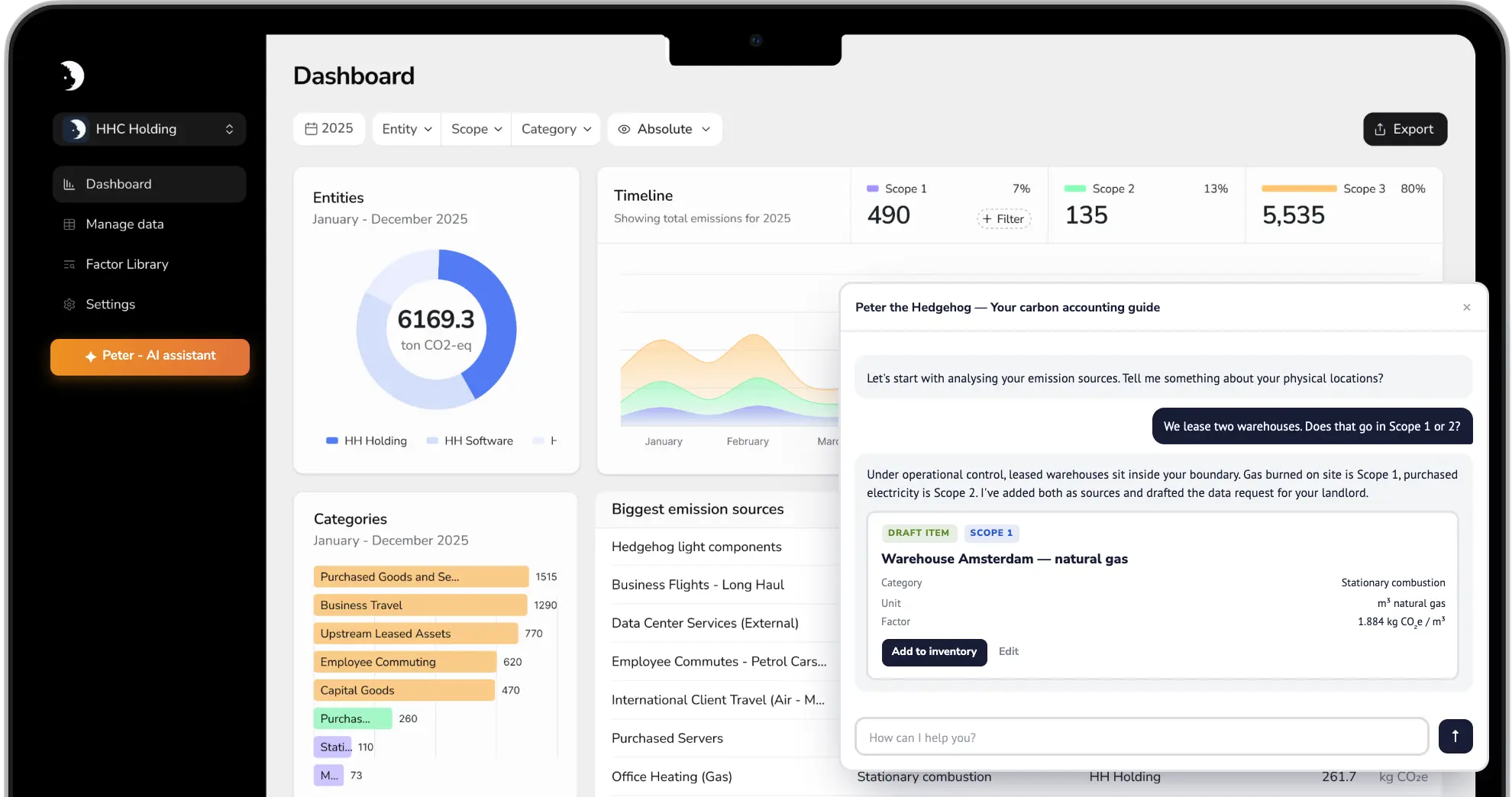
The platform walks you through GHG Protocol setup, identifying your data sources, data owners and documents, covers over 20,000 spend based and activity based factors, manages entities across locations and sites, and lets you invite colleagues, consultants and auditors with their own roles. There are 5,000+ users, and a free account needs no sales call. If you are choosing between tools, choosing the right carbon accounting software is the comparison to read first.
Two limits, stated because this page is about data quality. A Mid-Market reviewer rated us 3.5 out of 5 on G2 in June 2026 and wrote that for a broader ESG data and reporting platform, for example for CSRD, this one is less complete, with no data source management feature and no decarbonisation target monitoring. If your programme needs formal data source management across the whole statement, that is a gap, and the wider statement is CSRD consulting work.
The emissions data itself is what we do. Start with the boundary and the scope 2 pair; those two decisions shape everything else on the list.
Sources: Delegated Regulation (EU) 2023/2772 (the version in force on 24 September 2026), Annex I, ESRS 1 paragraphs 62 to 69 and Appendix C, and ESRS E1 paragraphs 44 to 55; Delegated Regulation (EU) 2025/1416; Directive 2013/34/EU Articles 29d and 34 as amended by Directive (EU) 2026/470. Read against the Official Journal text and verified 28 August 2026.
Facts on this page were last verified on 2026-09-24.