In short
- The revised ESRS apply from financial year 2027. For 2026 you choose the old or the new version and say which.
- Scope 2 is still two numbers, location-based and market-based. The total and the intensity ratio are no longer required.
- Missing supplier data is no reason to report a partial scope 3: the partial-scope relief explicitly excludes gross emissions.
The revised climate standard asks for less than the 2023 version, and what remains is mostly data you have to collect during the year. Delegated Regulation (EU) 2026/1563 has been in force since 10 November 2026 and applies to financial years beginning on or after 1 January 2027. Its gross emissions requirement, E1-8, asks for scope 1 with the share from the EU ETS, scope 2 both location-based and market-based, scope 3 for each significant category, a split between the consolidated group and other emissions, and biogenic CO2 separately. It binds undertakings above both EUR 450 million of net turnover and 1,000 employees.
The detail below matters because E1-8 is written at paragraph level, and much of the guidance in circulation still quotes the 2023 text, where the same requirement was E1-6 and asked for more.
Which version of the standards applies to which year?
It depends on the financial year you are reporting on.
From financial year 2027 the revised standards apply: Delegated Regulation (EU) 2026/1563 of 3 July 2026, published in the Official Journal on 21 September 2026. It replaced Annex I of Delegated Regulation (EU) 2023/2772, which held the original standards.
For financial years starting in 2026 there is a choice. Article 2 lets an undertaking use either the standards as last amended by Delegated Regulation (EU) 2025/1416, or the revised ones, and it must state clearly in its sustainability statement which version it applied.
The paragraph numbers on this page are those of the revised text. If a checklist you are working from mentions E1-6 and paragraphs 44 to 55 for emissions, it was written for the 2023 version.
What does E1-8 ask for, field by field?
Paragraph 30 sets the requirement: absolute gross emissions for the reporting period in metric tonnes of CO2 equivalent, classified by scope, plus the approach used to measure them.
| Field | What the revised standard asks for | Where |
|---|---|---|
| Scope 1 | The tonnage, plus the percentage of scope 1 emissions from the EU ETS if you have emissions in that system | Paragraph 30(a)(i) |
| Scope 2 | Both the location-based and the market-based figure | Paragraph 30(a)(ii) and AR 23 |
| Scope 3 | Each significant category, as a total and per category | Paragraph 30(a)(iii) and AR 24 |
| Scope 1 and 2 split | Between the consolidated accounting group and other emissions, following your boundary approach | Paragraph 30(c) and AR 19 |
| Method | The approach used to measure the emissions | Paragraph 30(b) |
| Biogenic CO2 | Direct biogenic CO2 from burning or biodegrading biomass, separately from scope 1 | Paragraph 31 |
Two fields from the 2023 version are gone. The revised text no longer asks for a total presented once on each scope 2 basis, and no longer asks for emissions per unit of net revenue.
The field that catches people is market-based scope 2. AR 23 points to the quality criteria for contractual instruments in the GHG Protocol scope 2 guidance and asks you to explain the instruments behind the figure. Supplier contracts, guarantees of origin and residual mix factors have to be gathered during the year. You cannot rebuild them from meter totals afterwards.
What is the reporting boundary?
The financial one, with a choice of method for greenhouse gases.
ESRS 1 paragraph 60 states that the sustainability statement is for the same reporting undertaking as the financial statements: the parent and its subsidiaries, under the applicable accounting rules.
For emissions, AR 19 of E1 says that boundary corresponds to financial control as defined in the GHG Protocol Corporate Standard. An undertaking may use the equity share or the operational control approach instead. The split between the consolidated group and other emissions in paragraph 30(c) then follows whichever approach you chose.
This reverses the 2023 rule, which brought in associates and joint ventures at 100 percent where you had operational control. If your inventory was designed for that rule, check the choice with finance before the 2027 year opens, document it, and keep it stable, because every comparison you publish later depends on it.
Do you need all fifteen scope 3 categories?
You report the significant ones, but you have to look at all fifteen to find them.
AR 24 asks you to screen your total scope 3 emissions across the fifteen GHG Protocol categories using estimates, then identify the significant categories by the size of their estimated emissions and by criteria such as spend, influence, transition risks and opportunities, and stakeholder views.
It also sets a rhythm: update each significant category every year with current activity data, and update the full scope 3 inventory at least every three years, or sooner after a significant change. If you buy cloud computing or data centre services, those emissions are shown as a subset of category 1.
So the work is a documented screen first, then real collection on the categories that matter. Dropping a category because its data is hard to get is a different finding from dropping it because it is small, and your working papers have to show which one you made.
What if you cannot get the data?
You use estimates, and you still report the full scope.
ESRS 1 paragraph 65 allows value chain information to come directly from suppliers and customers, or from estimates based on sector averages, sample analyses, spend-based data or other proxies. Paragraph 91 offers a relief for metrics that can only be reported for part of the value chain, but it starts with an exception: it does not apply to the E1-8 gross scope 1, 2 and 3 emissions.
For your first three years of mandatory reporting, paragraph 123 adds a duty to explain any gap: what you did to get the value chain data, why part of it could not be obtained, and how you plan to get it.
Plan for refusals as well. Suppliers averaging up to 1,000 employees may decline requests for CSRD purposes that go beyond the voluntary standard in Delegated Regulation (EU) 2026/1560. A collection strategy has to produce defensible numbers with a real refusal rate, which is a modelling problem and where scope 3 consulting usually earns its place.
Can you leave climate out altogether?
Only with a stated reason. Climate goes through the materiality assessment like every topical standard, but it is the one topic whose omission the standards single out.
Under ESRS 2, IRO-2 paragraph 37(b), an undertaking that concludes climate change is not material, and therefore omits all of E1, must disclose the basis for that conclusion. The 2023 demand for a detailed explanation including a forward-looking analysis is not in the revised text. For a company above EUR 450 million of turnover and 1,000 employees, that basis will be read closely by the assurance provider.
Who gets a phase-in, and for what?
Nothing in E1-8 is phased in.
The revised transitional provisions, ESRS 1 paragraphs 125 to 127, defer other things. Undertakings reporting for the first time from 2027 may omit information on anticipated financial effects in their first two years, including those in E1-11, apart from a few listed datapoints. Paragraph 124 also excuses them from comparative figures in their first year.
The scope 3 relief for undertakings up to 750 employees belongs to the earlier standards, as amended in 2025. It matters only to a 2026 report prepared under that version.
What does the assurance opinion mean for your records?
It means the working papers matter as much as the numbers.
Article 34(1), second subparagraph, point (aa) of the Accounting Directive requires an opinion based on a limited assurance engagement. It covers compliance with the standards, the process used to identify the reported information, the machine-readable markup and the Article 8 Taxonomy disclosures. The process is in scope, not only the output.
The Commission has until 1 July 2027 to adopt harmonised limited assurance standards, so engagements run on national standards until then. There is no route to reasonable assurance in the text any more, so budget for limited assurance.
Where should you start?
With market-based scope 2 and the boundary choice, because both have to be settled before the year begins.
Set up market-based scope 2 collection before your first 2027 reporting year opens, and agree the consolidation approach with finance in the same conversation. Then run the scope 3 screen and build one significant category end to end, so you learn your real supplier response rate before it matters.
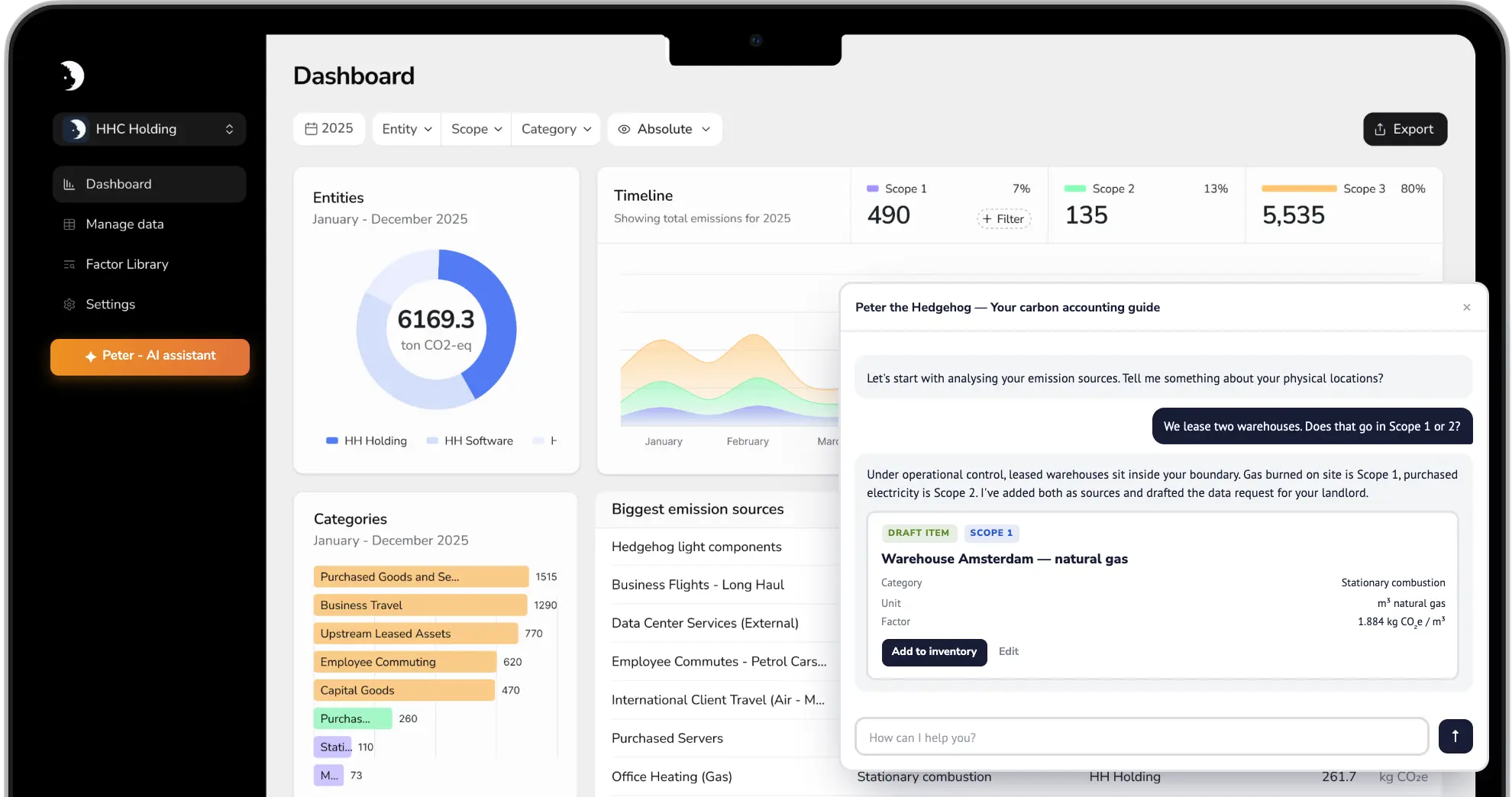
You can do the first pass on a free account on the platform, which serves 5,000+ users and covers over 20,000 spend-based and activity-based factors, with entity management across locations and sites. If the boundary question is the sticking point, that is what carbon footprint consulting is for, and the full statement is what CSRD consulting covers.
One limitation to weigh honestly. A mid-market reviewer scored Hedgehog 3.5 out of 5 on G2 in June 2026 and said it is less complete if what you want is a broad ESG and reporting platform, pointing at the absence of a data source management feature and of decarbonisation target monitoring. E1-8 is a calculation problem we handle. The rest of the sustainability statement is a wider job than this product.
Sources: Delegated Regulation (EU) 2026/1563 of 3 July 2026, Articles 2 and 3 and Annex I: ESRS 1 paragraphs 60, 65, 91 and 123 to 127, ESRS 2 paragraph 37, ESRS E1 paragraphs 30 and 31 and AR 19 to AR 24; Delegated Regulation (EU) 2023/2772 and Delegated Regulation (EU) 2025/1416; Delegated Regulation (EU) 2026/1560; Directive 2013/34/EU Article 34; Directive (EU) 2026/470 of 24 February 2026. Read against the Official Journal text and verified 22 November 2026.
Facts on this page were last verified on 2026-11-22.