In short
- WPM does not ask for a tonnage, a footprint or a CO2 figure. You submit kilometres by mode and fuel and the ministry does the arithmetic.
- No emission limit applies to any individual employer. The 96 grams value sits in a provision that has never been brought into force.
- Since 14 November 2026 employers with 100 to 249 staff have no duty for 2026 onward, but their report over 2025 was still owed.
Many of the costly beliefs about WPM are wrong. It does not ask for a carbon footprint, it does not put an emissions limit on your organisation, and there is no published fine. Since 14 November 2026 it no longer applies to employers below 250 staff for 2026 onward, but that change does not wipe out the report over 2025. What WPM does require is narrow: kilometres by travel mode and fuel type, filed once a year. Below are eight common claims and what the sources actually say.
WPM is the rapportageverplichting werkgebonden personenmobiliteit, the reporting obligation for work-related personal mobility, in force since 1 July 2024.
Does WPM require a carbon footprint?
No, and this misunderstanding costs the most.
You report kilometres: the total travelled in the calendar year for commuting and for business travel, split by combination of travel mode and fuel type. The ministry converts those kilometres into CO2 itself, to monitor a sector-wide ceiling. No employer submits a tonnage, keeps a greenhouse gas inventory or meets a CO2 target under WPM.
That changes who does the work. A footprint is an accounting exercise with boundary decisions and factor choices. A kilometre report is a data collection task, closer to payroll or expenses, and the people best placed to run it usually work in HR or facilities rather than finance or sustainability.
Is there a CO2 limit on your company?
No. Not today, and not from any date that has been fixed.
An emission limit value of 96 grams CO2 per passenger-kilometre for business mobility is written into art. 18.12 of the Besluit activiteiten leefomgeving. It has never been brought into force. The explanatory note to the November 2026 amendment says the limit would only come into force if emissions over 2025 exceeded the collective ceiling, and would then apply from 2030. It also says the figure will most likely have to be revised first, because 96 grams was the Dutch average when the decree was drafted.
Secondary sources say a norm applied from 2025, and so does footnote 39 of the 2022 Green Deal Duurzame Zorg text. That did not happen. What the ministry monitors is a collective ceiling, with an intermediate evaluation in the autumn of 2026. On 22 November 2026 its outcome had not been published.
If a slide shows 96 grams as a compliance threshold for your fleet, it describes something that does not apply today and could not apply before 2030.
Do employers with 100 to 249 staff still have to report?
Not for 2026 or later. For 2025, yes.
The amendment published in Staatsblad 2026, 381 on 13 November 2026 replaced "minder dan 100 werknemers" with "minder dan 250 werknemers". It applies since 14 November 2026 and works back to 1 January 2026. The explanatory note says 2025 is the last year organisations below 250 have to report on.
So two opposite claims are both wrong. "We are below 250, so we never had to file for 2025" is wrong: everyone with 100 or more employees on 1 January 2025 owed that report by 30 June 2026. "The threshold is still 100" is wrong too, from 14 November 2026. When we checked on 22 November 2026, RVO's own pages still described the change as a plan, so rely on the Staatsblad.
What are the other five claims?
Five more claims, each of which sends someone down the wrong path.
| The claim | What the sources actually say |
|---|---|
| "You report freight, flights and all travel abroad" | Freight, grey-plate vehicles, flights, vessel trips and trips between places abroad are out. Road and rail kilometres abroad on a work trip count |
| "You file with the municipality or the omgevingsdienst" | You file with RVO through eLoket. The head-office municipality is the competent authority, and an omgevingsdienst does the checking |
| "The collective goal is 1.5 Mton" | It was lowered to 1.2 Mton for 2030, alongside the exemption for smaller employers |
| "Missing the deadline carries a set fine" | The sources describe bestuurlijke sancties and name no amount |
| "The report must be audited" | Nothing in the sources requires assurance |
The first row deserves a second look if you run vehicles. A distribution business often assumes its lorries are the point of WPM. They are not. WPM is about people travelling for work and to work, so the trucks are out and the drivers commuting to the depot are in.
Why does the missing audit requirement matter?
Because it cuts both ways.
There is no assurance requirement, no template beyond RVO's own online form, and no accreditation for whoever prepares the numbers. Submission runs through Mijn RVO and eLoket with eHerkenning at level eH2+, which is an identity requirement, not a quality check.
So the filing is cheap. But nobody validates your kilometres before you submit them. Your own method is the only quality control, and the omgevingsdienst may later ask about it.
So what should you actually do differently?
Stop treating it as a carbon project and set up a data collection routine.
Split the job by data source, not by emission scope. Business travel usually already exists in expense claims, lease car records and public transport cards. Commuting almost never exists anywhere, which is why the government put the burden at about 24 hours a year for a smaller organisation, most of it spent on the commuting survey. One survey in a fixed window beats a reconstruction in June.
Collect once, use twice. Commuting and business travel data overlaps almost exactly with GHG Protocol scope 3 categories 7 and 6. That is our observation about the data, not a claim by RVO, but it is why the work is worth doing well, even for an employer that just dropped below the threshold. If a voluntary standard is next, the VSME standard is where these numbers come back.
Keep the ambition separate from the obligation. Cutting travel emissions is a good idea, but WPM does not ask for it, and mixing the two turns a modest filing into a programme. If a customer questionnaire is the real driver, our note on the value chain cap on ESG questions maps what you owe them better than the decree does.
Where can a platform genuinely help here?
With the second use of the data, more than the first.
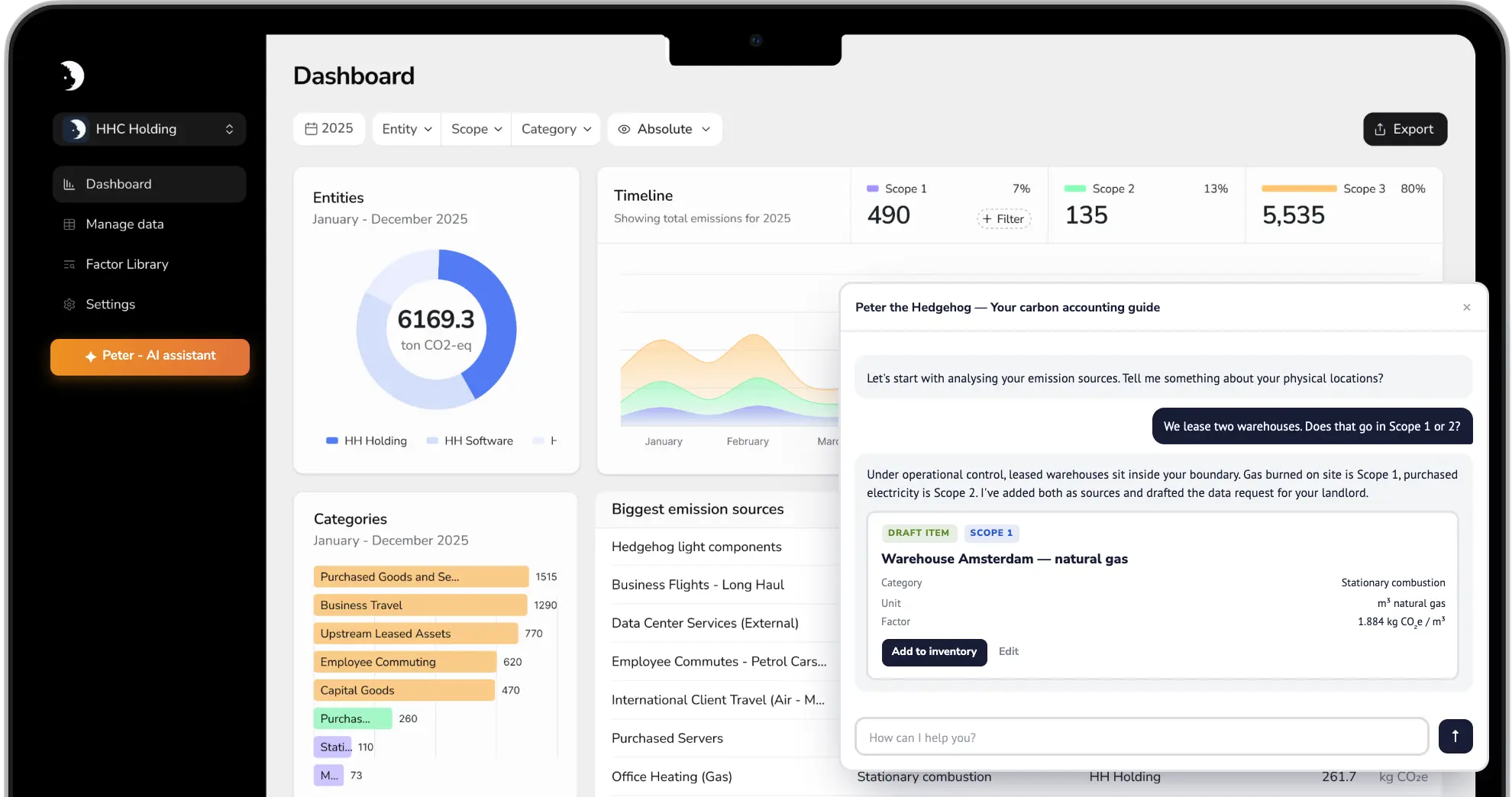
The Hedgehog platform carries over 20,000 spend-based and activity-based factors that you can supplement with your own organisation-specific or supplier-specific data. It handles entity management across locations and sites, and the platform page reports 5,000+ users. That helps once the kilometres exist and you want a scope 3 inventory from them.
A limitation to state plainly, since this page is about not overstating things: Hedgehog has few integrations with other software today, and a mid-market reviewer on G2 asked for more in June 2026. If you hoped a travel booking tool or HR system would push data in automatically, check that route first. For the parts that need judgement, carbon footprint consulting is the honest answer. If a public tender is why you are here, the CO2-Prestatieladder is the instrument that rewards the effort.
Sources: Staatsblad 2026, 381 and its nota van toelichting, RVO rapportage WPM and veelgestelde vragen, Stb. 2023, 472, art. 18.11, 18.12 and 18.15 Besluit activiteiten leefomgeving, Hedgehog platform, Hedgehog on G2. Read on 22 November 2026.
Facts on this page were last verified on 2026-11-22.