
In short
- Six different kinds of document get called a rule, and only two of them can be enforced against you by a public authority.
- The fastest test is the waiver test: if a named person can decide to let you off, it is a contract or a scheme, not a law.
- We checked two widely repeated requirements in 2026 and found neither existed as an obligation. Being able to say that is worth more than hedging.
The claim is that VSME, the GHG Protocol, certification schemes, sector covenants and EU strategies are all rules you have to follow. Almost none of them is. Six different kinds of document get called a requirement in sustainability work, and only two of them can be enforced against you by a public authority. The difference decides who can compel you, what happens when you decline, whether the date you were given is real, and whether the budget belongs in compliance or in sales. You can tell them apart in about two minutes.
This matters more here than in most fields because the vocabulary is loose. Standard, framework, directive, scheme, protocol and strategy are used interchangeably in marketing copy and then land in a compliance register as though they were the same kind of object.
What are the six kinds of thing people call a rule?
Ordered by how much power sits behind them, most to least.
| Type | What it is | If you ignore it | Example |
|---|---|---|---|
| EU regulation | Binding law, directly applicable in every Member State from a date in its own text | Enforcement and penalties under national implementing law | Regulation (EU) 2024/1781, whose Article 25 has banned large enterprises from destroying unsold apparel since 19 July 2026 |
| EU directive | Binding as to result, but it binds Member States, not you, until they write it into national law | Nothing, until your country transposes it. Then everything | Directive (EU) 2025/1892, transposition due 17 June 2027, schemes running by 17 April 2028 |
| National law | The layer that actually reaches a company, including transposed directives | Fines, orders, inspection by a named authority | Whatever your Member State enacts under the directive above |
| Commission Communication, strategy, action plan | A policy document addressed to the other EU institutions | Nothing. There is no offence to commit | The EU strategy for sustainable and circular textiles, COM(2022) 141 final |
| Voluntary standard or covenant | An agreed method or a signed commitment, adopted by choice | Nothing legal. Possibly a credibility cost | The GHG Protocol as a method; VSME as a reporting format; the Green Deal Samen werken aan duurzame zorg as a covenant |
| Certification scheme, rating or questionnaire | A private assessment somebody buys or requires commercially | You lose the bid, the contract or the score | The CO2-Prestatieladder, a certification scheme used as a procurement award criterion |
How do you check which one you are holding, in two minutes?
Four questions, in this order. Stop as soon as one of them answers you.
What is the exact name and number? Not the nickname. A real legal act has an identifier: a regulation or directive number, an Official Journal citation, a European Legislation Identifier. A Commission document has a COM number instead, which looks official and is not legislation. On EUR-Lex the CELEX code gives it away: a document code with DC in it is a Commission document, not an act.
Where is the article that says when it applies? Every binding act has one and it is usually near the end. If you cannot find a sentence of the form "it shall apply from", you are probably not holding a binding act.
If it is a directive, what is the national act? A directive date is a deadline for a government, not for you. Your date is in your own country's law and it can land anywhere up to the transposition deadline, or later if your government is late.
Who can let you off? This is the fastest test of the four. If a named person, a buyer, a certification body, a customer, can decide to waive the requirement, it is not law. Laws are not waived by counterparties. Anything waivable is contractual, and contractual things are negotiable.
What did we find when we ran this on our own fact base?
Two claims that everybody repeats turned out not to be obligations at all. We publish both, because the finding is the point.
The EU strategy for sustainable and circular textiles. Checked against the primary text on 28 August 2026. It is COM(2022) 141 final, a Commission Communication from 30 March 2022. It creates no obligation, sets no company deadline and carries no penalty. Its only prominent date, "By 2030 textile products placed on the EU market are long-lived and recyclable", is a description of a desired market and not a compliance date. Our own fact base had it filed under regulations for the apparel sector, which was wrong, and it is now marked as refuted.
A Dutch education procurement CO2 requirement. Checked on the same day against the Aanbestedingswet 2012 and the national procurement guidance. There is no dated requirement obliging Dutch schools, vocational colleges, universities of applied sciences or universities to apply a carbon criterion when they buy. Sustainable procurement in that sector runs on a policy agenda plus a manifest that organisations sign voluntarily and under which each signatory sets its own ambition. The nearest provision in the procurement act is an open norm about delivering societal value for public money, which names no environmental criterion, no threshold and no date. That claim did not survive contact with the source.
Both had been sitting in our own notes as things that needed checking. Neither had reached a published page, because unverified is a reason to say nothing rather than a reason to hedge.
Why does the distinction matter commercially?
Because the four answers you get are completely different in cost and in timing.
Different consequence. A regulation produces enforcement. A scheme produces a lost tender. A questionnaire produces an awkward call with a customer. Each of those deserves a different amount of money and a different level of seniority.
Different date. Legal dates are fixed and public. Scheme and buyer dates move, and they are negotiable, because somebody chose them. Treating a buyer's date as though it were statutory removes your own leverage.
Different owner. Legal obligations belong with whoever runs compliance. Certification and questionnaires belong with whoever owns the customer relationship, because the return on them is revenue rather than the avoidance of a fine.
Different exit. You cannot decline a regulation. You can decline a questionnaire, and sometimes you should. Where the requests exceed what a customer can reasonably require, our note on the value chain cap on ESG questions sets out the boundary.
When is a voluntary thing effectively compulsory anyway?
Whenever a contract is holding it up, which happens more often than the word voluntary suggests.
A certification scheme nobody is legally required to hold can still be the difference between winning and losing public work, because a buyer chose to award points for it. That is real money and it deserves real budget. It is still not a law, and that matters when the scheme changes, because you can walk away from a scheme. Our introduction to the CO2-Prestatieladder for SMEs is a worked example of a voluntary instrument with commercial force.
The same logic runs through buyer frameworks. A public health service supplier assessment, a national procurement note, a large customer's supplier code: none binds you in law and each can gate a contract. Our walkthroughs of the NHS Evergreen supplier assessment and the PPN 006 checklist for UK suppliers are both about instruments in this category, and the VSME standard is the voluntary format many of those requests now converge on.
What should you change on Monday?
Add one column to your register, headed instrument type, and fill it in for every row. Anything you cannot classify gets checked before it gets a budget. That single column tends to remove a third of the entries and reprioritise another third.
Then get comfortable writing the sentence we now write ourselves: we checked this against the source and it is not a requirement. It reads as more competent than a confident yes, and unlike a confident yes, it survives being asked for evidence.
Where does Hedgehog fit in that?
At the measurement end, once you know which instrument you are answering.
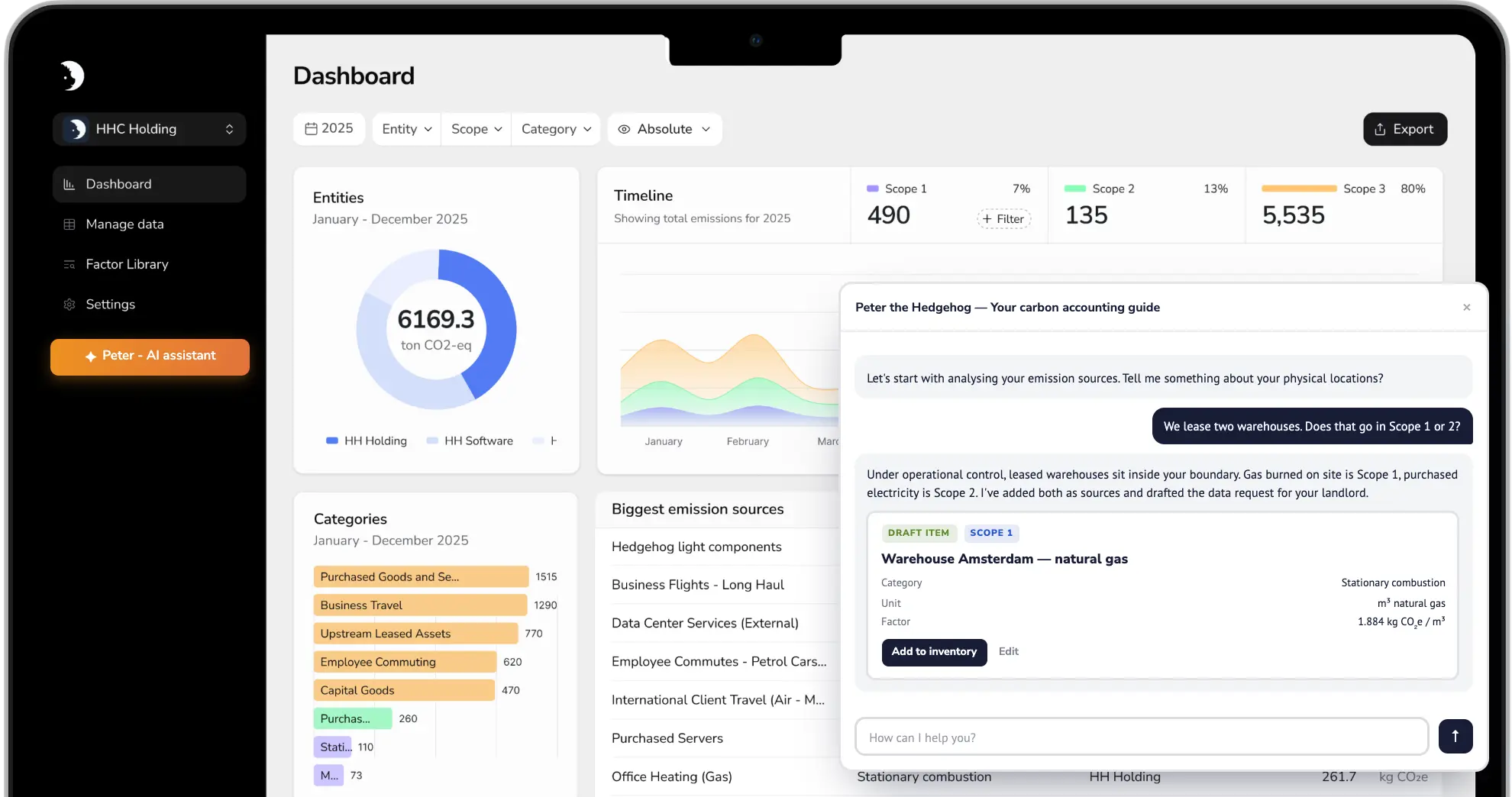
Most of the requests above want the same underlying thing: a defensible organisational greenhouse gas figure with a traceable route back to source data. The Hedgehog platform builds that inventory with an AI guide through setup and human greenhouse gas experts reachable in-app, and the platform page reports 5,000+ users. You can start a free account without a sales call and see a first number before deciding anything.
The limitation we publish alongside that: a Mid-Market reviewer on G2 in June 2026 rated the platform 3.5 out of 5 and said it is less complete as a broad ESG or CSRD reporting platform, with no data source management feature and no target monitoring. If the instrument you are answering is a full sustainability report rather than a carbon number, that is a fair caution, and CSRD consulting is the honest route.
Sources: COM(2022) 141 final, Regulation (EU) 2024/1781, Directive (EU) 2025/1892, Aanbestedingswet 2012 and national procurement guidance, the Hedgehog regulation fact base, and the Hedgehog platform page. Verified 28 August 2026.
Facts on this page were last verified on 2026-08-28.