
In short
- The pressure comes from customers, not from a regulator. Shippers need upstream transport emissions and ask their carriers.
- Fuel is nearly everything, which makes this one of the few sectors where scope 1 is the main event.
- Subcontracted haulage is the line that decides whether your number holds up.
In logistics the request does not come from a regulator, it comes from a customer. Shippers need upstream transport emissions for category 4 of their own scope 3 inventory, and they ask the carriers who move their freight, usually with a deadline attached to a contract renewal. Your emissions sit almost entirely in fuel, which makes this one of the few sectors where scope 1 is the main event rather than a footnote. So the tool has to turn fuel cards, telematics and subcontracted haulage invoices into one defensible annual figure, and then cut that figure by customer or by lane when somebody asks.
Who is actually asking, and what for?
Your customers. Shippers that report on their value chain need upstream transport and distribution emissions, and the only place that data exists is with the carriers doing the moving. That request lands on a fleet or operations director, not on a sustainability department, because in most logistics businesses there is no sustainability department.
Two things follow from that. First, the deadline is commercial. It attaches to a tender, a rate negotiation or an annual supplier review, so it moves faster than a reporting calendar would. Second, the answer has to be reusable. Ten customers will ask ten slightly different questions about the same trucks, and rebuilding the calculation for each one is the failure mode that eats a year.
If you employ 100 or more people in the Netherlands, you already have a Dutch reporting obligation of your own. The rapportageverplichting werkgebonden personenmobiliteit has applied since 1 July 2024 to any KvK-registered organisation with 100 or more employees on 1 January of the reporting year, and it is filed with RVO by 30 June for the year before. It asks for kilometres, not carbon: total commuting and business travel kilometres, split by travel mode and fuel type. The government converts them into CO2 itself, and there is no CO2 ceiling on an individual employer today.
Two things are worth knowing about it. The regional omgevingsdienst, not RVO, is the body that checks whether you filed. And the threshold is moving: the cabinet has approved a change to 250 employees with retroactive effect to 1 January 2026, which would make 2025 the last reporting year for anyone below 250. As of late August 2026 that change had not been published and was still with the Raad van State, so check the RVO page before you assume you are out of scope. The useful part for a carrier is that this is the same commuting and business travel data that scope 3 categories 6 and 7 need, so it is work you can do once.
If the requests are already arriving in spreadsheets, the value chain cap on ESG questions is worth reading, because a good deal of what gets asked is beyond what a customer can reasonably require.
Where do logistics emissions actually sit?
In fuel, and then a long way down to everything else.
That is unusual. In most sectors we write about, scope 3 purchased goods dominate and scope 1 is a rounding error. Here it inverts. Diesel, and increasingly electricity for depot charging, is the footprint. Depot energy, tyres, maintenance and the office matter for completeness but they will not change the shape of your number.
The complication is subcontracting. Freight you buy in from other hauliers is not your scope 1. It is your scope 3, and it is your customer's scope 3 too, which means it has to be counted and it has to be counted once. A carrier that runs sixty of its own trucks and buys in another forty loads a week has two different data problems in one inventory, and only one of them is solved by fuel cards.
Where does the data come from?
Better than in most sectors. You already hold nearly all of it, in systems built for costing rather than for carbon.
| Source | What it gives you | Effort | Quality |
|---|---|---|---|
| Fuel cards | Litres by vehicle and date, the core of scope 1 | Low, it is already an export | High |
| Telematics | Kilometres, load, idling, per vehicle | Low to medium | High |
| Tonne-kilometre data | The unit customers ask for | Medium, needs weight joined to distance | Medium to high |
| Subcontracted haulage invoices | The bought-in freight line | High, invoices rarely carry distance or weight | Low without supplier input |
| Depot energy meters | Buildings and charging | Low | High |
The lesson from the table is that the easy data is the big data. Fuel cards alone get you most of a credible scope 1 figure in an afternoon. The hard data is the subcontracted line, and that is where the effort should go once the easy part is done. Our guide to starting carbon accounting from scratch covers the sequencing.
What does a carrier's tool have to produce?
Four outputs, and the order matters.
An annual company footprint with fuel properly separated. Scope 1 by fuel type, scope 2 for depots and charging, scope 3 for bought-in freight. This is the base document everything else is cut from.
A per customer or per lane view. The shipper does not want your company total. It wants the share attributable to its own freight. If the platform cannot allocate, you will do that allocation in a spreadsheet every time, which defeats the purpose.
An intensity figure. Grams per tonne-kilometre is the language your customers negotiate in. Absolute tonnes tells them nothing about whether you are a good option compared with the carrier next door.
An audit trail. When a shipper's auditor queries a number, you need to get from the reported figure back to the fuel card line. Ask for that on a single record during a trial, not after you have signed.
What does Hedgehog do for a logistics business?
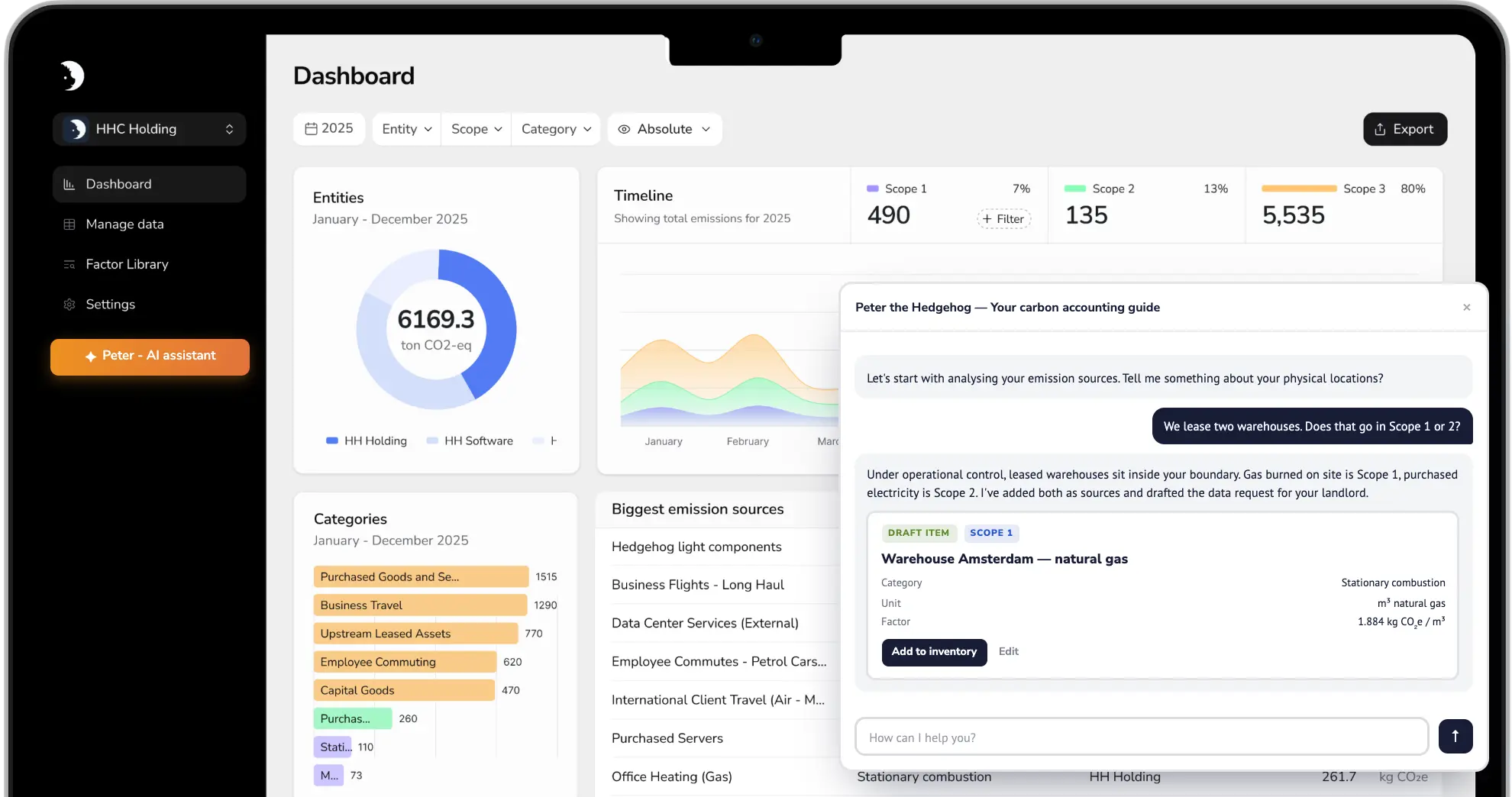
The platform guides you through GHG Protocol setup, data collection planning and inventory building, with an AI assistant for setup and human GHG experts reachable in the product. It holds more than 20,000 spend-based and activity-based factors and lets you add your own organisation-specific or supplier-specific CO2 data, which is how a subcontractor's real figure replaces a generic one. Entity management covers multiple depots and operating companies, with user roles for data owners, auditors and managers. Reporting outputs include the GHG Protocol, PPN 006 and the CO2-Prestatieladder. It is rated 4.7 on G2 from 9 reviews. There is a free account with no sales call, and Pro starts at EUR 1,200 a year.
Three limits worth knowing before you decide, all of them from our own customers.
Loading the data is the work. A reviewer on G2, small business segment, said in August 2026 that once the data is in everything works perfectly and getting it loaded is the challenging part. For a carrier with several fuel card providers and a stack of subcontractor invoices, that is the honest shape of the first month.
Few integrations today. A reviewer on G2, mid-market segment, named more integrations with other software as the thing they would change, in June 2026. If your plan is a live feed from a telematics platform or a transport management system, test that specifically rather than assuming it.
Product footprints are a service, not a platform feature. If a customer wants a footprint for one shipment or one product moved through your network rather than for your company, that is consultancy work. The platform does the organisational footprint. You can buy both from us, and you should know which one you are being asked for.
What should you do first?
Export twelve months of fuel card data. That single file gets you most of a scope 1 figure, and it will tell you within a day whether your vehicle references are clean enough to allocate anything by customer later.
Then count your subcontracted loads as a share of turnover. If bought-in haulage is a serious part of your business, that is your real project, and it is a supplier engagement exercise rather than a software exercise. Scope 3 support is where that conversation goes.
You can start a free account and get a first fuel-based number without speaking to anybody, which is the cheapest way to find out how much the rest will cost you in time.
Sources: Hedgehog platform, Hedgehog on G2, Hedgehog industry fact base. Rapportageverplichting werkgebonden personenmobiliteit verified against RVO and Stb. 2023, 472 on 28 August 2026, including the pending threshold change that was not yet in force on that date. Other facts verified 27 August 2026.
Facts on this page were last verified on 2026-09-17.