
In short
- Evergreen is a voluntary self-assessment that returns one of four maturity levels, not a pass or fail. The carbon reduction plan you need to bid is a separate requirement.
- April 2027 moves the boundary from UK-only to global and from a scope 3 subset to every relevant scope 3 category.
- Purchased goods and services is the category that decides your number, and it has the longest data lead time.
The Evergreen Sustainable Supplier Assessment returns a maturity level rather than a pass or a fail, and separately, from April 2027 the NHS requires a Carbon Reduction Plan covering global emissions and every relevant scope 3 category. That is a bigger data exercise than the plan most NHS suppliers already publish. If you are choosing software for it, the thing to test is whether the tool can hold a global boundary and an inventory of every relevant scope 3 category steady across annual cycles, because your figures are compared year on year.
What is Evergreen asking for, and how is it different from PPN 006?
PPN 006 is a gate. You have a compliant published Carbon Reduction Plan or you cannot bid. Evergreen is an online self-assessment that places you at one of four maturity levels. NHS England says it was not designed as a scored procurement requirement, though it is mandatory for NHS Supply Chain Frameworks and NHS England Medicines tenders. A higher level shows readiness and helps the relationship; it does not score you points in a bid.
Since April 2023, new NHS contracts above GBP 5 million a year have required a Carbon Reduction Plan covering UK scope 1 and 2 plus the PPN 006 subset of scope 3. Most suppliers built to exactly that. From April 2027, suppliers must publicly report targets and emissions and publish a Carbon Reduction Plan addressing global emissions across scope 1, 2 and 3, aligned to the NHS net zero target.
| Requirement | Current position | From April 2027 |
|---|---|---|
| Geography | UK operations | Global operations |
| Scope 3 | Five named categories | All relevant categories, with an explanation for each one deemed not relevant |
| Targets | Disclosed in the plan | Publicly reported and aligned to the NHS trajectory |
| Outcome | Eligible to bid | Eligible to bid; your Evergreen level is separate and renewed each year |
We set out the requirement itself in NHS Evergreen: what suppliers must provide from April 2027. This page is about what it means for the tool.
Which part of this is actually a software problem?
Three of the four rows above are.
The global boundary. Your existing plan covers UK entities. The 2027 plan covers everything. That means the tool has to hold multiple legal entities, sites in more than one country and more than one currency, and produce both a consolidated figure and a per-entity breakdown you can defend.
Every relevant scope 3 category. The PPN subset excludes purchased goods and services, which for most product suppliers is the largest category by a distance. Suppliers routinely find that the category they have never calculated is several times larger than everything they have been reporting. Adding it means spend data, supplier data, or both, and a factor library that covers the categories you buy in.
The annual series. NHS England recommends completing Evergreen every year, and a maturity level is valid for twelve months. You want your figures to show improvement, and that only reads as improvement if the method stayed the same. A tool that quietly changes emission factors between years, or that cannot restate a prior year while keeping the original on file, will make a genuine reduction look like a methodology change.
The fourth row, target alignment, is a decision rather than a calculation. Software helps you evidence it, not make it.
What should you test before you buy?
Ask for these five things in a trial or a demo, with your own data.
Can it consolidate entities in more than one country? Not in theory. Load two entities in different currencies and check the consolidated total and the per-entity split.
Can it take scope 3 in stages? You will start with spend-based estimates for purchased goods and services and replace them with supplier data over time. The tool has to let you swap the method for one category without rebuilding the inventory.
What happens when factors update? Ask directly whether you can restate a prior year and still keep the original as published. If the answer is vague, your year two comparison is at risk.
Can it show its working? Your plan is published and your Evergreen level is shared with the NHS, so you want to trace an input file through to a reported figure. Ask to see the factor and the conversion behind a single entry.
Can it export to an arbitrary template? The CRP is a published document and the assessment is an online form. Getting numbers out in whatever shape is asked for is a real requirement, not a nice extra.
Why does the timeline matter more than it looks?
April 2027 sounds distant. Working backwards from supplier data, it is not.
Primary data from your own suppliers takes months, depends on companies with no obligation to help you, and cannot be compressed by adding effort at your end. Spend-based estimates are defensible and quick, but they produce a less flattering number and a weaker maturity position than primary data does.
So the practical sequence is: set the global boundary and get a complete spend-based scope 3 number early, then replace the biggest categories with supplier data through 2026 and into 2027. That order gives you a usable figure at every point, which a supplier who waits for perfect data does not have.
If you already hold a PPN 006 plan, the gap is specific and it is two items: geography and purchased goods and services. Both are data problems rather than analysis problems, which is exactly why they take calendar time. The baseline obligation is covered in the PPN 006 checklist.
What does Hedgehog do here?
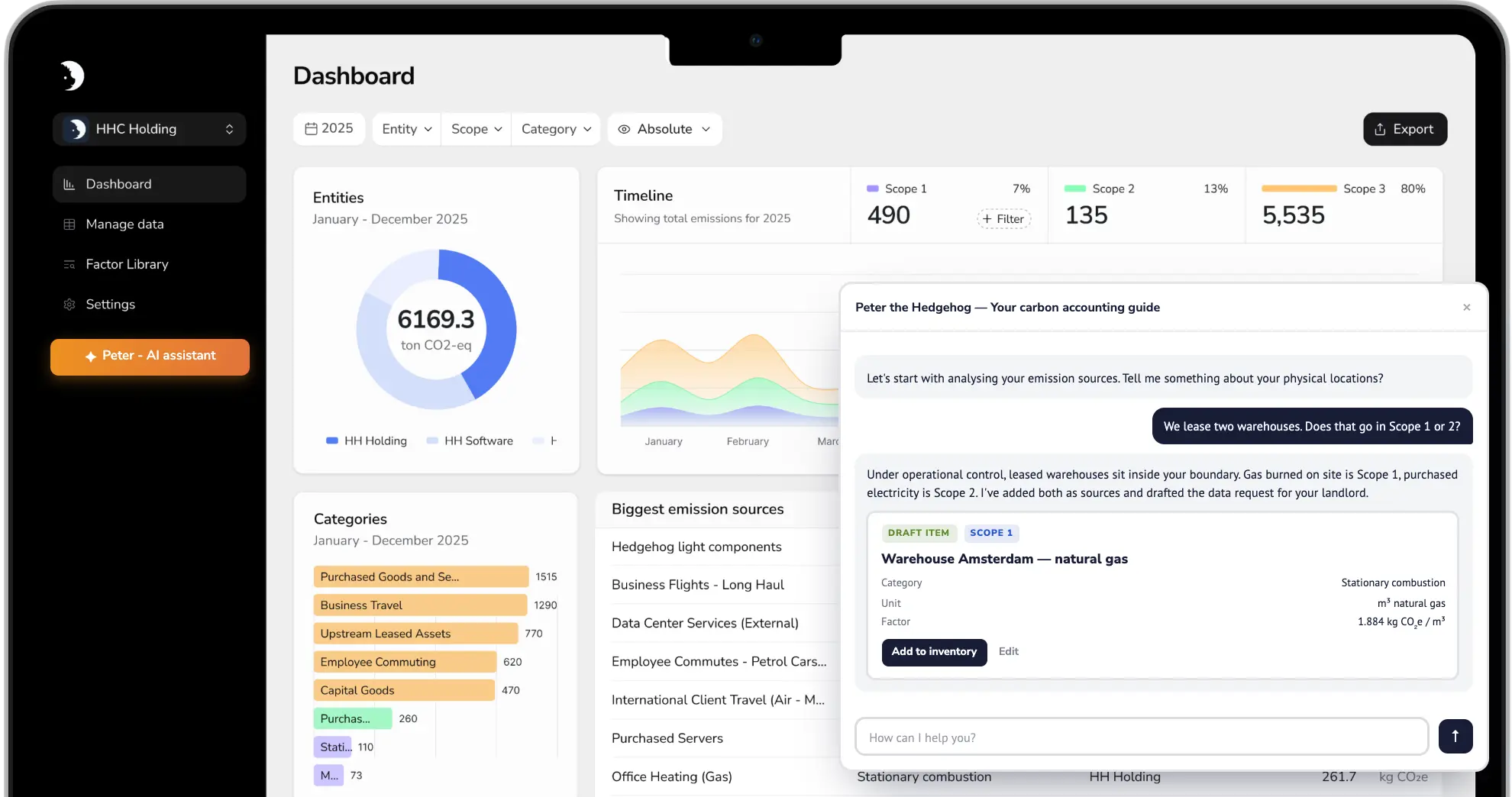
The platform builds a GHG Protocol inventory with an AI guide through setup, data upload and reporting, and human GHG experts reachable in the product. It handles entity management across locations and sites, with user roles for data owners, auditors and managers, which is the shape a multi-country supplier needs. The factor library covers over 20,000 spend-based and activity-based factors, and you can add organisation-specific or supplier-specific data as it arrives, which is how the spend-to-primary transition above is meant to work.
Reporting output covers the GHG Protocol, PPN 006 and the CO2-Prestatieladder.
Two limits worth stating plainly.
Loading data is the work. A customer said so on G2 in August 2026: once the data is loaded everything works, and getting it loaded is the challenging part. That is true of every tool in this market and it is the line most often underestimated in an Evergreen plan.
We do not write the whole assessment. Evergreen spans more than carbon. The platform covers the emissions calculation and the reporting output. For the plan document, the boundary decisions and the target trajectory, that is carbon footprint consulting and scope 3 consulting work.
What should you do first?
Set the global boundary. It costs a day, it is the input to everything else, and getting it wrong means restating later in a document that is published.
Then get a complete scope 3 number, however rough, so you know which two or three categories decide your footprint. Effort belongs where the emissions are, and a well-argued materiality assessment is itself evidence of maturity.
You can do both on a free account without a sales call, and find out how bad your data is before you commit a budget.
Sources: NHS England Evergreen sustainable supplier assessment, NHS Net Zero Supplier Roadmap, UK Procurement Policy Note 006, GHG Protocol Corporate Value Chain (Scope 3) Standard, Hedgehog platform, Hedgehog on G2. Verified 27 August 2026.
Facts on this page were last verified on 2026-08-27.