
In short
- PPN 006 is a pass or fail check. At each tender the plan must have been signed off and published in the previous 12 months, and the Technical Standard says to refresh it within six months of your financial year-end.
- The government template is free and fine. The work is the calculation behind it, and repeating it every year.
- Set the baseline year carefully. It anchors every refresh you will ever publish.
PPN 006 needs a published Carbon Reduction Plan before you can bid for a UK central government contract above GBP 5 million a year including VAT, and you have to redo that plan every year because it is only valid for twelve months. The document itself is short and the template is free. What software is for is the calculation behind it and the fact that you have to do it again next year, on the same basis, or the comparison in the plan stops meaning anything.
What does the plan actually need, and which parts need a tool?
A compliant plan is a short public document with prescribed contents: a commitment to net zero by 2050 for your UK operations, current emissions for the year, a baseline year on the same basis, reduction targets, the carbon reduction projects implemented and planned, confirmation that the GHG Protocol and the published reporting standard were used, and a statement of board approval with its date, signed off by a director.
Only some of that is a software job.
| Element of the plan | What it needs |
|---|---|
| Net zero commitment | A board decision, not a calculation |
| Current year emissions | Scope 1, scope 2 and five scope 3 categories, calculated |
| Baseline year | The same categories on the same basis, held stable |
| Targets and trajectory | A decision, evidenced by the baseline |
| Reduction projects | Your own operational record |
| Standard used | The method the tool applies, stated |
| Board approval, director sign-off and publication | A document and a web page |
The scope 3 subset is the part that bites: business travel, employee commuting, upstream transportation and distribution, waste generated in operations, and downstream transportation and distribution. The full requirement is set out in the PPN 006 checklist for UK suppliers.
Do you need software at all, or is the free template enough?
The template is free and it is genuinely fine. It is a form. Nobody buys software to fill in a form.
What people buy software for is the four things the template does not do.
It does not calculate. Upstream transportation and distribution looks modest until you try to work it out from carrier data, and the first attempt usually uses proxies that do not survive scrutiny.
It does not remember. A plan is a snapshot. The refresh next year needs the same boundary, the same categories and the same method, or your year-on-year comparison is a methodology change dressed as a reduction.
It does not survive staff turnover. When a plan is treated as a bid artefact, the method lives in one person's spreadsheet. When they leave, the next refresh starts from scratch.
It does not tell you when it is too old. Suppliers commonly publish a plan to win one contract and discover eighteen months later that it is too old for the next tender notice.
If you bid once and never again, the template and a careful spreadsheet will do. If you bid regularly, you are running an annual reporting routine and should build it as one.
What is the refresh cycle really like?
It is more predictable than it feels. Recalculate after your financial year closes, refresh the plan, get approval and sign-off, republish. The Technical Standard says to do this within six months of your financial year-end. Companies with a 31 March or a 31 December year end cluster into two waves, which means the people who help with these are busiest in exactly those two windows.
Three things go wrong often enough to plan around.
The baseline is set carelessly. Whatever year you choose anchors every future plan. Set it with an incomplete boundary and every refresh either carries the error forward or needs a restatement that reads as a correction.
Scope 3 is estimated once and never improved. Improving a proxy later changes the comparison against the baseline. Better to spend the extra week on it in year one.
The plan is refreshed late. The plan has to state the date of board approval, and boards meet on their own calendar, which is easy to forget until it blocks publication.
What should you test in a tool before you buy it?
Five questions, in the order they will cost you.
Can it produce the five PPN scope 3 categories from data you actually hold? Fuel cards, expenses, carrier invoices, waste transfer notes. Not from data you would need to start collecting.
Can it keep a baseline year fixed? Ask what happens to a published baseline when the factor library updates, and whether you can hold the original while restating alongside it.
Can you trace an entry back to its factor? A published plan invites scrutiny. Being able to show how an input file became a reported figure is what makes the number defensible.
Can it export into your own document? The plan is published on your website in your format. Getting the numbers out cleanly matters more than a pretty in-app dashboard.
What does year two cost? This is an annual obligation. A first-year price that resets changes the real cost of the whole thing.
Is PPN 006 the end of it?
No, and this is worth knowing before you buy for the minimum.
The requirement is the floor. From April 2027, NHS suppliers must publicly report targets and emissions and publish a Carbon Reduction Plan addressing global emissions rather than UK-only, and every relevant scope 3 category rather than the PPN subset of five. We cover that in NHS Evergreen.
If you sell to the NHS, buying a tool that only does the PPN subset means doing this exercise twice. The cheaper path is to build the measurement capability once, on a boundary that can widen.
What does Hedgehog do for PPN 006?
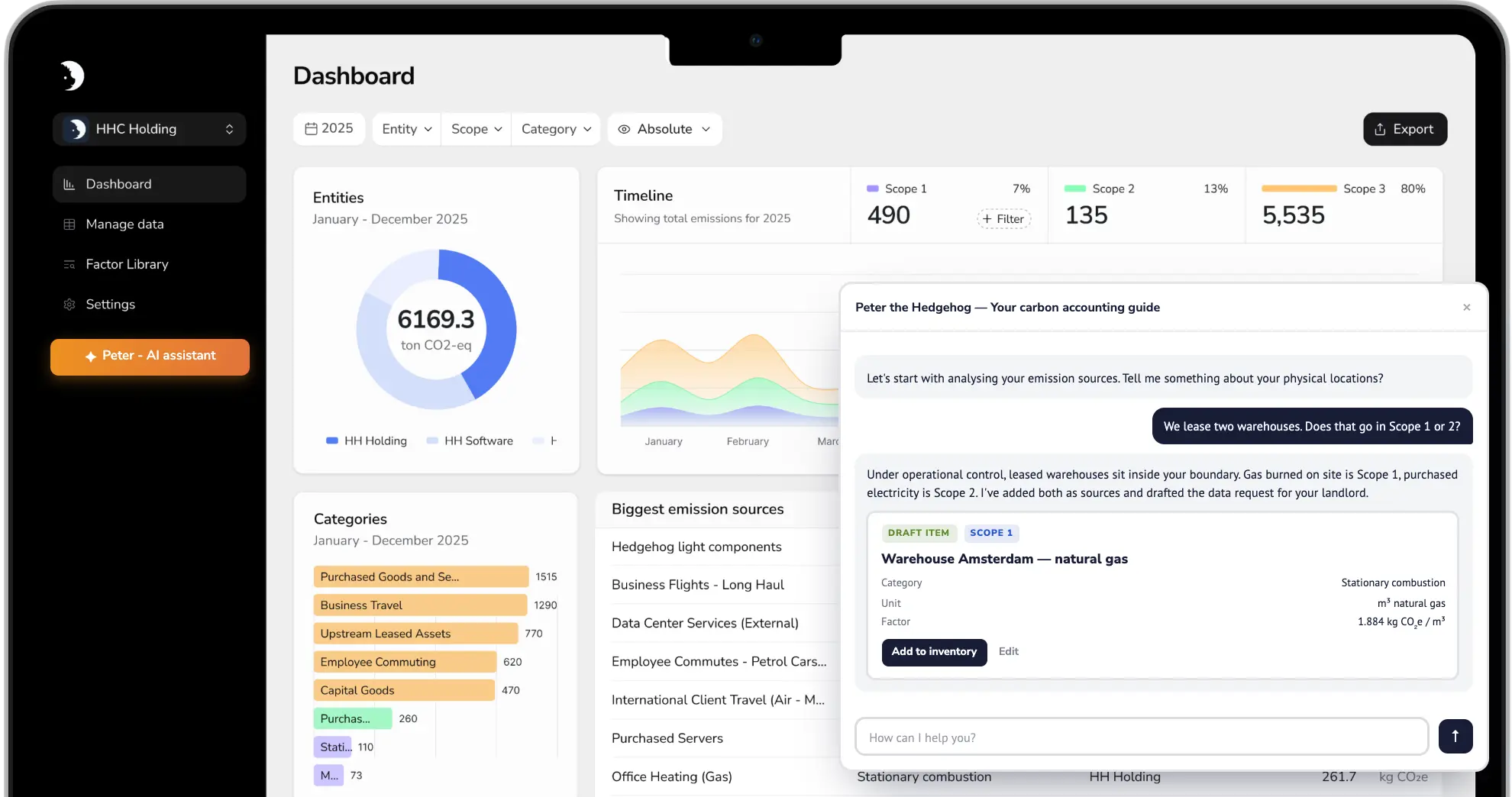
The platform names PPN 006 as a reporting output alongside the GHG Protocol and the CO2-Prestatieladder. It guides you through GHG Protocol setup, a data collection plan and inventory building with an AI guide, with human GHG experts reachable in the product. It covers over 20,000 spend-based and activity-based factors, supports entity management across locations and sites with roles for data owners, auditors and managers, and lets you add your own organisation-specific or supplier-specific data.
Free account, no sales call. Pro from EUR 1,200 per year.
Two honest limits.
Getting the data in is the slow part. A customer said exactly that on G2 in August 2026: once the data is loaded everything works perfectly, and getting it loaded is the challenging part. Budget for it. It is the single most underestimated line in a first Carbon Reduction Plan.
The platform does the numbers, not the narrative. The commitment, the trajectory and the reduction projects are yours to decide and write. Where you want that done with you, it is carbon footprint consulting work rather than a subscription.
What should you do first?
If a tender is live and you have no plan, the constraint is data availability, not analysis. Get scope 1 and 2 done first, because they are fast, and be realistic about which scope 3 categories you can evidence before the deadline.
If nothing is live yet, this is the good moment. Set the baseline properly, calculate it once, and put the refresh in the calendar for the month after your year end.
You can build a first inventory on a free account and see what your data actually supports before you commit to anything.
Sources: UK Cabinet Office Procurement Policy Note 006 (formerly PPN 06/21), Procurement Act 2023, GHG Protocol Corporate Standard, NHS England Evergreen sustainable supplier assessment, Hedgehog platform, Hedgehog on G2. Verified 27 August 2026.
Facts on this page were last verified on 2026-08-27.