In short
- The live trigger for converters is customer requests for product-level declarations, not a reporting deadline.
- Material choice dominates the footprint and recycled content is the main lever.
- A company footprint and an EPD are different deliverables. Read the request before you buy anything.
In packaging the request that actually arrives is a customer asking for a product-level declaration, not a regulator asking for a company report. Buyers increasingly want an EPD or a comparable figure per pack, per format or per thousand units, and they want it during a specification decision rather than at year end. Your emissions sit overwhelmingly in the material you buy, by polymer or by grade, with converting energy and transport behind it. Recycled content is the main lever you have. So the software has to hold material purchases at grade level and evidence what any claim about them is based on.
What is actually forcing this, and when?
Customer requests for product-level declarations, on the buyer's timetable rather than a legislative one.
The Packaging and Packaging Waste Regulation, Regulation (EU) 2025/40, has applied across the EU since 12 August 2026. It binds by role in the chain rather than by company size, so a small converter is in scope of the product requirements. What actually started on that date is narrower than the coverage suggests: PFAS limits in food-contact packaging, heavy metal limits, and a restriction on environmental claims about packaging properties the regulation covers. The requirements most converters are being asked about, recyclability grading, minimum recycled content, packaging minimisation and reuse targets, apply from 2030, and harmonised labelling from 2028. If you have been told empty space in parcels is capped at 40 percent from this year, that is wrong twice over: the cap is 50 percent, and it applies from 2030 at the earliest.
Article 14 matters for the claims point below. A claim about a packaging property that PPWR regulates can only be made where the packaging exceeds the minimum requirement, and the substantiation has to sit in your technical documentation.
What is verified, and what is already on desks, is the EPD request. A brand owner comparing two suppliers on the same specification wants a number for each. The converter who can produce one gets specified, and the one who cannot is asked again in six months.
There is a second thing to be careful about, and it reaches you indirectly. Environmental claims made to consumers are in scope from 27 September 2026. Most converters sell to brands rather than to shoppers, so the claim on the shelf is usually the brand's to defend, not yours. What that means in practice is that the brand needs substantiation from you before it will put recycled content, recyclability or a lower-carbon alternative on a pack. The obligation sits with your customer and the evidence request lands on your desk. Our claims checklist sets out what substantiation has to look like.
Why does the customer want a product number instead of a company number?
Because they are making a specification decision, and a company total cannot inform one.
| Aspect | Company footprint | Product footprint or EPD |
|---|---|---|
| Question it answers | What did this business emit in a year | What does one unit of this pack carry |
| Who asks | Procurement, tenders, questionnaires | Product managers and brand owners choosing a specification |
| What it needs | Ledger, energy, fleet | Bill of materials, mass, process data, allocation rules |
| How it is produced | Carbon accounting platform | An LCA study, usually reviewed |
| How often it changes | Annually | Whenever the specification changes |
Both are legitimate and most converters end up needing both. The mistake is buying one when the request on your desk is the other, which happens in this sector more than in any other we write for.
Where do packaging emissions actually sit?
In material choice, first and by a distance. Converting energy and transport are real but they are not the story.
That has a hard commercial consequence. If material dominates, your footprint is largely determined by what you buy and by what your customer specifies, which means most of your reduction options are also purchasing decisions rather than operational ones. Recycled content is the main lever available, which is why every conversation in this industry ends up there.
It also means a spend-based calculation is not good enough for long. Two grades of the same polymer at the same price per tonne can differ materially in carbon, and a spend-based method will show them as identical. Moving to mass by grade is the step that makes the numbers usable.
Where does the data come from?
Three sources, and you already hold two of them.
Material purchase data by polymer or grade. The core dataset. It exists in purchasing, usually in tonnes as well as euros, which is a better starting point than most industries have. The work is mapping grades consistently rather than finding the data.
Converting energy. Meters at the plant, and if you can split by line or by process you are ahead of most.
Transport. Inbound material and outbound distribution, from freight invoices.
The gap is supplier-specific material data. A generic factor for a polymer grade is a starting point. A real figure from the resin or board supplier is what makes a comparison between two of your own specifications meaningful, and getting it is a procurement conversation, not a software feature.
What does the software have to produce?
Four outputs, in the order a converter needs them.
An organisational footprint. Scope 1, 2 and 3 for the business. This is what tenders and customer questionnaires ask for, and it is the foundation for everything else.
Material data at grade level with supplier-specific overrides. You need to record what a specific supplier's grade actually carries, not what an average of that material type carries.
Traceability to source. When a customer asks how a figure was derived, the route from reported number to purchase record has to exist.
Evidence for any claim you make. If a specification is presented as the lower-carbon option, the file behind that statement is what matters when it is questioned.
What does Hedgehog do for a packaging business?
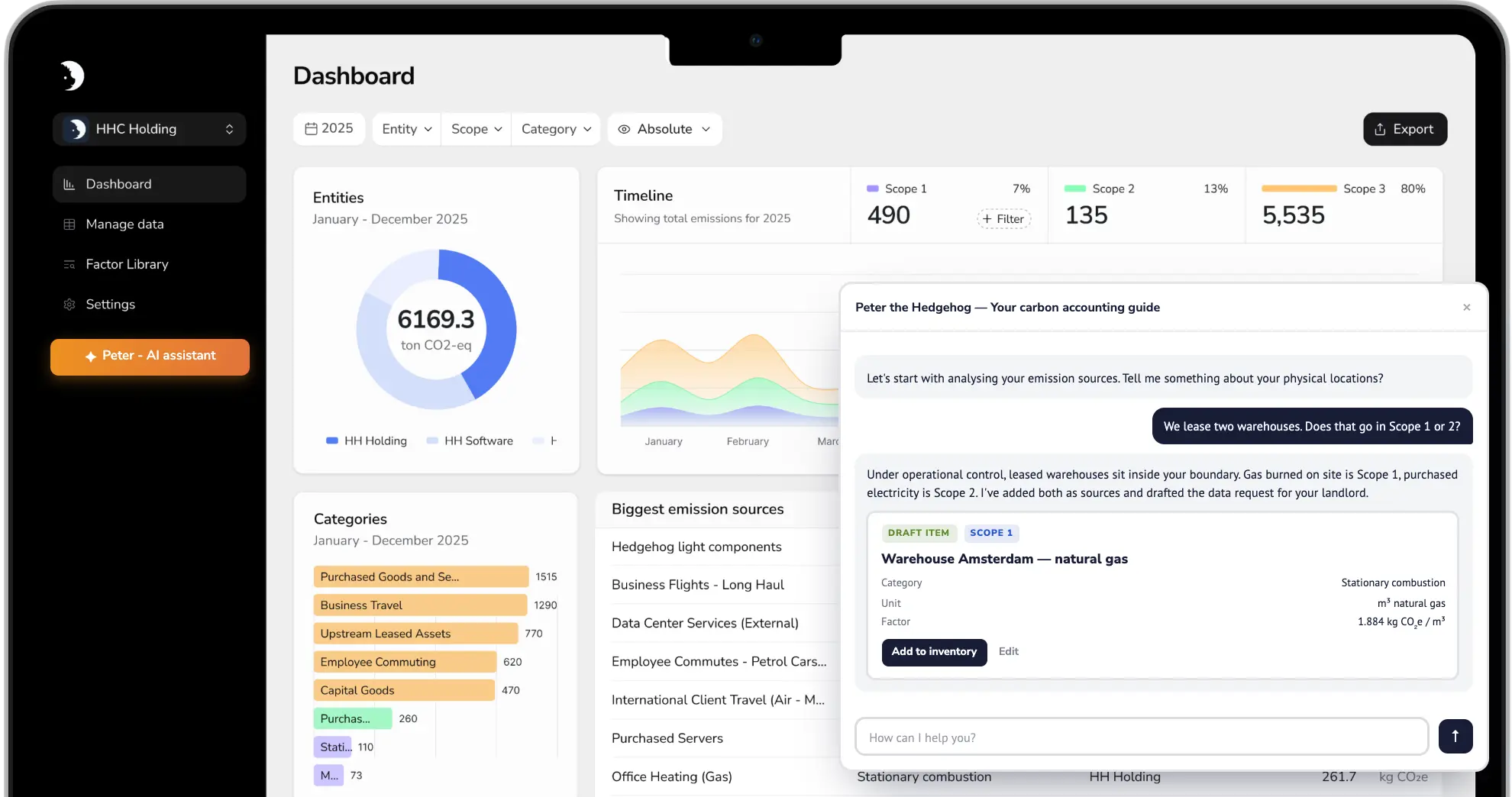
The platform guides you through GHG Protocol setup, data collection planning and inventory building, with an AI assistant for setup and human GHG experts reachable in the product. It carries more than 20,000 spend-based and activity-based factors and lets you add organisation-specific or supplier-specific CO2 data, which is how a resin supplier's real figure replaces a generic grade average. Multi-entity management covers several plants, with roles for data owners, auditors and managers. It is rated 4.7 on G2 from 9 reviews. Free account with no sales call, Pro from EUR 1,200 a year.
Two limits, stated plainly, because in this sector one of them decides the purchase.
Product footprints are a service, not a platform feature. LCA, EPD, MKI and PCF work is delivered as consultancy. The platform does organisational footprints. If the request from your customer is a declaration per pack, that is the service, and you should buy it as one. If it is a company figure for a questionnaire, the platform is the right tool. Plenty of converters need both, and knowing which is which before you sign is the point.
Loading the data takes real effort. A reviewer on G2, small business segment, said in August 2026 that once the data is in everything works perfectly and getting it loaded is the challenging part. For a converter with hundreds of grades across several plants, that is an honest description of the first month.
What should you do first?
Read the request literally. If a customer has asked for an EPD, a company footprint will not satisfy it, however good the number is. If they have sent a supplier questionnaire, an EPD is expensive over-delivery. The value chain cap on ESG questions is useful for judging what a customer can reasonably require of you.
Then export twelve months of material purchases in tonnes by grade. That single file is the whole basis of a packaging footprint, and how clean it is decides how long the project takes.
You can start a free account and build the company figure from energy and purchases without a sales call, or talk to us about a footprint engagement if a customer deadline is already fixed.
Sources: Hedgehog platform, Hedgehog on G2, Hedgehog industry fact base, verified 27 August 2026. PPWR and EmpCo dates and figures verified against the Official Journal texts on 28 August 2026.
Facts on this page were last verified on 2026-09-17.