In short
- Two triggers: corporate customers asking for data, and printed environmental claims falling in scope from 27 September 2026.
- Paper and substrate purchases dominate. Press energy is secondary and it is the part most printers measure first.
- If you print a climate statement on a job, the substantiation behind it is now part of the product.
Printing has two triggers and they arrive from different directions. Corporate customers ask for carbon data as part of their own supplier reporting, and environmental claims fall in scope from 27 September 2026, which covers the statement printed on the back of the job as well as the one on your website. Your emissions sit in paper and substrate purchases, which dominate, with press energy a clear second. So the software has to build a footprint from paper purchases by grade rather than from meter readings, and it has to leave an evidence trail behind whatever you or your customer print about it.
Which rules actually apply to a printer, and when?
Two, and only one of them has a date.
Customer data requests, continuously. Corporate customers request emissions data from their print suppliers because they are assembling their own value chain figures. This arrives as a questionnaire attached to a framework agreement or a rate card renewal, and the practical deadline is commercial.
Environmental claims, from 27 September 2026. Printed environmental claims are in scope. That matters more in this trade than in most, because printers do not only make claims about themselves, they manufacture other people's claims. A climate statement, a logo or a line of copy printed on a job is a claim in the physical world with your name in the colophon. Our claims checklist covers what substantiation now has to look like.
The two triggers want different things. The customer request wants a company footprint in a format they can slot into their own reporting. The claims rule wants a file that stands behind a specific statement. A printer needs both, and they are not the same document.
Where do printing emissions actually sit?
In paper and substrate, and it is not close.
Press energy is the part most printers measure first, because it is on a bill and it feels like the visible industrial part of the operation. It is secondary. The paper coming in on pallets carries most of the footprint, and it sits in your purchase records as reams and tonnes against a grade and a merchant, with no carbon attached to any of it.
That inversion is worth sitting with, because it changes what a reduction programme looks like. A more efficient press is an operational project with a modest carbon return. A grade change, a lighter stock, or a merchant with real data behind their product moves the number far more, and it is a purchasing decision.
Ink and consumables sit behind both. They are needed for completeness and they are rarely material.
Where does the data come from?
Three places. The ranking by effort is almost the exact inverse of the ranking by importance.
| Source | Share of the footprint | Where it lives | Effort |
|---|---|---|---|
| Paper and substrate purchases | Dominant | Purchase ledger and merchant statements, by grade | Medium, grades need mapping to factors |
| Press energy | Secondary | Utility bills and sub-meters | Low |
| Ink and consumables | Small | Purchasing | Low to medium |
Most printers do the two cheap rows in a week and then discover that they have accounted for the smaller part of the answer. The paper mapping is the project. It is also the row that turns into commercial value later, because a footprint expressed per grade is the only version that lets you answer what a customer's specific job costs in carbon.
What can you actually claim on the back of a job?
Only what you can evidence, and the bar rose on 27 September 2026.
That has three practical consequences for a printing business. First, a claim about a printed product is a claim about a specific job on a specific stock, so a company-wide average will not substantiate it. Second, your customer's claim, printed by you, is your production but their statement, and the two of you should be clear in writing about who holds the substantiation. Third, vague wording is the exposure. A specific, sourced, checkable statement is safer than a warm general one.
None of this makes claims impossible. It makes unsupported ones expensive.
What does the software have to produce?
Four things, in the order they will be asked for.
A company footprint in a shareable format. Scope 1, 2 and the scope 3 categories that matter, mainly purchased goods. This is the answer to the customer questionnaire.
Paper recorded by grade, with supplier-specific data where you have it. Generic grade factors are a legitimate start. A real figure from the mill or merchant is what makes any comparison between two stocks meaningful.
Traceability from a reported figure back to a purchase record. Required both by customers who check and by any claim you attach to a job.
A repeatable annual method. Printing customers ask every year, and the second year is worth far more when it is comparable to the first.
If you are starting from nothing, our beginners guide to carbon accounting covers the sequencing, and choosing the right software covers the selection criteria for a business of this size.
What does Hedgehog do for a printing business?
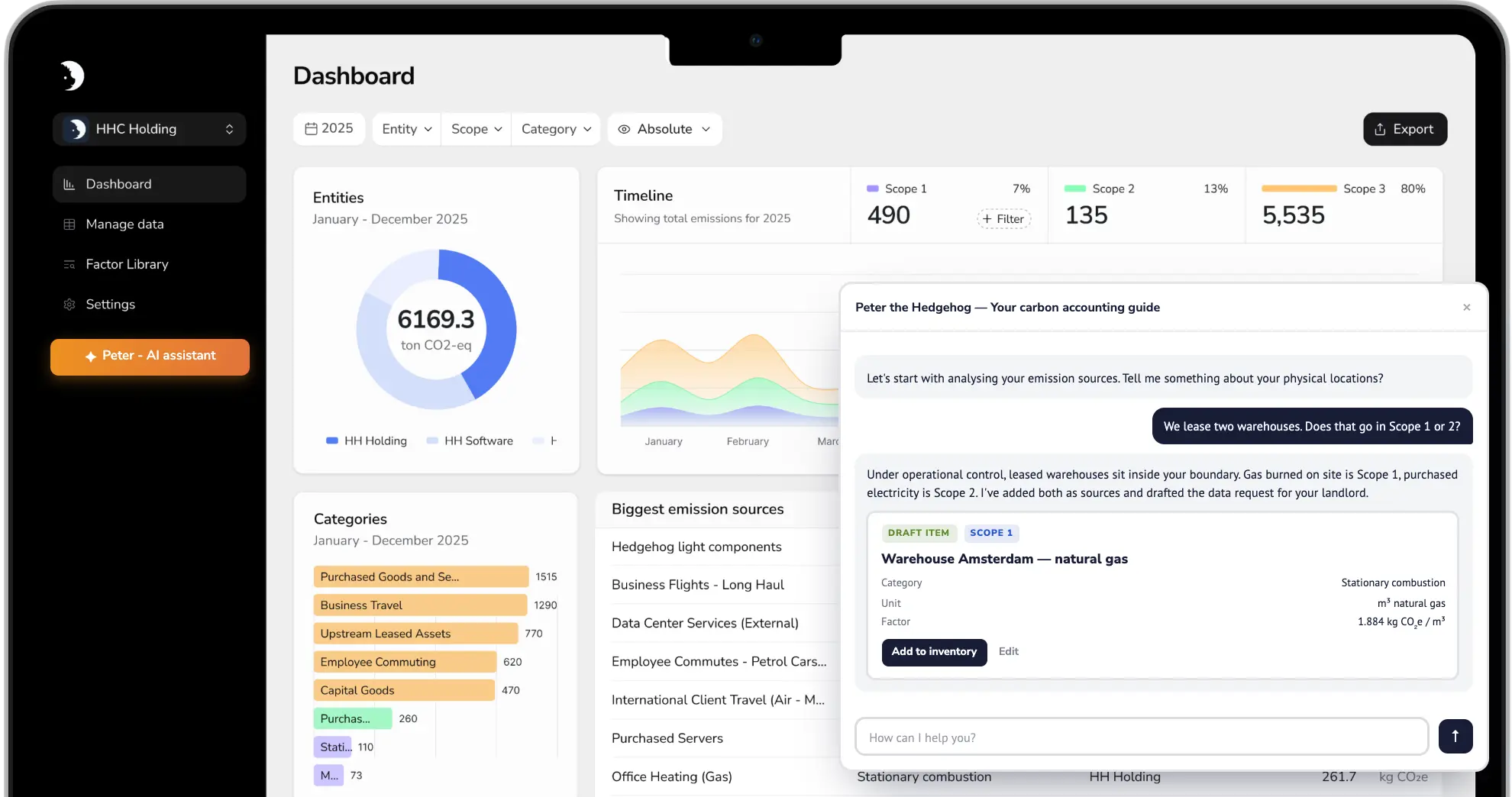
The platform guides you through GHG Protocol setup, data collection planning and inventory building, with an AI assistant for setup and human GHG experts reachable in the product. It carries more than 20,000 spend-based and activity-based factors and lets you add your own organisation-specific or supplier-specific CO2 data, which is the mechanism for putting a merchant's real figure against a grade. It works in English, French and Dutch, which matters for a Dutch or Belgian printer answering requests in more than one language. It is rated 4.7 on G2 from 9 reviews. Free account with no sales call, Pro from EUR 1,200 a year.
Three limits worth knowing. The first two come from paying customers in public G2 reviews.
Loading the data takes real effort. A reviewer on G2, small business segment, said in August 2026 that once the data is in everything works perfectly and getting it loaded is the challenging part. For a printer, that means the paper ledger, and it is a fair description of the first few weeks.
No forecasting. A reviewer on G2, small business segment, said in August 2026 that forecasting would be welcome and that we had told them it is on the development list. If you want to model a stock change before you make it, ask about that directly.
Product footprints are a service. A carbon figure for one job, one stock or one product is consultancy work, not a platform feature. The platform does organisational footprints. Owner-managers in this trade often need both, and buying the right one first saves money.
What should you do first?
Pull twelve months of paper purchases in tonnes by grade. Not in euros. That one export is the whole basis of a printing footprint, and how clean it is decides whether this is a two-week job or a two-month one.
Then look at every environmental statement your business currently prints or publishes, including the ones on job tickets and in tender responses, and ask what file sits behind each. That review usually takes an afternoon and it is the cheapest risk reduction available to a printing business right now.
You can start a free account and get a first figure from energy and paper without a sales call, or talk to us about a footprint engagement if a customer has already set the date.
Sources: Hedgehog platform, Hedgehog on G2, Hedgehog industry fact base. Verified 27 August 2026. The claims date is due for re-check before any refresh.
Facts on this page were last verified on 2026-09-17.