In short
- The pressure comes from customer inventories, not from a waste regulation.
- Customers want a per tonne, per stream, per treatment route figure, not your company total.
- Avoided emissions are not your reduction, and claiming otherwise is now a regulated statement.
The rule that bites a waste company is not a waste rule. It is your customers' greenhouse gas inventories: the waste you handle for them is their scope 3 category 5, so they ask you for figures on their reporting calendar, usually in the first quarter. Your own emissions sit in collection fleet, site energy and the treatment process itself. What the software has to produce is a defensible company total plus a split fine enough to answer per tonne, per stream and per treatment route, because that is the shape of the question your commercial team keeps receiving.
Which rule actually applies, and when?
Two, and neither of them is about waste.
Your customers' reporting obligations. Category 5 of the GHG Protocol covers waste generated in operations. Every customer building an inventory needs an emissions figure for the waste they hand you, broken down by what they gave you and what you did with it. They ask when they collect, which is annual and clustered early in the year. There is no penalty for not answering. There is a contract renewal.
EmpCo, the EU consumer-facing environmental claims directive. From 27 September 2026 it is in application, and the waste sector makes exactly the kind of claim it targets: a generic environmental claim (a recycling percentage, a circularity statement) that the trader cannot demonstrate recognised excellent environmental performance for is an unfair commercial practice in all circumstances. It does not create a general substantiate-on-request duty; it prohibits specific named practices. We set out what a defensible claim now looks like in the EmpCo claims checklist.
So the timeline is not a compliance deadline. It is a commercial one, and it has already started.
Where do waste management emissions actually sit?
Unusually for this market, a large share is scope 1. That changes the work, because scope 1 is measured rather than estimated and it cannot be improved by choosing a better emission factor.
| Source | Scope | Data you already hold | Difficulty |
|---|---|---|---|
| Collection and haulage fleet | 1 | Fuel cards, telematics, litres by depot | Low |
| Treatment process emissions | 1 | Tonnage by stream and treatment route | Medium |
| Site energy at transfer stations and plants | 2 | Meter reads and utility bills | Low |
| Subcontracted haulage and onward treatment | 3 | Subcontractor invoices | Medium |
| Purchased goods, services and capital equipment | 3 | Purchase ledger | Medium |
The line that generates the arguments is treatment. The same tonne of the same material has a very different footprint depending on whether it went to recycling, anaerobic digestion, incineration with energy recovery, or landfill. If your systems record tonnage by stream but not by route, that is the gap to close first, because it is the gap between a company number and a customer answer.
Why are avoided emissions a problem rather than a selling point?
Because they are somebody else's reduction, and because saying otherwise is now a regulated statement rather than a marketing choice.
The logic is seductive. You recover energy or produce recyclate, which displaces virgin production somewhere else, so a saving exists in the world. It genuinely does. What it is not is a deduction from your own inventory. Under the GHG Protocol, avoided emissions sit outside the scopes and are reported separately, if at all. Netting them against your scope 1 produces a company total that no customer's auditor will accept and that your competitors can attack.
The commercially safe treatment is three separate numbers, clearly labelled: your gross inventory by scope, the customer's category 5 figure for the waste they gave you, and any avoided emissions stated on their own, with the method and the counterfactual written down. That is more work than one impressive headline. It is also the version that survives a procurement challenge.
What must the software actually output?
Four outputs, and only the first is standard.
A gross inventory by scope for the company and per site. Multi-site is normal in this sector, and a group total that cannot be split by depot is not much use for management or for a customer serving one region.
A per tonne intensity by stream and treatment route. This is your product, in effect. Customers do not want your company total. They want the number that attaches to their contract.
A customer-ready extract. Different customers want different formats, and some send their own template. Test an export with a real customer workbook before you buy anything.
A claims audit trail. Whatever you publish about recycling rates or recovery should be traceable to the tonnage records behind it, held with the same discipline as the emissions data.
What data will you actually need, and where is it?
The good news for this sector is that the hard data mostly exists already, because it is operationally required.
Weighbridge records give you tonnage by stream. Route and disposal records give you treatment method. Fuel cards and telematics give you fleet. Meters give you sites. The purchase ledger gives you the scope 3 you are least likely to be asked about.
The work is not finding this. It is reconciling it, because these four systems were built by different people for different reasons and they rarely agree on a period end, a site name or a material category. That reconciliation is the project. Anybody who tells you otherwise has not done one.
If you would rather have the first year built with you rather than by you, that is what carbon footprint consultancy is for.
What does Hedgehog cover here, and what does it not?
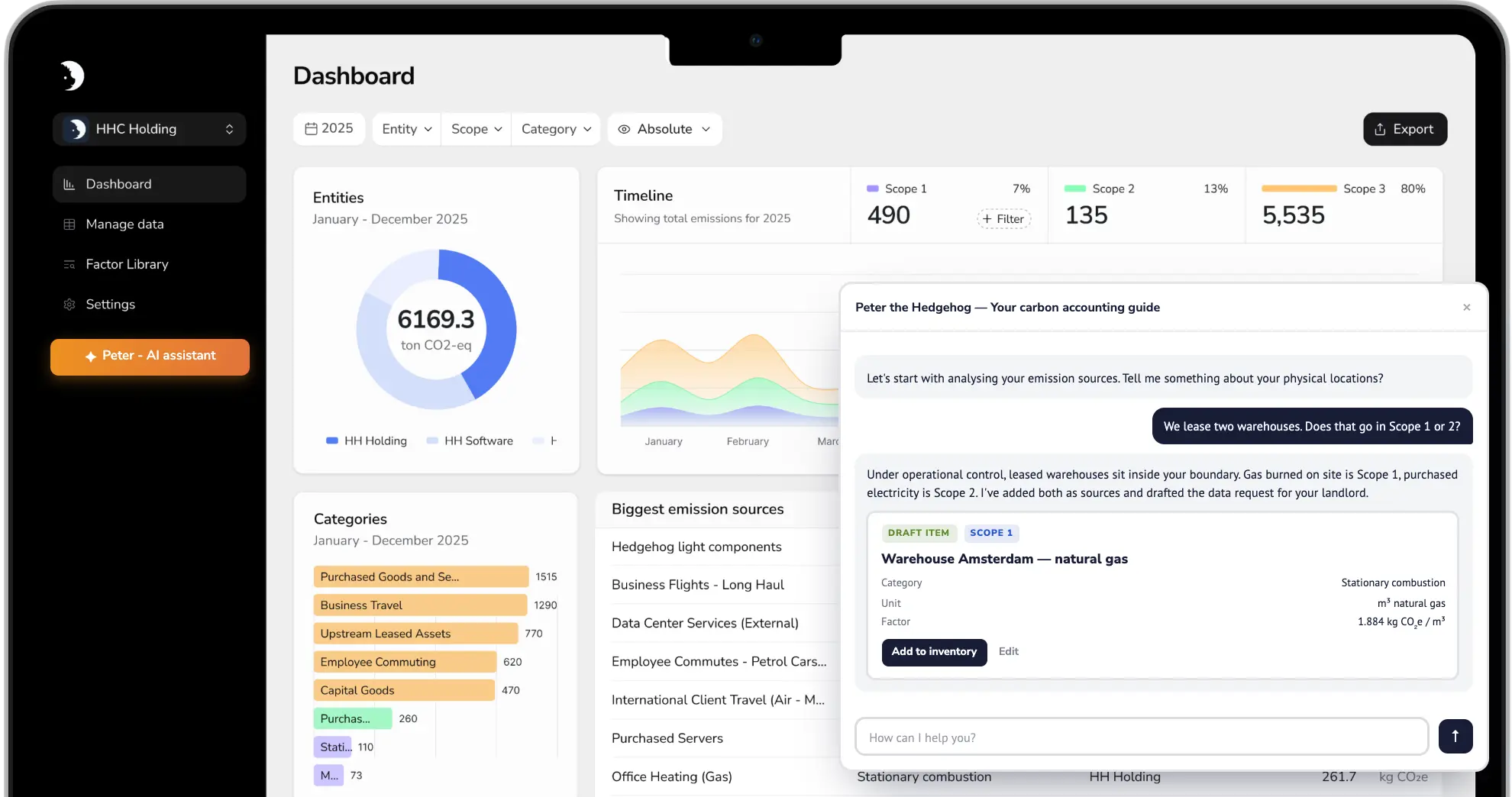
The platform guides you through the GHG Protocol with an AI assistant covering setup, inventory building, data upload and reporting. It carries over 20,000 spend-based and activity-based factors and lets you add organisation-specific or supplier-specific data, which is how you handle a treatment route that no generic factor describes properly. Entity management works across locations and sites with roles for data owners, auditors and managers, so a depot manager can upload without being able to edit the group inventory. Reporting covers the GHG Protocol, PPN 006 and the CO2-Prestatieladder. Starting an account is free and needs no sales call; the Pro plan begins at EUR 1,200 a year.
Two limits, stated plainly.
Getting the data in is the work. A customer said so on G2 in August 2026: once the data is loaded everything works perfectly, and getting it loaded is the challenging part. With four operational systems to reconcile, that is exactly what a waste company should expect in year one.
A material-level declaration is not a platform output. Organisational footprints are what the platform produces. A declared footprint for the recyclate you sell is LCA work, delivered as consultancy.
What should you do first?
Pull one month of weighbridge data and try to attach a treatment route to every tonne. If you can, you are close to a real customer answer. If you cannot, that gap is your project, and it is worth knowing before you buy anything.
Then check what your customers are actually entitled to ask for. Some of the workbooks landing on commercial teams go well beyond what a supplier is reasonably expected to provide, and we cover where that line sits in refusing ESG questions.
You can start a free account and build a first fleet and site inventory without a sales call.
Sources: Hedgehog platform, Hedgehog on G2, the GHG Protocol Corporate Value Chain (Scope 3) Accounting and Reporting Standard, and Directive (EU) 2024/825 (EmpCo). G2 and platform facts verified 27 August 2026; GHG Protocol and EmpCo facts verified 17 September 2026. Regulatory dates move, so recheck the EU claims rules before relying on them.
Facts on this page were last verified on 2026-09-17.