
In short
- The obligation is the constant, not the emissions profile. What you supply barely changes what you have to file.
- PPN 006 lapses after twelve months, the ladder is audited annually, and the 2027 NHS carbon reduction plan requirement widens the boundary to global scope 1, 2 and 3 from April 2027.
- Run one inventory that feeds three formats, or you will rebuild the same numbers three times a year.
If you hold public sector contracts, the rule that applies depends on the buyer, not on what you sell: PPN 006 for UK central government contracts above GBP 5 million a year, refreshed within twelve months to stay valid, the CO2-Prestatieladder as an award advantage in Dutch public procurement, and the 2027 NHS carbon reduction plan requirement for NHS suppliers from April 2027, a separate and wider obligation from NHS Evergreen, the voluntary supplier self-assessment. The emissions themselves vary enormously by what you supply. The obligation is the constant. What the software has to produce is one inventory that survives an audit and exports into whichever prescribed format the contract requires.
Which regime are you actually under?
Most suppliers can name the one that got them through their last bid and are vague about the rest. That is fine until a second buyer appears.
| Aspect | PPN 006 | CO2-Prestatieladder | 2027 NHS CRP requirement |
|---|---|---|---|
| Market | UK | Netherlands | UK |
| Trigger | Central government contracts above GBP 5m per year including VAT | Dutch public procurement, as an award advantage | NHS contracts above GBP 5m per year including VAT, and all new NHS frameworks regardless of value, from April 2027 |
| Form of the obligation | A published Carbon Reduction Plan | A certified tier, externally audited | Published targets, emissions and a carbon reduction plan |
| Cadence | Refresh within 12 months of sign-off and publication, reviewed within 6 months of your financial year-end | Annual audit cycle to hold the tier | Ongoing, with the boundary widening |
| Boundary | UK operations, scope 1, 2 and five named scope 3 categories | Organisational, with project-level requirements at higher tiers | Global scope 1, 2 and every scope 3 category deemed relevant |
| Who checks | The buyer, at bid stage and after, pass/fail not scored | An external certifying body | The buyer |
The three are not variations on one theme. PPN 006 is a document. The ladder is a management system with an auditor attached. The 2027 NHS requirement is a wider boundary than either, and it is a separate, distinct obligation from NHS Evergreen, the NHS's voluntary supplier self-assessment tool, which the same framework often gets confused with. A supplier that holds all three is running one measurement process and three reporting formats, and the whole trick is not letting that become three measurement processes.
Our walk-throughs of each: the PPN 006 checklist, the CO2-Prestatieladder for SMEs, and the Evergreen supplier assessment, where the 2027 requirement is explained alongside it.
Why does winning the contract start the work rather than end it?
Because the bid is a snapshot and the contract is a subscription.
A carbon reduction plan submitted to win a tender has an expiry date. A ladder certificate has an audit behind it that recurs. Contract performance conditions frequently carry reporting duties that only appear once you are past award and reading the schedules properly for the first time.
What that means in practice is that the person who built the numbers for the bid, usually under deadline, usually in a spreadsheet, is not the person who has to reproduce them eleven months later. Very often they are not even in the business any more. The most common failure we see in public sector supply is not a bad number. It is a good number that nobody can rebuild.
Three things go wrong on a predictable schedule.
The plan lapses in the gap between contracts. A supplier publishes a plan to win one framework, does not refresh it, and finds it expired the week a second opportunity opened.
The boundary drifts. A site is acquired, a subsidiary is folded in, a fleet is outsourced. Nobody records the change, and the next year-on-year comparison quietly compares two different companies.
The method changes hands. Emission factors update, a new person picks different ones, and the reduction in the report is a methodology change wearing a costume. This is the version an auditor is most likely to catch.
What does the buyer actually check after award?
Less than you fear at bid stage and more than you expect afterwards.
At bid stage most buyers check that the artefact exists and is in date. After award, and particularly at renewal or at a framework refresh, the questions get more specific: is the plan still current, has the figure moved, does the tier still hold, and can you evidence the reduction projects you listed.
That last one catches people. A carbon reduction plan lists projects implemented and planned. If a buyer asks about them at year two and the honest answer is that none of them happened, the credibility problem is larger than the number ever was. It is also the point where a well-meant but unsupported environmental claim in your own marketing becomes a live risk, because it is now sitting next to a contractual document that contradicts it.
The practical defence is dull and effective: keep the evidence trail with the numbers rather than in somebody's inbox. Which input file produced which entry, which factor was applied, who signed it off and when.
What should you look for in a tool for an ongoing obligation?
The buying criteria for a recurring duty are not the criteria for a one-off bid.
Can it hold a baseline year fixed? Every one of these regimes compares the current year to a baseline. Ask specifically what happens to a published baseline when the factor library updates, and whether you can restate alongside the original rather than over it.
Can it produce more than one output format from one inventory? If the answer is no, you will maintain parallel workbooks, and they will diverge.
Does it survive a handover? Roles, permissions and a method recorded in the system rather than in a person. This is the single highest-return feature for a supplier with a bid team and an operations team.
Can you trace an entry back to its source? Both the ladder auditor and a diligent buyer will ask.
What does year two cost? This is an annual routine for as long as you hold the contract. A first-year price that resets changes the real cost of the whole arrangement.
What does Hedgehog do for public sector suppliers?
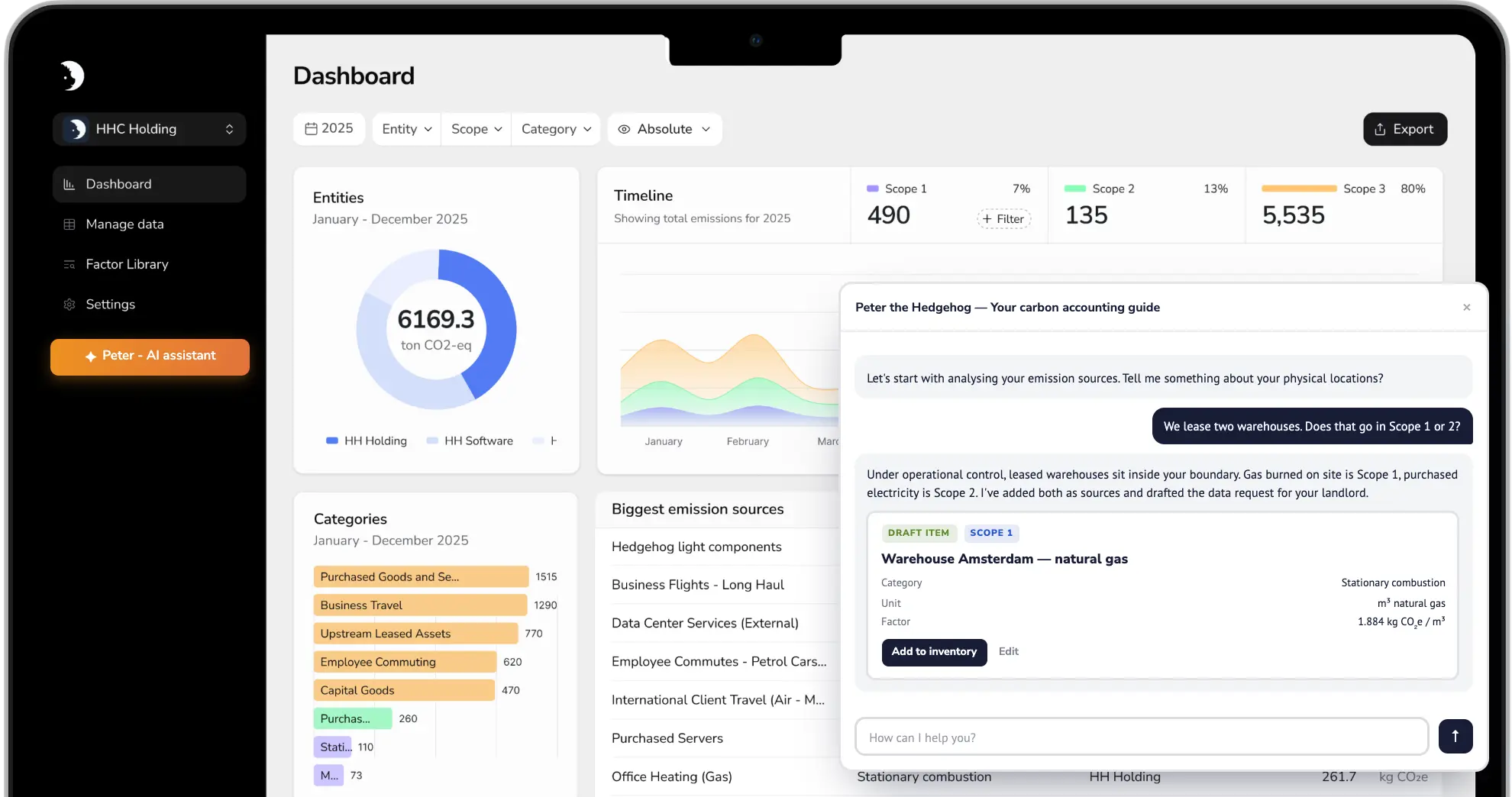
The platform names PPN 006 and the CO2-Prestatieladder as reporting outputs alongside the GHG Protocol, which covers the two most common obligations directly. It guides you through GHG Protocol setup, the data collection plan and inventory building with an AI guide, with human GHG experts reachable in the product. Entity management covers multiple locations and sites, with roles for data owners, auditors and managers, which is the part that matters when the contract outlives the person who built the first inventory. Over 20,000 spend-based and activity-based factors, plus your own organisation-specific or supplier-specific data. Named legislation support includes CSRD, SECR and SB253, and there are workflows for SBTi, B-Corp and EcoVadis.
Free account, no sales call. Pro from EUR 1,200 per year.
Three honest limits.
The first load is the work. A G2 reviewer said in August 2026 that once the data is loaded everything works perfectly, and that getting it loaded is the challenging part. Year one is a project. Year two is a routine, and that is the whole argument.
There is no forecasting. A small business reviewer noted that on G2 in August 2026 and said Hedgehog had told them it is on the development list. If you need to model a trajectory to a target date rather than report a position, that modelling happens outside the tool today.
Product footprints are a service. The platform does organisational footprints. Where a contract asks for product-level data, an EPD or an MKI value, that is LCA work delivered through carbon footprint consulting rather than a feature you switch on.
What should you do first?
Find out when your current obligation expires. Not roughly. The exact date your published plan lapses or your certificate comes up for audit. A surprising number of suppliers cannot answer that question in the meeting where it is asked.
Then put the recalculation in the calendar for the month after your financial year closes, with a named owner who is not the bid manager. Bid managers are busy exactly when tenders are open, which is the worst possible moment to be rebuilding a baseline.
If you are between obligations right now, that is the good moment to build the inventory properly. Start on a free account and see what your data actually supports before the next deadline sets the terms for you.
Sources: UK Cabinet Office Procurement Policy Note 006, SKAO CO2-Prestatieladder, NHS England's 2027 NHS carbon reduction plan requirements and Evergreen sustainable supplier assessment, GHG Protocol Corporate Standard, Hedgehog platform, Hedgehog on G2. PPN 006, CO2-Prestatieladder and NHS facts verified 17 September 2026; G2 and platform facts verified 27 August 2026.
Facts on this page were last verified on 2026-09-17.