
In short
- Carbon appears in tenders as four distinct criterion types. Read which one you are facing before you write anything.
- A gate criterion is pass or fail and cannot be argued up. An award criterion is points and can.
- Everything except certification is fixable inside a bid window. Certification is not, so plan two bids ahead.
Carbon accounting software for public tenders is what turns a maintained emissions inventory into the specific artefact a bid asks for: a Carbon Reduction Plan in a prescribed format, a figure for a scored award criterion, or the inventory evidence behind a certification. It is for bid managers, tender managers and the sustainability lead they call in week two. The first thing to do is read the tender documents and work out which of four kinds of carbon criterion you are facing, because two of them can be won inside the bid window and two of them cannot.
What do carbon criteria in a tender actually look like?
Four types, and they behave completely differently under pressure.
| Criterion type | What it is | What you submit | Fixable in this bid window |
|---|---|---|---|
| Gate or selection | Pass or fail eligibility | A published plan or a valid certificate | Sometimes, if it is a document |
| Award criterion | Points within the quality score | A number, a plan, a method statement | Yes |
| Bid price adjustment | A discount applied to your price for scoring | A certified tier held at award | No |
| Contract performance condition | A commitment you take on after award | A signed undertaking and later evidence | Yes, but read it carefully |
The costliest mistake is treating all four as writing exercises. A gate criterion requiring a published plan on your own website is a two-week job if you hold the data and impossible if you do not. A bid price adjustment based on a certificate you lack is not a writing problem at all.
Read the award criteria before the specification. Where carbon carries real weight, the scoring rules tell you what evidence is acceptable and how it will be judged.
How much is a carbon score actually worth?
Do the arithmetic before you decide how much effort to spend, because the answer varies by an order of magnitude between tenders.
For a scored award criterion, take the weight of the sustainability criterion, take the points you plausibly lose against a strong competitor, and convert that into the price difference it would take to make up. Often the answer is small enough that you should submit a competent minimum and put your effort into the technical response.
For a bid price adjustment the answer is different, and much larger. In Dutch public works, Rijkswaterstaat has applied fictitious reductions of 2, 4 and 6 percent by CO2-Prestatieladder trede since 1 July 2026, and ProRail, which has awarded on the ladder since 2010, intends to switch to version 4.0 on 1 January 2027 with a proposed 4, 7 and 10 percent it calls provisional. A fictitious reduction is a discount applied to your bid for scoring purposes only, so a competitor one tier above you is effectively bidding lower at the same price. Against your typical bid value, that is a number your commercial director will understand immediately, and it usually settles the certification question in one calculation. We set out how the ladder works for smaller firms in the CO2-Prestatieladder for SMEs.
The general rule: points criteria are worth writing well, price adjustments are worth restructuring your year around.
What can you still fix before the deadline?
Be honest about the timeline, because bid teams routinely promise things the calendar does not allow.
Format and presentation, yes. If you hold the data and submitted it in the wrong shape last time, that is days of work. Get the prescribed template, rebuild against it, and make sure every claim in it has a source.
Scope 1 and 2, usually yes. Fuel, energy and vehicles come off bills and fuel cards. For most bidders this is achievable inside a bid window.
Scope 3, partly. PPN 006 names five categories: business travel, employee commuting, upstream transportation and distribution, waste generated in operations, and downstream transportation and distribution. Travel and waste come quickly. Upstream and downstream transport is where estimates get thin, and thin estimates are what evaluators notice. Detail in our PPN 006 checklist.
Certification, no. Getting onto a ladder or moving up a tier involves an external audit and a timeline you do not control. If the tender awards on tier and you do not hold one, this bid is decided and probably the next one too. Start now for the one after that.
Why do good numbers still score badly?
Because evaluators are scoring the credibility of what you submitted, not the size of the number.
Four things pull a score down even when the underlying inventory is sound.
Targets with nothing behind them. A commitment to a percentage reduction by a date, with no costed measures and no named owners, reads as an aspiration. Evaluators have seen a great many of those.
A baseline nobody can follow. If the boundary is not stated, the reader cannot tell whether your reduction is real. State what is in, what is out and why.
Estimates presented as measurements. Say which categories are estimated and on what basis. A declared estimate scores better than an undeclared one that a technical evaluator spots.
A claim you cannot evidence. An unsupported environmental claim in a bid document is worse than a low score, because it survives into the contract you sign and a challenge later costs more than a point today.
What should a bid team test in a tool before buying it?
Five things, and all five are about the day of the deadline rather than the day of the demo.
Can a non-specialist produce the output? Bid submissions happen at eleven at night. If only one person in the company can generate the figure, you have a single point of failure with a deadline attached.
Does the inventory persist between bids? The expensive pattern is rebuilding a footprint every time a tender appears. The cheap one is maintaining it so a submission is an export.
Can it produce more than one prescribed format? If you bid in both the UK and the Netherlands, one inventory should feed both.
Can you show your working? Evaluators and auditors ask how an input became a reported figure. Being able to answer is what makes a number defensible under challenge.
What does year two cost? Bidding is continuous. A first-year price that resets changes the real cost.
What does Hedgehog do for tender submissions?
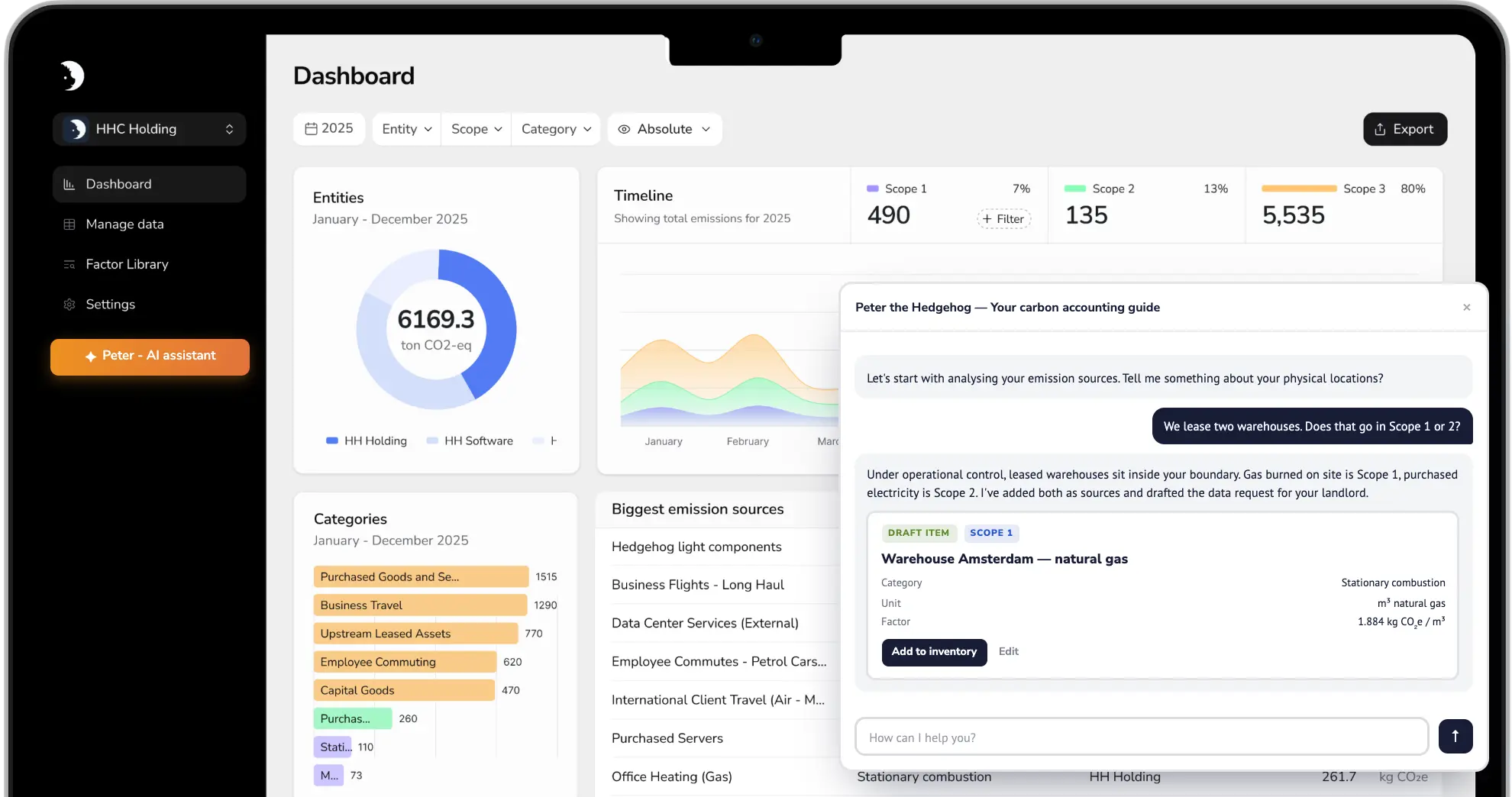
The platform names PPN 006 and the CO2-Prestatieladder as reporting outputs alongside the GHG Protocol, which are the two formats UK and Dutch public tenders most often ask for. It guides you through GHG Protocol setup, a data collection plan and inventory building with an AI guide, with human GHG experts reachable in-app. Over 20,000 spend-based and activity-based emission factors, with the option to add your own organisation-specific or supplier-specific data. Entity management across locations and sites with roles for data owners, auditors and managers. There are also workflows for SBTi, B-Corp and EcoVadis, which show up in tenders more often than they used to.
Free account, no sales call. Pro from EUR 1,200 per year.
Three honest limits, stated plainly because a bid team needs to plan around them.
Software will not save a bid that is due in three weeks with no data. A G2 reviewer said in August 2026 that once the data is loaded everything works perfectly, and that getting it loaded is the challenging part. That is the constraint. It will save the bid after this one.
No platform certifies you. A tool produces the inventory and the documentation that certification requires. Reaching a tier still involves an external body and a schedule you do not set.
Product footprints are a service. The platform does organisational footprints. Where a tender asks for an EPD, an MKI value or a product carbon footprint, that is LCA work and it comes through carbon footprint consulting.
What should you do first?
Take the last three tenders you bid and classify their sustainability criteria against the four types above. Most bid teams discover they have been treating a price adjustment as a writing exercise, or spending a week on a criterion worth two points. That exercise tells you whether your gap is a document, a dataset or a certificate, and those three have completely different lead times.
If it is a document or a dataset, start a free account and build the inventory before the next notice appears. If it is a certificate, book a call and we can work the tier arithmetic against your actual bid pipeline.
Sources: UK Cabinet Office Procurement Policy Note 006 and its Technical Standard, Rijkswaterstaat's and ProRail's own CO2-Prestatieladder pages, SKAO CO2-Prestatieladder, GHG Protocol Corporate Standard, Hedgehog platform, Hedgehog on G2. RWS, ProRail and PPN 006 facts verified 17 September 2026; G2 and platform facts verified 27 August 2026.
Facts on this page were last verified on 2026-09-17.