
In short
- SB 253 is a public disclosure obligation. Scope 3 is what makes it a data project rather than a form.
- Check scope, thresholds and timing with the California Air Resources Board, not with a software vendor.
- A European group with US revenue can usually reuse one inventory for both sides if the boundary is built for it.
SB 253 is California's corporate climate disclosure law, and in general terms it requires large companies doing business in California to publicly disclose their greenhouse gas emissions across their full value chain. The part that needs software is the inventory behind the disclosure, particularly scope 3. If it applies to you, the first move is to confirm scope and timing directly with the California Air Resources Board, then work out whether your existing reporting can carry the extra weight.
What is SB 253 asking for, in practice?
A public number, on a recognised method, that survives being looked at.
That sounds mild until you notice the phrase value chain. Scope 1 and scope 2 are a metering and invoicing exercise most finance teams can complete in weeks. Scope 3 is an estimation exercise that touches purchasing, logistics, travel and the products you sell, and it is where every disclosure regime that includes it becomes a real project.
We are deliberately not restating the revenue threshold, the phase-in order or the first reporting date on this page. Those details have moved during rulemaking, and the only source worth relying on is the California Air Resources Board's own published regulation. Get that from CARB or from counsel, and treat any vendor page that states them confidently, including ours, as something to verify rather than something to cite.
What we can be specific about is what the reporting work looks like, because that part does not change.
Who does this actually land on?
Three profiles turn up repeatedly.
US groups above the threshold. The obvious case. They usually already have some emissions reporting and now need it to be complete, public and defensible rather than internal.
European groups with a US business. Frequently the most awkward case. They already report under EU rules, and the question is whether one inventory can serve both. Usually it can, if the entity structure is built properly from the start.
Suppliers to companies in scope. Not directly obligated, but on the receiving end of questionnaires from customers who are. This is the largest group by headcount and the one that gets least attention.
If you are in the third group, you do not need an SB 253 project. You need a footprint you can hand over on request, which is a much smaller thing, and it is worth knowing which questions you are entitled to push back on before you answer all of them. We cover that in refusing ESG questions.
Which parts of this are a software job?
Fewer than a vendor will tell you, and more than you would like.
| What SB 253 reporting involves | Software job? |
|---|---|
| Deciding the reporting boundary and entity list | No, a decision with your auditor and counsel |
| Scope 1 and scope 2 calculation | Yes, and the fastest part |
| Scope 3 across the value chain | Yes, and the longest part |
| Holding the method stable year on year | Yes, and the part people forget |
| Evidence trail for assurance | Yes, and the part that decides your review cost |
| Publishing and legal sign-off | No, that is your process |
The two rows in the middle are the ones that separate tools. Any platform can produce a number. Producing the same number twice, on the same basis, with a route back to the source record for every line, is the harder specification and the one that matters when someone reviews it.
What should you test before buying?
Five questions, in the order they will cost you.
Can it build scope 3 from data you actually hold? Purchase ledger, expense system, carrier invoices. Not from data you would have to start collecting from suppliers who have never been asked.
Can it hold a multi-entity, multi-country structure? A US subsidiary of a European parent needs to be a separate entity that rolls up cleanly, with different energy grids and different currencies underneath it.
Can you trace a published figure back to an input? This is the assurance question. Ask for an audit trail on one line item during the demo. It is a fast way to tell a serious tool from a dashboard.
What happens when emission factors update? Public disclosure means restatements are visible. You want to be able to hold a published year fixed and restate alongside it, not silently overwrite.
Can it serve your EU reporting too? If you report in both places, one inventory feeding two outputs is far cheaper than two projects. That is a question about export flexibility, not about branded compliance modules. Where the EU side is the bigger burden, CSRD consulting is usually the better place to start.
What does Hedgehog do here?
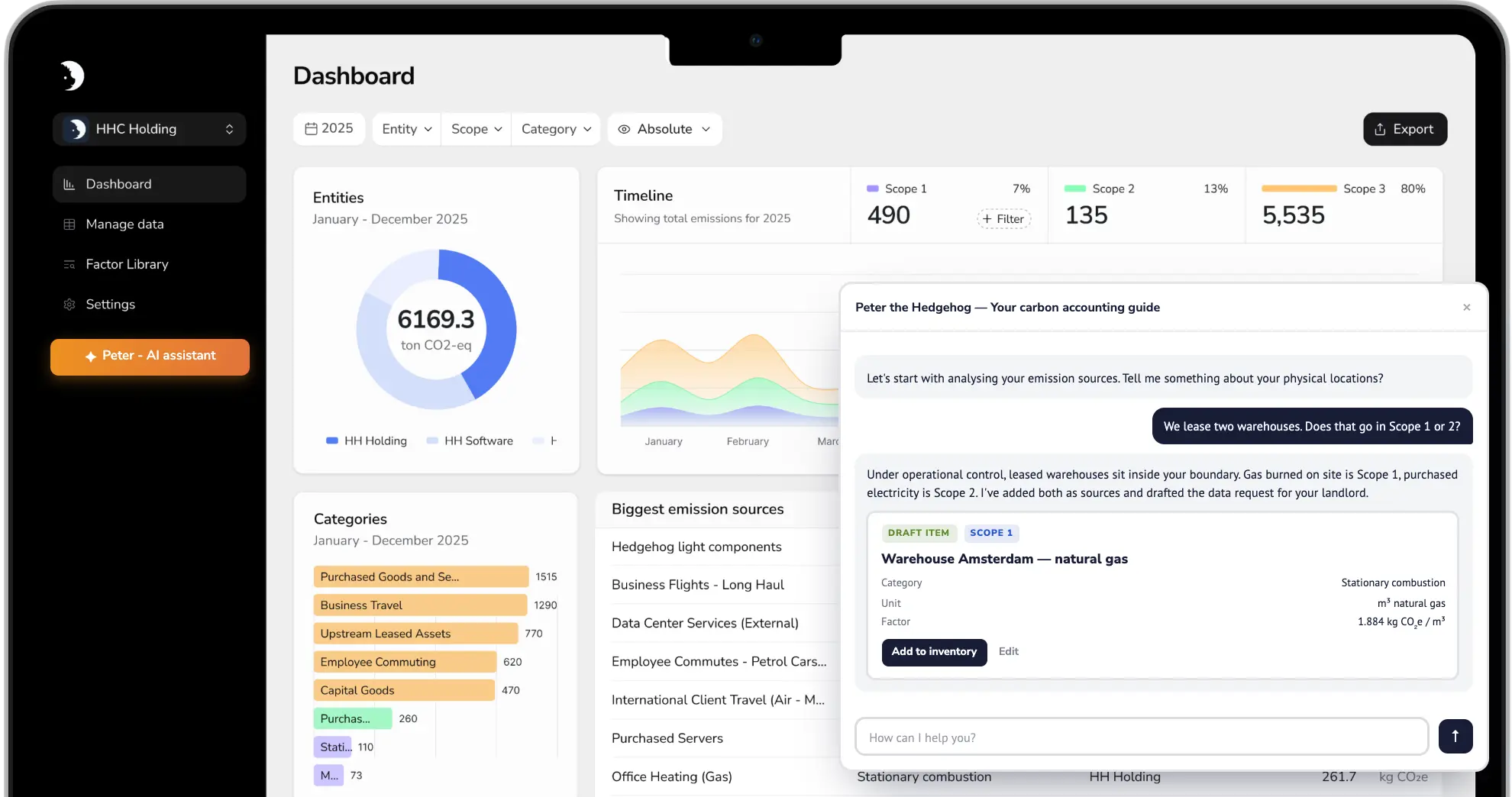
The platform names SB 253 alongside CSRD and SECR as supported legislation. It guides you through GHG Protocol setup, a data collection plan and inventory building with an AI guide, with human GHG experts reachable in the product. It holds over 20,000 spend-based and activity-based factors, supports entity management across locations and sites with roles for data owners, auditors and managers, and lets you add your own organisation-specific or supplier-specific CO2 data. Interface languages are English, French and Dutch.
Free account with no sales call. Pro from EUR 1,200 per year.
Three limits you should weigh before you decide.
Loading data is the slow part. A Small-Business reviewer said so on G2 in August 2026: once the data is loaded everything works perfectly, and getting it loaded is the challenging part. For a full value chain inventory, that is the honest shape of year one.
Traceability of applied conversions is not complete. A Mid-Market reviewer noted on G2 in July 2026 that the applied conversion factors and distance calculations are not exposed in the product, so a currency conversion or a distance calculation cannot always be checked line by line. If your assurance provider will want that, ask us about it directly rather than assuming.
Product footprints are a service. LCA, EPD, MKI and PCF work is consultancy. The platform does organisational footprints, which is what a disclosure obligation needs.
What should you do first?
Confirm whether you are in scope, from CARB or from counsel. That single answer changes the size of the project by an order of magnitude, and getting it from a vendor is the wrong way round.
If you are in scope, start the scope 3 screening now, before the boundary is finalised. Screening tells you which categories carry your emissions, and that determines where the year of work goes. Where the value chain is the hard part, scope 3 consulting exists for exactly this.
If you are a supplier to someone in scope rather than in scope yourself, start a free account and build scope 1 and 2. That answers most questionnaires and costs you a fraction of the effort.
Sources: California Air Resources Board rulemaking for SB 253, GHG Protocol Corporate Standard, Hedgehog platform, Hedgehog on G2. Verified 27 August 2026. Scope, thresholds and reporting dates are deliberately not restated here and must be checked against CARB's published regulation.
Facts on this page were last verified on 2026-09-17.