
In short
- The target is the visible part. The base year inventory is the part that decides whether you can ever hit it.
- Scope 3 screening comes before target setting, not after. It tells you what you are actually committing to.
- Most carbon accounting tools measure. Fewer track progress against a target. Ask which one you are buying.
SBTi is the Science Based Targets initiative, which reviews and validates corporate emissions reduction targets against published criteria. Software does not set your target and does not get it validated. What it does is build and maintain the base year inventory the target is anchored to, and then produce the same measurement every year so progress against the target actually means something. If you are considering a target, the inventory is the first job, not the second.
What does SBTi actually require of your data?
Three things, and only one of them is a decision.
A complete base year inventory. Scope 1, scope 2 and a scope 3 assessment across your value chain. This is the foundation and it is the part people rush.
A target, expressed against that base year. That is a management decision informed by the criteria the SBTi publishes. Those criteria are updated periodically, so read the current version on the initiative's own site rather than a summary of it, including this one. Version 1.3.1 of the Corporate Net-Zero Standard, the version most near-term targets are set against today, remains open for target-setting until the end of 2027; Version 2.0, published June 2026 and validating from early 2027, changes the base year mechanic itself, covered below.
Annual measurement on the same basis. A target is only meaningful if next year's number is comparable to the base year. Every methodology change you make afterwards either has to be absorbed with a restatement or it quietly invalidates your trend.
The third one is the software question. Anyone can produce a footprint once. Producing the same footprint, five years running, through a factor library update and a staff change and an acquisition, is the specification that matters.
Why does the base year matter more than the target?
Because you cannot change it later without explaining yourself.
Set a base year on an incomplete boundary and one of two things happens. Either you carry the gap forward for the life of the target, which means your reported reductions include things that were never really measured, or you restate, which reads externally as a correction whatever the reason.
There is a second, less obvious trap. Choosing an unusually high emissions year as your base makes early progress look easy and later progress look impossible, because you will have spent the easy reductions on a number that was inflated to start with. Choosing an unusually low year does the reverse and makes the whole commitment harder than it needed to be.
Neither of those is a software problem. Both are made much worse by software that cannot restate cleanly.
This is the Version 1.3.1 picture, and it changes under Version 2.0. SBTi's Corporate Net-Zero Standard Version 2.0 requires a new "target base year" to be selected at the start of every five-year target cycle, rather than fixed once for the life of the commitment. SBTi's own framing is that this is "a continuation, not a reset, of the decarbonization journey," and it still needs a comprehensive inventory behind it every time. But it means a company planning its next cycle from 2028 onward is choosing a base year it will revisit on a schedule, not one it is stuck with indefinitely. Check which version applies to your target before treating either picture as permanent.
Which parts of SBTi are a tool, and which are a decision?
| Step | Tool or decision |
|---|---|
| Base year inventory, scopes 1 and 2 | Tool |
| Scope 3 screening across the value chain | Tool, with judgement on category selection |
| Choosing the target and its ambition | Decision, against SBTi criteria |
| Submission and validation | Process, not software |
| Annual recalculation on the same basis | Tool |
| Tracking progress against the target | Tool, and the feature to check hardest |
| Deciding which reductions to fund | Decision |
The row worth pausing on is progress tracking. A lot of carbon accounting platforms are inventory tools. They tell you what your emissions were. Fewer of them hold a target and show you the gap to it over time. Those are different features and they are frequently sold as the same thing.
What should you test before buying for SBTi?
Five questions.
Can it screen scope 3 quickly and roughly? Before you commit to a target you want to know which categories dominate. A rough spend-based screen in a week beats an exact figure in a quarter, because it changes what you commit to.
Can it hold a base year fixed? Ask precisely what happens to your base year when the factor library updates. The answer should be that the original is preserved and a restatement sits alongside it.
Can it restate a prior year deliberately? You will need to, after an acquisition or a boundary change. Ask to see it done.
Does it track progress against a target, or only measure? Ask directly. If the answer is a dashboard of past years with no target line, that is an inventory tool, which may still be the right purchase.
What does year five cost? An SBTi commitment is a multi-year routine. Price the whole period, not the first invoice.
What does Hedgehog do for SBTi, and what does it not do?
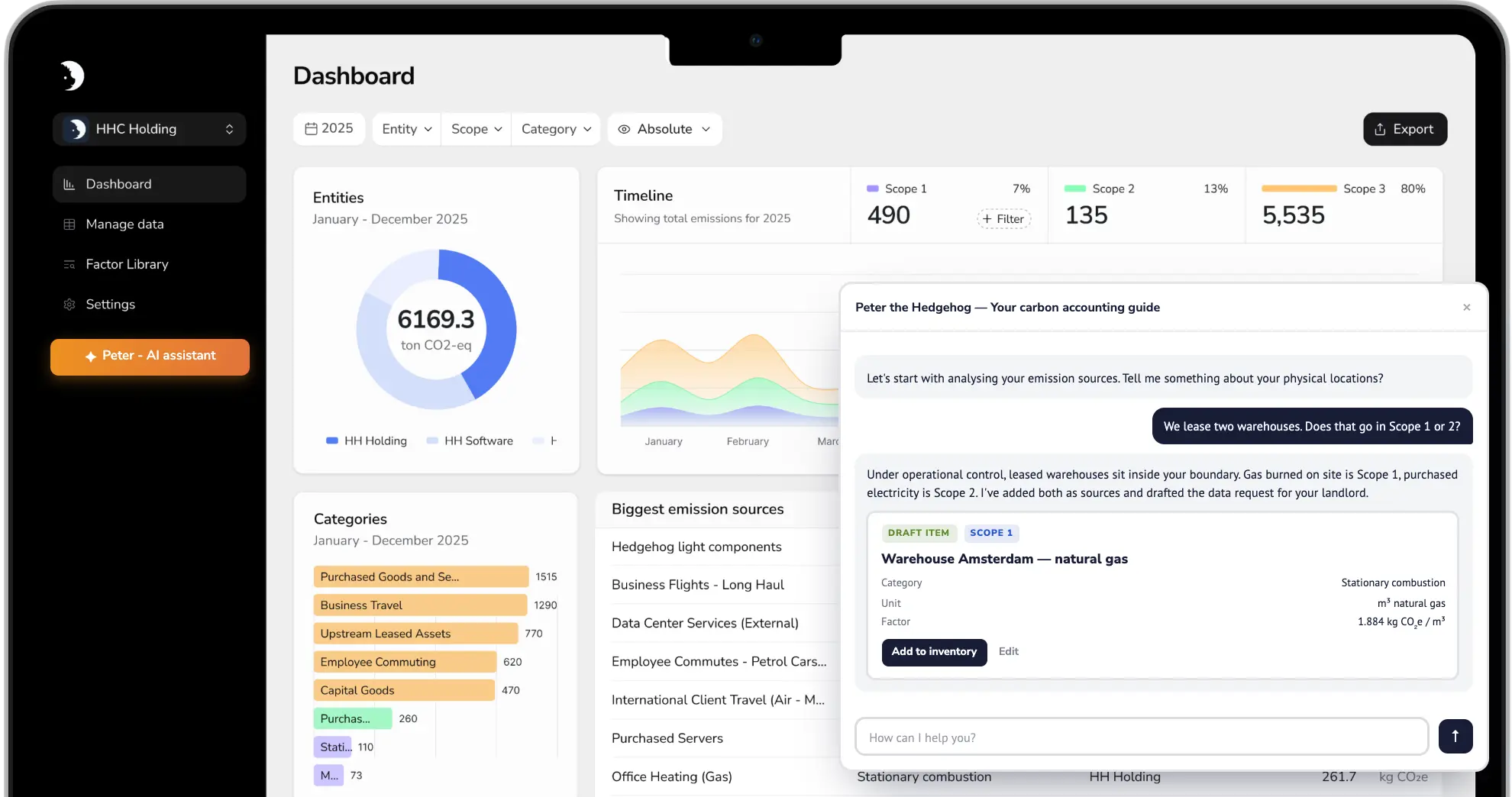
The platform supports SBTi compliance workflows alongside B Corp and EcoVadis. It guides you through GHG Protocol setup, building a data collection plan and a GHG inventory, with an AI guide for setup and human GHG experts reachable in-app. It holds over 20,000 spend-based and activity-based factors, which is what makes a first scope 3 screen practical, and lets you add organisation-specific or supplier-specific data as better numbers arrive. Entity management covers multiple locations and sites with roles for data owners, auditors and managers.
Free account with no sales call. Pro from EUR 1,200 per year.
Now the part you should read before deciding, because this page would be dishonest without it.
There is no decarbonisation target monitoring feature today. A Mid-Market reviewer rated us 3.5 out of 5 on G2 in June 2026 and said exactly that, alongside the absence of a data source management feature. If a target tracking dashboard is the reason you are buying, ask us where that stands before you sign rather than after.
There is no forecasting. A Small-Business reviewer noted on G2 in August 2026 that forecasting would be welcome and that we had told them it is on the development list. That is accurate and we are not going to dress it up.
Loading data takes real effort. Another Small-Business reviewer said on G2 in August 2026 that once the data is loaded everything works perfectly, and getting it loaded is the challenging part. For a full base year inventory including scope 3, budget accordingly.
Product footprints are a service. LCA, EPD, MKI and PCF work is consultancy rather than a platform feature. The platform does organisational footprints, which is what a target is set against.
Where the target itself, the trajectory and the reduction plan are the work, that is science based targets consulting rather than a subscription, and where the value chain is the obstacle it is scope 3 work.
What should you do first?
Do not submit anything yet. Build a rough inventory across all three scopes first, including a coarse scope 3 screen, and look at where your emissions actually are.
That exercise routinely changes the commitment people were about to make, because the categories that dominate are usually not the ones the board has been discussing. It takes weeks, not quarters, and it is the cheapest risk reduction available in the whole process.
You can start a free account and get scope 1 and 2 done before you decide anything, or book a conversation if the target is already committed and the deadline is fixed.
Sources: Science Based Targets initiative Corporate Net-Zero Standard, Versions 1.3.1 and 2.0, read 17 September 2026. GHG Protocol Corporate Standard, Hedgehog platform, Hedgehog on G2, read 27 August 2026. SBTi criteria are revised periodically and must be read in their current published version.
Facts on this page were last verified on 2026-09-17.