
In short
- SECR is part of the directors' report, not a separate sustainability publication. Finance owns the deadline.
- Energy use in kWh sits underneath the emissions figure. Tools that only report tonnes make the disclosure harder.
- Comparability year on year is the whole point. Pick a method you can repeat before you pick a tool.
SECR is Streamlined Energy and Carbon Reporting, the UK requirement to disclose energy use and associated greenhouse gas emissions inside the directors' report of your statutory annual accounts. It applies to certain large and quoted UK companies and LLPs. Because it is filed with the accounts, the deadline is the accounts deadline and finance usually owns it. Software is for producing the underlying energy and emissions figures on a basis you can repeat every year without argument.
What goes into an SECR disclosure?
In broad terms, a disclosure covers UK energy consumption, the greenhouse gas emissions associated with it, at least one intensity ratio of your choosing, a narrative on the energy efficiency measures you took during the year, and the methodology you used. After the first year it also carries the prior year comparatives.
What exactly your company must disclose depends on which category of reporter you fall into, and quoted companies are treated differently from large unquoted companies and LLPs. We are not going to restate the thresholds or the category rules here. Read the current government guidance, or ask the auditor who is signing the accounts, because they will have an opinion regardless.
The mechanics are the part worth planning, and they do not change.
| Element | Where it comes from | Difficulty |
|---|---|---|
| UK energy consumption in kWh | Utility invoices, fuel cards, half hourly data | Low if metering is tidy |
| Scope 1 emissions | Gas, fleet fuel, on-site combustion | Low |
| Scope 2 emissions | Purchased electricity and heat | Low |
| Intensity ratio | An emissions figure over a business metric you choose | A decision, made once |
| Energy efficiency narrative | Your own operational record | Not a software job |
| Prior year comparatives | Last year's figures on the same basis | The one that breaks |
Why does SECR feel different from other carbon reporting?
Because the audience is different, and so is the calendar.
A sustainability report is published when you are ready. An SECR disclosure is filed inside a statutory document with a fixed deadline and a signature on it. That changes three things.
Finance owns it, not sustainability. In many UK companies SECR is prepared by the same people closing the accounts, in the same weeks, under the same pressure. A tool that only makes sense to a sustainability specialist is a poor fit for that.
Your auditor will look at it. Not necessarily to the same depth as the financial statements, but they will ask where a number came from. Being able to answer quickly is worth more than any dashboard.
The comparatives lock you in. Once you have published a figure, next year's disclosure sits next to it. Change your method and you have to explain the change in a document nobody wants to add paragraphs to.
What does the kWh requirement change about tool selection?
More than people expect, and it is the most common mis-buy on this page.
SECR asks for energy use as well as emissions. Plenty of carbon accounting tools are built to output tonnes of CO2 equivalent and treat the underlying kWh as an intermediate value that never surfaces. If you cannot get the consumption figure back out in the units the disclosure wants, you end up rebuilding half the work in a spreadsheet anyway.
So test it. Load one month of real electricity and gas data during evaluation, and ask the tool for kWh by fuel and by site. If that takes a support ticket, it will take a support ticket every March.
The same applies to the intensity ratio. You choose the denominator, usually turnover or floor area or output. The tool needs to accept a business metric you define, not only the ones it ships with.
What should a UK finance team test before buying?
Five questions, in the order they will cost you.
Can it output energy in kWh as well as emissions in tonnes? As above. This is the SECR-specific test and it is quick.
Can you trace a disclosed figure back to an invoice? Your auditor will ask about one line, probably the largest one. Ask for an audit trail export during the demo.
Does it hold the prior year unchanged? When factors update, the published comparative should stay as published, with a restatement available separately if you decide you need one.
Does it fit the accounts timetable? SECR is prepared in the same window as year end close. Ask how long a full recalculation takes once the data is loaded, not how long onboarding takes.
Will it stretch beyond SECR? Many companies filing SECR also bid for public contracts, which brings a separate carbon reduction plan obligation with a different scope 3 subset. Our PPN 006 checklist sets out that one. Buying once for both is cheaper than buying twice.
It is also worth knowing whether you want a carbon accounting tool or a broader ESG reporting suite, because they solve different problems and the overlap is smaller than the category names suggest. We compare them in ESG reporting software versus carbon accounting.
What does Hedgehog do for SECR?
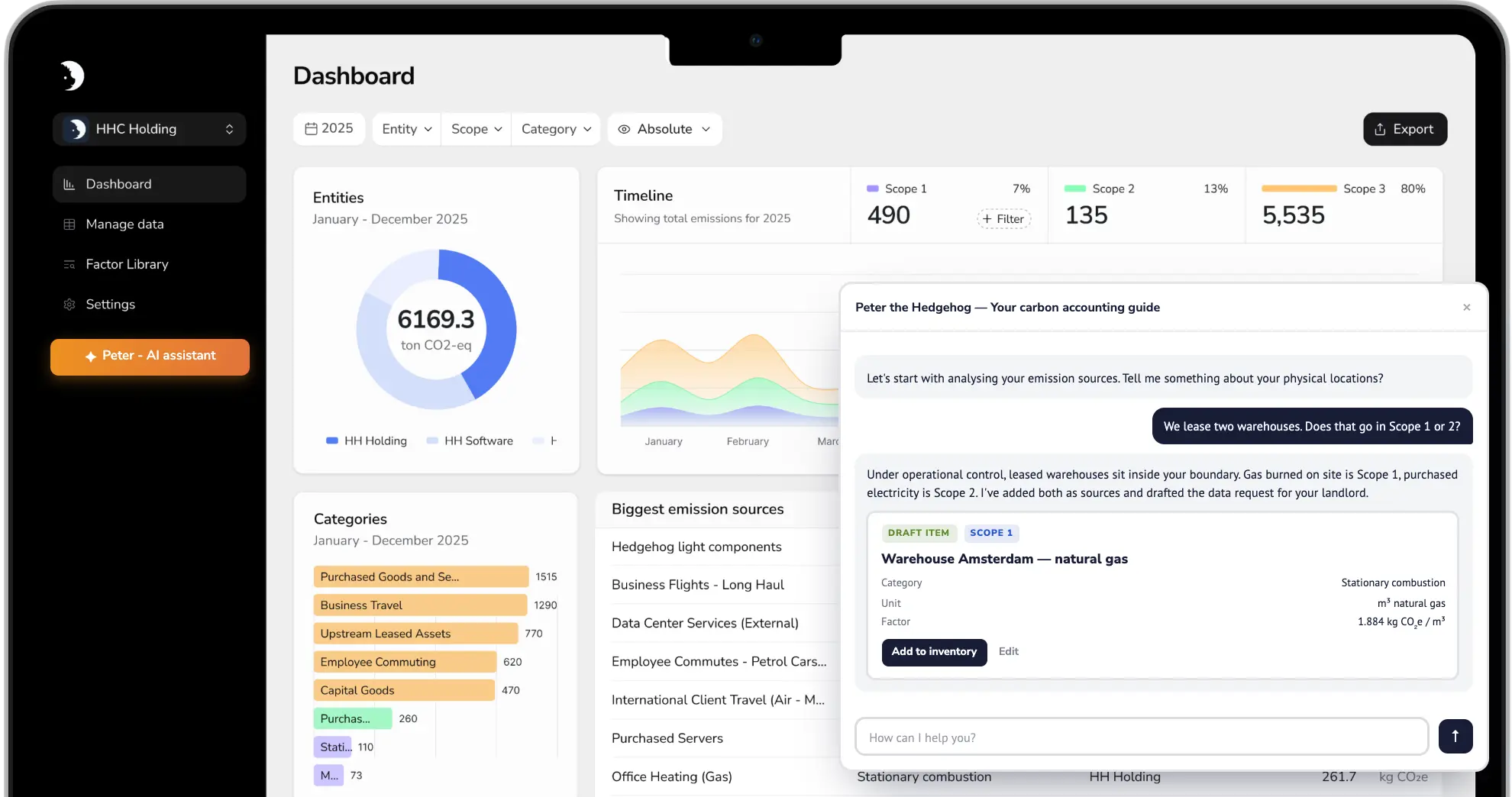
The platform names SECR as supported legislation alongside CSRD and SB 253, and its reporting module covers the GHG Protocol, PPN 006 and the CO2-Prestatieladder. It guides you through GHG Protocol setup, a data collection plan and inventory building, with an AI guide and human GHG experts reachable in the product. It holds over 20,000 spend-based and activity-based factors, supports entity management across locations and sites with roles for data owners, auditors and managers, and lets you add your own organisation-specific data where a supply contract has a factor no generic library carries.
Free account with no sales call. Pro from EUR 1,200 per year.
Two limits that matter specifically to a filed disclosure.
Applied conversions are not fully visible. A Mid-Market reviewer noted on G2 in July 2026 that they could not see the conversion factor applied to a currency conversion, or which calculator produced a distance figure, and wanted a link to the source. If your auditor is going to ask that question, raise it with us before you buy rather than in March.
Getting the data in is the work. A Small-Business reviewer said on G2 in August 2026 that once the data is loaded everything works perfectly, and loading it is the challenging part. The first year is the expensive one. The second is not.
And to be explicit about scope: the platform does organisational footprints. Product footprints, meaning LCA, EPD, MKI and PCF work, are delivered as a service rather than a feature.
What should you do first?
Work backwards from your accounts deadline, not forwards from today. Count back the audit window, the board approval and the drafting, and you usually find the emissions figures are needed a month earlier than anyone assumed.
Then get one site's electricity and gas into a tool and produce a kWh figure and a tonnes figure from it. That single test tells you more about whether a platform suits SECR than any demo will.
You can start a free account and do exactly that, or read our carbon accounting from scratch guide if this is the first year anyone has asked.
Sources: UK government environmental reporting guidance including Streamlined Energy and Carbon Reporting, Companies Act reporting requirements, GHG Protocol Corporate Standard, Hedgehog platform, Hedgehog on G2. Verified 27 August 2026. Scope thresholds and reporter categories are deliberately not restated here and must be checked against the current guidance.
Facts on this page were last verified on 2026-09-17.