
In short
- A questionnaire is a procurement document with a deadline, not a reporting exercise.
- Build one inventory and export it into each customer's format. Never answer twice from scratch.
- The slow part is collecting the data, not calculating the number.
Carbon accounting software for supplier questionnaires is a system that holds one defensible emissions inventory and lets you answer every customer data request out of it, in whatever format each customer happens to want. It is for companies who get asked rather than companies who report: suppliers into large manufacturers, retailers, public bodies and healthcare buyers, where the request arrives attached to a contract deadline. The next step is to build one reusable inventory before the next request lands, instead of assembling a fresh answer per customer.
That sounds obvious. Almost nobody does it, which is why the same commercial team answers the same eight questions four times a year and gives four slightly different numbers.
What is a supplier questionnaire actually asking for?
Strip the formatting and there are only five things behind almost every one of them.
| What they ask | What they actually want | Where your answer comes from | How often it changes |
|---|---|---|---|
| Your scope 1 and 2 emissions | A total in tonnes CO2e for a stated year | Fuel, fleet, electricity, heat | Annually |
| Your scope 3, or parts of it | Usually purchased goods, transport, or a total | Purchase ledger, freight data, supplier data | Annually |
| Your calculation method | That you used the GHG Protocol and can say so | Your method documentation | Rarely |
| A reduction target | A dated target, sometimes validated | Your board, not your software | Rarely |
| A carbon reduction plan | A published document in a prescribed format | Assembled from the above | Annually |
Two things follow from that table. First, the underlying data is the same every time and only the packaging changes. Second, the questions that hold up contracts are the ones about method and evidence, not the ones about the number itself.
Who actually gets these, and how often?
Anyone selling to a company large enough to have its own reporting obligation, which is now most of the mid-market and all of the public sector.
Arrival is bunched rather than random. The heaviest month for most suppliers is the one after their largest customers close their own books, and a second wave lands whenever you bid, because carbon questions now sit inside tender documents instead of arriving as a separate request.
The formats differ by buyer. UK central government contracts above GBP 5 million a year (including VAT) can carry a condition of participation requiring a carbon reduction plan under PPN 006 -- valid for twelve months, but the Technical Standard tells you to refresh it within six months of your financial year-end -- and we go through that format in the PPN 006 checklist. NHS suppliers face a heavier ask from April 2027, when they publish targets, emissions and a carbon reduction plan covering global emissions and every relevant scope 3 category, which we cover in the NHS Evergreen assessment. Corporate buyers mostly send a spreadsheet or an EcoVadis link.
Why does answering each one from scratch fail?
Because the answers stop agreeing with each other, and someone eventually notices.
The failure mode is specific and it is always the same. Person A answers a questionnaire in March using calendar year data. Person B answers a different customer in September using financial year data and a newer emission factor set. Both numbers are defensible in isolation. Side by side in a procurement file they look like an error, and the customer who spots it now has a reason to ask for evidence you cannot produce quickly.
The second failure is cost. Each rebuild takes days of commercial time that nobody budgets, because it never appears as a project. It appears as a series of urgent favours.
The fix is boring: one inventory, one stated boundary, one method, versioned by year, exported into whatever template arrives. That is a software problem, not a consultancy problem.
What does the software have to produce?
Five outputs. Test all five before you buy, using a real questionnaire you have already received.
A total by scope and by year, with the boundary written down. Not a dashboard. A number you can paste into a cell with a footnote.
A category-level scope 3 breakdown, because customers increasingly ask for their own relevant category rather than your total.
An export into an arbitrary template. Every large customer has its own spreadsheet. This is the single most underrated requirement in the whole market, and it is the one demos skip.
A method statement. Which standard, which factor sources, which year, what was estimated. If you cannot produce this on request, the number is worth less than you think.
A prior-year comparison that still reconciles. When factors update, you need to restate last year and keep the original. Ask exactly how a tool handles that.
What can you refuse to answer?
More than most suppliers realise, and this is worth knowing before you spend a week on a spreadsheet.
EU law was amended in 2026 to give a "protected undertaking" (broadly, under 1,000 employees, sitting in a large reporting company's value chain) the statutory right to decline sustainability-reporting requests that go beyond a forthcoming voluntary standard -- and to make any contract clause overriding that right non-binding. The standard's own content applies from financial years starting on or after 1 January 2027 and was still going through EU scrutiny as of August 2026, but the direction is clear: if you fit the definition and a customer sends a fifty-tab workbook for sustainability-reporting purposes, part of it is very likely more than you can be required to provide. It does not touch ordinary procurement or due-diligence questions, only requests made for sustainability reporting. We set out which requests fall outside the cap in refusing ESG questions.
Saying so politely, with a complete answer to the reasonable part attached, is a much stronger commercial position than a late partial response.
What does Hedgehog do for a questionnaire, and what does it not?
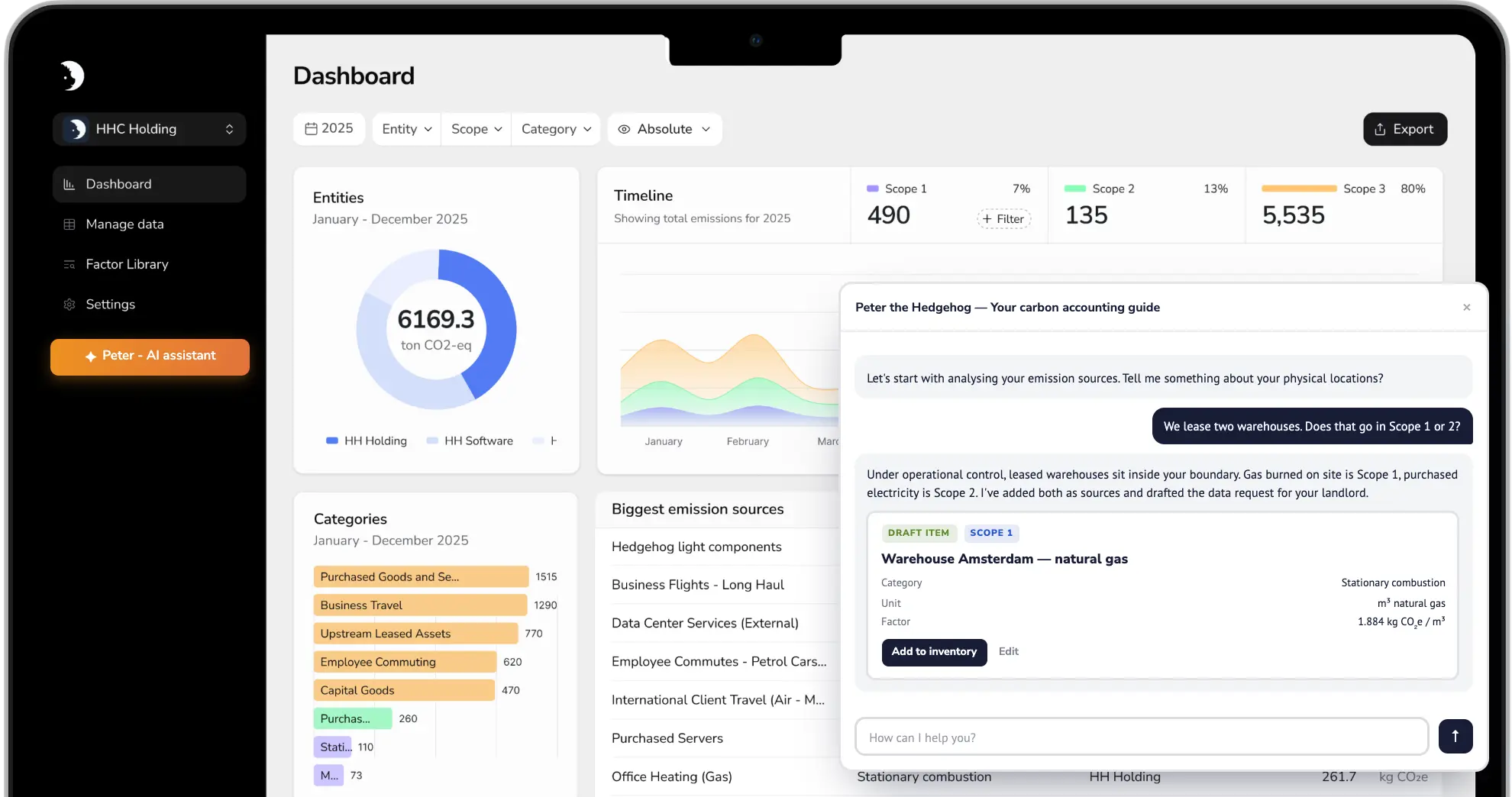
The platform builds an organisational inventory under the GHG Protocol with an AI guide through setup, data upload and reporting. It carries over 20,000 spend-based and activity-based factors and lets you add your own organisation-specific or supplier-specific data, which matters when a customer sends you their own factor and expects you to use it. Reporting output covers the GHG Protocol, PPN 006 and the CO2-Prestatieladder, and there are workflows for SBTi, B-Corp and EcoVadis. Entity management and user roles for data owners, auditors and managers let you spread data entry across sites without spreading edit rights. Interface languages are English, French and Dutch. A free account is available without a sales call, and the Pro plan starts at EUR 1,200 a year.
Two limits to weigh honestly.
Loading the data takes real work. In August 2026 a small-business reviewer on G2 put it plainly: everything works perfectly once the data is loaded, and getting it loaded is the challenging part. That is the true shape of this project, so budget days rather than hours for the first year.
Product footprints are a service, not a platform feature. If a customer asks for a per-product number, an LCA, an EPD, an MKI or a PCF, the platform does organisational footprints and that work is delivered as LCA consultancy. Check which one your questionnaire is actually asking for, because the two get confused constantly and the effort involved is very different.
What should you do first?
Take the last questionnaire you received and mark every question as either a number, a method statement or a policy. The numbers are the only part with a lead time.
Then build the inventory once, for the year your customers keep asking about, and keep it. The second questionnaire is where the return arrives, and it arrives whether or not anyone remembered to budget for the first.
You can start a free account and get a first scope 1 and 2 figure without talking to anyone.
Sources: Hedgehog platform, Hedgehog on G2. Verified 27 August 2026. Regulatory dates change, so re-check PPN 006 and NHS Evergreen requirements against the primary source before relying on them in a bid.
Facts on this page were last verified on 2026-09-17.