
In short
- One site means a short footprint. Most of the complexity in carbon software is solving problems you do not have.
- If you rent and share a meter, apportionment is your real problem, not calculation.
- Get the first number out in an afternoon, then improve it. Do not wait for perfect data.
A single-site business has one building, usually one electricity meter, sometimes a gas meter, maybe a couple of vehicles, and a purchase ledger. That is the entire footprint. Carbon accounting software here is a tool for turning those few inputs into a defensible annual number you can send to a customer, a bank or a certification scheme. Most of the machinery in enterprise carbon platforms exists to solve problems you do not have, and you should not pay for it.
What is actually in a single-site footprint?
Less than you fear, and it fits on one page.
Scope 1. Anything you burn on site or in your own vehicles. Gas for heating, a boiler, an oven, diesel in a van. If you have none of those, your scope 1 is zero and that is a legitimate answer.
Scope 2. Your purchased electricity, and heat if you are on a district network. One meter, twelve invoices.
Scope 3. Everything you buy, plus staff travel and commuting, waste and water. This is where the number gets bigger and vaguer, and it is where you should start rough and improve later.
The honest shape of the work is that scope 1 and 2 take an afternoon once you have the invoices, and scope 3 takes as long as you let it. A single-site business gets more value from a rough complete picture than from an exact partial one.
Do you even need software, or will a spreadsheet do?
For one year, once, a careful spreadsheet is genuinely fine. Say so out loud, because most vendors will not.
Software starts paying for itself at the second repetition, and for four reasons that have nothing to do with the arithmetic.
The factors change. Emission factors are updated. A spreadsheet built in one year quietly becomes wrong in the next unless someone remembers to update every cell.
The person leaves. In a business with one site, the carbon calculation usually lives with one person, often in a file on one laptop. That is a single point of failure and it fails at exactly the wrong moment.
The questions repeat. The first customer questionnaire feels like a one-off. It is not. Once one customer asks, the others follow within a year or two.
Consistency is the product. A number that is comparable to last year's is worth several times a number that is not, and consistency is much harder to maintain by hand than to buy.
If you will do this once and never again, use a spreadsheet and our guide to starting from scratch. If this is now an annual routine, buy the routine.
What breaks when you only have one site?
The meter, usually. This is the single-site problem nobody writes about.
If you own your building and hold the supply contracts, you are fine. Many single-site businesses do not. They rent a unit in a shared building, on a landlord supply, with a service charge instead of an invoice, and no sub-meter.
| Your situation | What you can report | What to do |
|---|---|---|
| Own meter, own contract | Actual consumption | Nothing special, use the invoices |
| Sub-metered unit in a shared building | Actual consumption for your unit | Ask the managing agent for the sub-meter readings |
| Service charge only, no sub-meter | An apportioned estimate | Apportion by floor area, record it as an estimate, ask the landlord in writing |
| Serviced office or coworking | An apportioned estimate | Apportion by desks or square metres, and say so in the report |
The rule in the bottom two rows is the same: apportion on a basis you can describe in one sentence, write the basis down, and label the figure as an estimate. An estimate you can explain is acceptable to almost everyone who asks. A precise-looking number with no traceable source is not.
What should a single-site business look for in a tool?
Four things, and one of them is a warning. Our fuller buying checklist for smaller companies is in choosing the right carbon accounting software for SMEs.
Speed to a first number. You should be able to get scope 1 and 2 out of your own invoices without a consultant and without a project plan.
A price that matches one site. Carbon platforms are commonly priced per entity or per site. If you are one site, you should be near the bottom of that curve. Check what the second year costs.
Room to add scope 3 later. Start with energy. Add purchases when a customer asks about them. A tool that forces the full inventory on day one will stall you.
Do not pay for multi-entity machinery. Consolidation, intercompany elimination, group roles and portfolio rollups are real features that solve real problems. None of those problems are yours. If a demo spends twenty minutes on them, you are being shown the wrong product.
What does Hedgehog do for a single-site business?
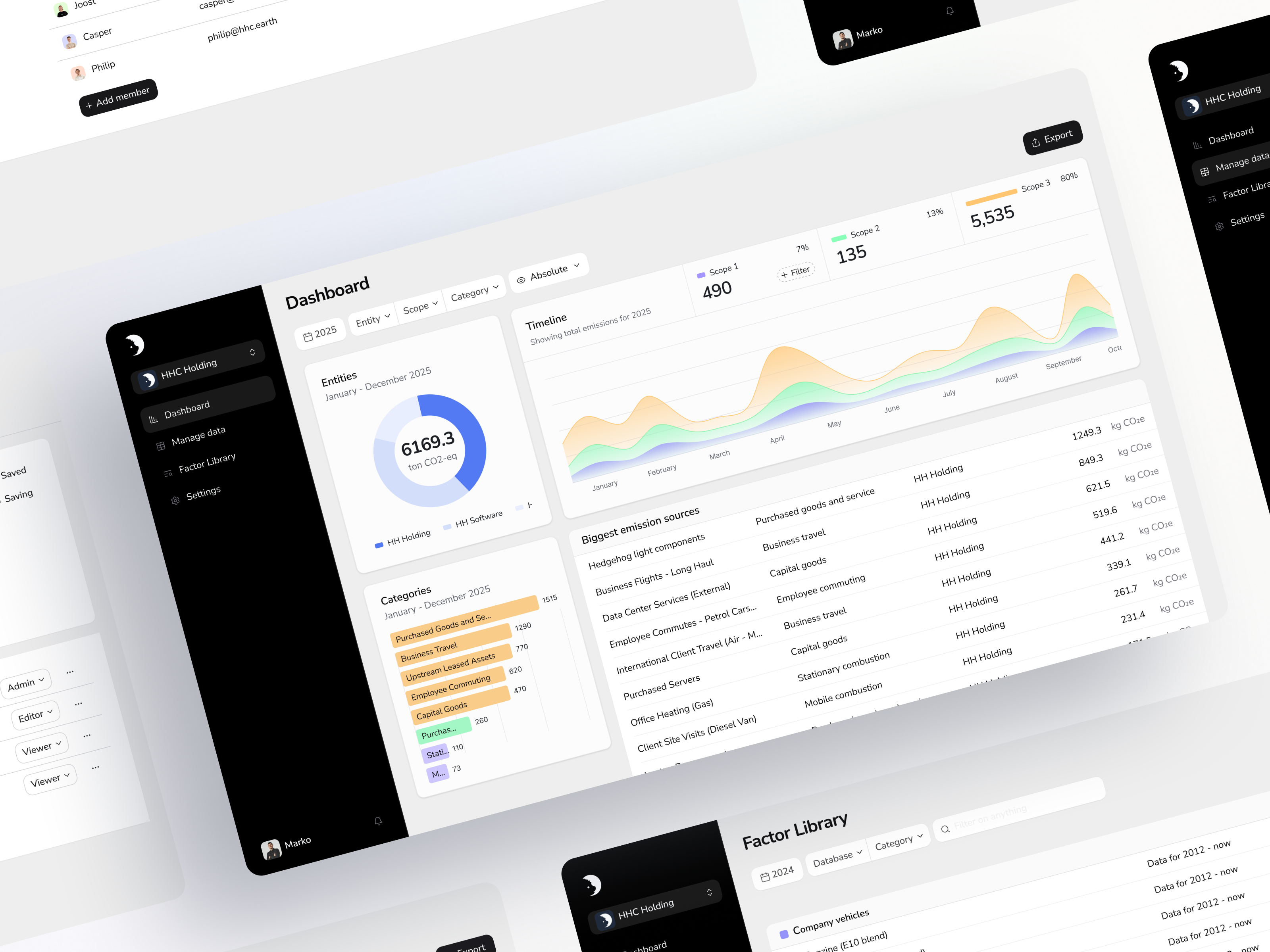
The platform guides you through GHG Protocol setup and inventory building with an AI guide, walking you through identifying your data sources, data owners and documents, and human GHG experts are reachable inside the product, which matters when there is nobody in the building who has done this before. It holds over 20,000 spend-based and activity-based factors, so a purchase ledger can be mapped without you sourcing factors yourself, and you can add your own organisation-specific data where a supplier has given you a real figure.
Free account with no sales call, so you can find out what your own data supports before spending anything. Pro from EUR 1,200 per year. Pricing is published on our G2 profile, which is worth noting: we went to eleven competitor pricing pages on 27 August 2026 and reached eight of them, three returned a 404 and we can say nothing about those, and of the eight we read exactly one published plan prices, EcoHedge, with a free Lite tier and Express Growth at GBP 990 a year.
Two honest limits.
Loading the data is the work. A Small-Business reviewer said on G2 in August 2026 that once the data is in, everything works perfectly, and getting it in is the challenging part. With one site that is an afternoon of invoices rather than a quarter of ledger mapping, but it is still the part that takes your time rather than ours.
There is no forecasting. A Small-Business reviewer noted on G2 in August 2026 that forecasting would be nice and that we had said it is on the development list. If you want the tool to project next year's energy use, it does not do that today.
Also worth stating plainly: the platform does organisational footprints. Product footprints, meaning LCA, EPD, ECI (MKI in Dutch) and PCF work, are a service rather than a feature. A single-site manufacturer who needs a per-product number should treat that as a separate, advised piece of work.
What should you do first?
Collect twelve months of electricity and gas invoices and any fuel card statements. That is the whole input for scope 1 and 2.
If your energy sits in a service charge, email the managing agent today and ask for the sub-meter readings or the building total and your floor area share. That request takes weeks to come back and it is the only part of this with a lead time.
Then start a free account and get the first number out. Improve it when someone asks a harder question, which they eventually will.
Sources: the GHG Protocol Corporate Accounting and Reporting Standard for the scope definitions. Hedgehog platform and Hedgehog on G2, both read on 27 August 2026. The pricing census covers eleven competitors, whose own pricing pages were read on 27 August 2026; three of the eleven returned a 404 and are reported as unreached rather than as quote-only. Page verified 17 September 2026.
Facts on this page were last verified on 2026-09-17.

