
In short
- A wholesaler sits between two parties who both want the same numbers for different reasons.
- Almost the whole footprint is scope 3 category 1, so the purchase ledger is the project.
- Start spend-based across everything, then replace your top suppliers with real data.
For a wholesaler the rule that applies is not a statute, it is a customer. Larger retail customers remain in CSRD scope and push data requests down the chain, while your manufacturer suppliers ask for the same figures from the other direction, both on an annual cycle that peaks in the first quarter. Your emissions are almost entirely scope 3 category 1, purchased goods, with warehouse energy and outbound transport a distant second. So the software has to turn a purchase ledger into a category-level footprint, and produce it per customer, per product group and per year.
You are in the unusual position of being asked by both sides of your own trade. That is annoying, and it is also the argument for doing this once, properly.
Which rule actually applies, and when?
Nothing addressed to you. Everything addressed to the people you sell to and buy from.
Downstream. Retail and corporate customers that are in scope for their own reporting need purchased goods data from their suppliers. You are a supplier. The request usually arrives as a spreadsheet from procurement, timed to their reporting cycle.
Upstream. Manufacturers building their own downstream picture ask distributors what happens to their product after it leaves the factory: where it went, how far, in what quantity. That request tends to arrive through the account manager rather than procurement, which means it lands on commercial rather than finance.
The practical timing is the same in both directions. Assume the questions arrive in the first quarter and that the year they ask about is the one that has just closed. Which means the data work happens in the year you are in now.
Where do wholesale emissions actually sit?
Overwhelmingly in what you buy. This is one of the sectors where the company footprint and the purchase ledger are close to the same document.
| Source | Scope | Share of a typical wholesale footprint | Data source |
|---|---|---|---|
| Purchased goods for resale | 3, category 1 | Dominant | Purchase ledger by category |
| Warehouse and office energy | 1 and 2 | Small | Meters and utility bills |
| Outbound transport and last mile | 3, category 4 or 9 | Small to moderate | Carrier invoices, tonne-kilometres |
| Own fleet, where you run one | 1 | Small | Fuel cards |
| Purchased services and overheads | 3 | Small | Ledger |
The consequence is uncomfortable and worth saying out loud to your board before you start: almost none of your footprint is under your direct control. You do not manufacture it, you resell it. Reduction, for a wholesaler, means changing what you buy or who you buy it from, and that is a commercial decision rather than a facilities one.
Why is the purchase ledger the entire project?
Because the ledger was built for finance and you are about to ask it a physical question.
The finance system knows you spent EUR 4.2 million with a supplier last year. It very often does not know how many kilograms of what that bought. Spend-based accounting bridges the gap by applying an emission factor per euro of spend by category, which is a legitimate and widely used method, and which has one obvious weakness: if you negotiate a better price for the same physical goods, your calculated emissions fall. Nothing about the world changed.
That does not make spend-based the wrong starting point. It makes it the right starting point and the wrong ending point.
The realistic path is three steps. Categorise the whole ledger and run it spend-based, so you have a complete number nobody can call incomplete. Identify the handful of suppliers or categories that produce most of the total, which in wholesale is usually a very short list. Then replace just those with supplier-specific or activity-based data, and leave the long tail on spend.
This is the point where most wholesalers benefit from help with the category mapping specifically, which is what scope 3 consultancy is for.
What does a distributor need from the tool?
Five things, and the first three are non-negotiable for a distributor.
A ledger import that survives your category structure. You have thousands of lines and your own product groups. If mapping them to emission categories is a manual exercise every year, the tool has not solved your problem.
Both spend-based and activity-based methods in the same inventory. You will run a mixture for years. A tool that forces one method makes the transition impossible to stage.
Supplier-specific factors you can add yourself. When a manufacturer sends you their product carbon footprint, you need somewhere to put it that overrides the generic factor and keeps the source recorded.
A split by customer or product group. Your downstream customers want their share, not your total.
A year-on-year series that holds when factors update. Ask directly whether you can restate a prior year and still keep the original figure.
What does this do for the commercial conversation?
More than most wholesalers expect, which is the part worth planning for rather than discovering.
Once the ledger is categorised, you know which of your suppliers carry the highest embedded emissions per euro you spend. That is a procurement lever and a range-planning input, not just a reporting output. It is also the answer to the manufacturer who asks what you are doing about it.
In the other direction, it lets you answer a customer request in a day rather than a fortnight, which in a low-margin trade where switching costs are small is a real retention argument. We go through what to weigh when choosing between tools in choosing carbon accounting software for SMEs.
How does Hedgehog handle a purchase ledger, and what does it miss?
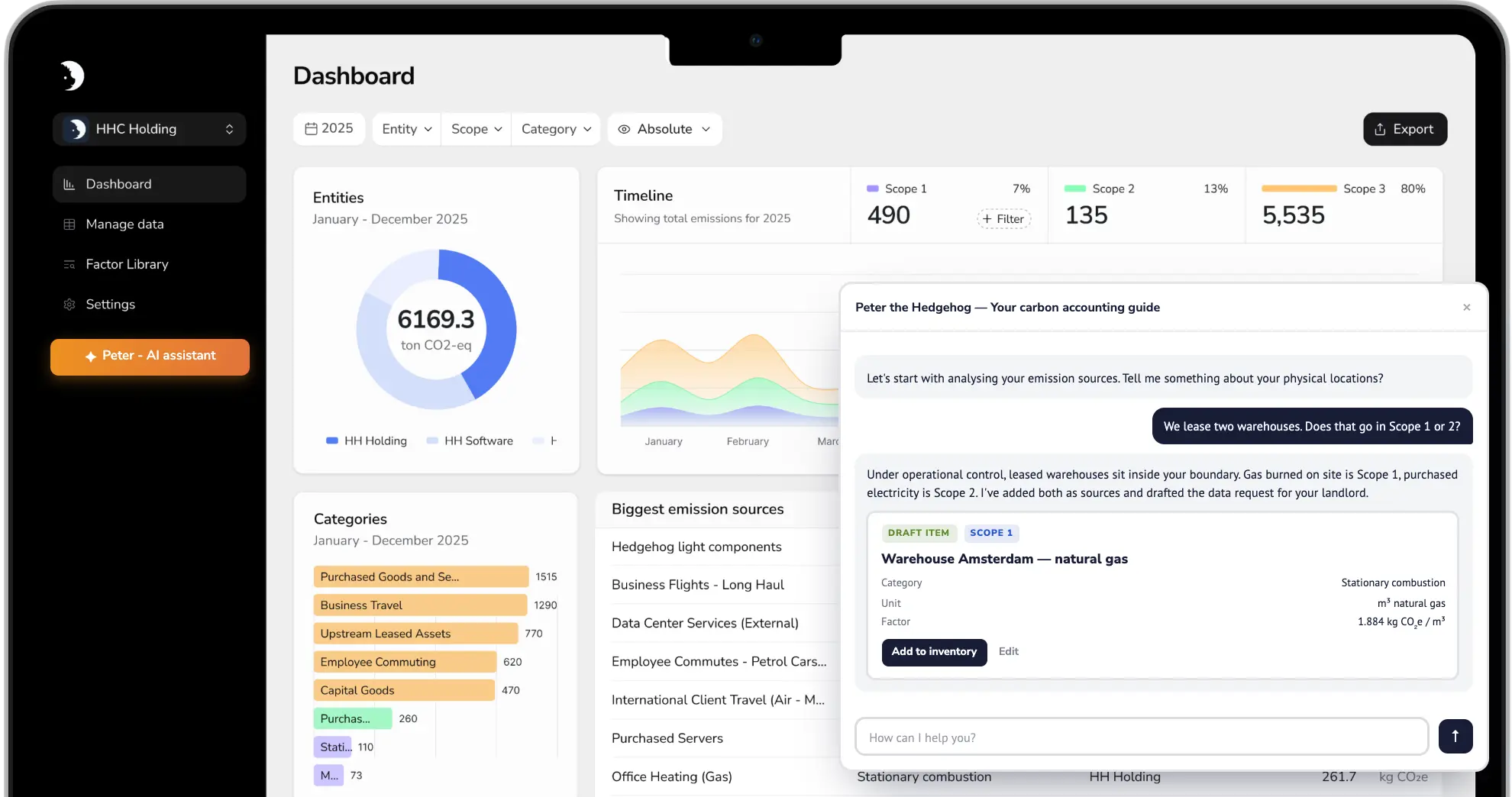
The platform carries over 20,000 spend-based and activity-based factors and lets you add organisation-specific or supplier-specific CO2 data, which is exactly the mixed-method setup a distributor needs. An AI assistant guides GHG Protocol setup, inventory building, data upload and reporting. Locations and sites are managed as entities, with separate roles for data owners, auditors and managers. Reporting covers the GHG Protocol, PPN 006 and the CO2-Prestatieladder, and there are workflows for SBTi, B-Corp and EcoVadis. The interface is available in English, French and Dutch, which matters for a Benelux operation. A free account requires no sales call, and Pro starts at EUR 1,200 a year.
Two honest limits.
The first import is real work. A customer said on G2 in August 2026 that once the data is loaded everything works perfectly, and getting it loaded is the challenging part. For a wholesaler that means the category mapping, and it is worth doing carefully once rather than badly three times.
Article-level numbers are not a platform output. Organisational footprints are what the platform builds. A declared footprint for a specific article you distribute is LCA, EPD or PCF work, delivered as consultancy, and it needs data from whoever manufactured the product.
What should you do first?
Export twelve months of purchase lines with supplier, category and value. If that file exists, you can have a complete spend-based footprint quickly, and the rest is refinement.
Then pick the three suppliers that dominate it and ask them for their product data. You will find out something useful either way: either you get better numbers, or you learn how far up your own chain the data actually stops.
You can start a free account and test one category before committing to anything.
Sources: Hedgehog platform, Hedgehog on G2. Verified 27 August 2026. CSRD scope has been revised, so confirm your customers' current status against the primary source rather than assuming.
Facts on this page were last verified on 2026-09-17.