
In short
- No dated Dutch procurement rule obliges an education institution to apply a CO2 criterion when it buys. We checked the primary sources and it does not exist.
- Most institutions are aanbestedende diensten and must tender above the EU thresholds, but that duty attaches no environmental criterion whatsoever.
- Two dated rules do sit nearby: the Rbsw, which is a vehicle quota, and WPM, which is a commuting report and is not procurement at all.
No. There is no dated Dutch procurement requirement obliging a school, an MBO institution, a hogeschool or a university to apply a CO2 criterion when it buys. We checked the Aanbestedingswet 2012, PIANOo's own education pages and the MVOI framework on 28 August 2026, and it does not exist. Most institutions are aanbestedende diensten, contracting authorities, and so must tender above the EU threshold values. That duty carries no environmental criterion at all. Two real dated rules sit nearby, and neither of them is what anyone means by procurement sustainability criteria. Three questions will tell you in a minute which of them, if any, touches you.
What is the test, stated exactly?
There is no single test, because there is no single rule. There are three separate questions and they have nothing to do with each other.
One. Are you an aanbestedende dienst? If your institution meets the criteria for a publiekrechtelijke instelling, a body governed by public law, you are a contracting authority and the Aanbestedingswet 2012 applies to you above the EU threshold values. Most Dutch education institutions are.
Two. Are you tendering for vehicles or for a covered transport service? If yes, the Regeling bevordering schone wegvoertuigen sets minimum clean-vehicle shares in that tender. If you buy no vehicles, this rule never touches you.
Three. Did you have 100 or more employees on 1 January? If yes, you have an annual reporting duty about commuting and business travel. It is real, it is dated, and it is not procurement. A change raising this threshold to 250 employees has been approved by the cabinet but was not yet in force in late August 2026, and is expected to take retroactive effect to 1 January 2026 once published — check the current threshold before relying on 100.
Nothing in that list is a CO2 criterion in buying. That is the finding.
What does being a contracting authority actually oblige?
Process, not content. PIANOo puts the scope plainly: "Veel onderwijsinstellingen zijn een aanbestedende dienst omdat zij voldoen aan de criteria voor een 'publiekrechtelijke instelling'." Many education institutions are contracting authorities because they meet the criteria for a body governed by public law.
What follows from that is the ordinary machinery of European procurement: publish above the threshold values, run a lawful procedure, treat bidders equally, award on the stated criteria. It tells you how to buy. It does not tell you what to buy, and it says nothing about carbon.
What does the nearest provision in the Act actually say?
Article 1.4 lid 2 of the Aanbestedingswet 2012 is the provision people reach for, and it is an open norm: "De aanbestedende dienst of het speciale-sectorbedrijf draagt zorg voor het leveren van zo veel mogelijk maatschappelijke waarde voor de publieke middelen." The contracting authority takes care to deliver as much societal value as possible for public money.
Read it again for what is missing. No environmental criterion. No mention of CO2. No threshold. No date. No method. It is a duty to think about public value, addressed to the buyer, with the content left entirely to the buyer. It cannot be cited as a carbon requirement, and anyone citing it that way has read the sentence and not the silence around it.
Which dated rules with an emissions dimension do reach an education institution?
| Instrument | Binding on you? | What it actually is |
|---|---|---|
| Aanbestedingswet 2012, art. 1.4 lid 2 | Yes, as an open norm | A duty to deliver societal value. No environmental criterion, threshold or date |
| Rbsw, Regeling bevordering schone wegvoertuigen | Yes, but only in a vehicle or covered transport tender | Minimum shares of clean vehicles. PIANOo names hoger onderwijs in scope |
| MVOI and the Manifest MVOI | No | Policy agenda plus a voluntary manifest. Signatories set their own ambition level |
| MVI-criteria per productgroep | No | Criteria documents PIANOo publishes for buyers to use. Tools, not clauses |
| Sectorale routekaarten onderwijsvastgoed | No | Sector-level Klimaatakkoord plans about buildings, not institution-level duties |
| WPM | Yes, if you had 100 or more employees on 1 January (a change to 250 is approved but not yet in force) | An annual kilometre report to RVO. Not procurement |
| CO2-Prestatieladder | No | Used by Rijkswaterstaat, ProRail and some decentral authorities in works tenders. Nothing verified extends it to education buying |
One row is deliberately absent. EED articles 5 and 6 carry a real reporting deadline of 1 December 2026 for overheidsinstanties, and RVO's list of those bodies covers Rijk, provinces, municipalities, waterschappen, agentschappen, politie, ZBOs, koepelorganisaties and regionale samenwerkingsorganen. Education is neither on that list nor excluded from it. We could not resolve it against a source that names education, so we will not tell you that deadline applies to you and we will not tell you it does not.
What do you do if the Rbsw catches you?
Treat it as a fleet question, not a carbon question. Reference period two runs from 1 January 2026 to 31 December 2030. Cars and light commercial vehicles carry a 38.5 percent minimum share, and from 1 January 2026 only zero-emission vehicles count toward it, where the previous period also allowed low-emission ones. Heavy vehicles are at 15 percent, up from 10, and buses at 65 percent, up from 45, of which at least half must be zero-emission.
What that asks of you is a specification decision in a tender document. It does not ask you to hold a footprint, calculate emissions or report anything.
What do you do if none of it catches you?
Then you have no procurement carbon obligation, and you should say so internally rather than letting an unexamined assumption drive a budget.
What genuinely drives measurement in this sector is not a rule. It is the energy bill, a governing body that has set a target, funders and research partners who ask before they attach their name to something, and students and staff who will check your arithmetic. Those reasons are better than a fictional one, because they survive contact with a finance committee.
What if a tender document has quoted a criterion at you?
Then that document is your requirement, and this page is beside the point.
A contracting authority may put an environmental criterion in a tender because it wants to. Several education institutions have signed the Manifest MVOI and published their own action plans, and those plans are that institution's own commitment, freely made. If you are a supplier and a real tender in front of you scores carbon, read the tender documents and answer them. Do not generalise from that one document to a sector-wide obligation, and do not accept the reverse generalisation from a vendor.
Where does the measurement work sit if you decide to do it anyway?
An organisational inventory, built once and repeated. For an education estate the first year is meter data, and commuting is the line that takes longest, because it does not exist until somebody runs a survey.
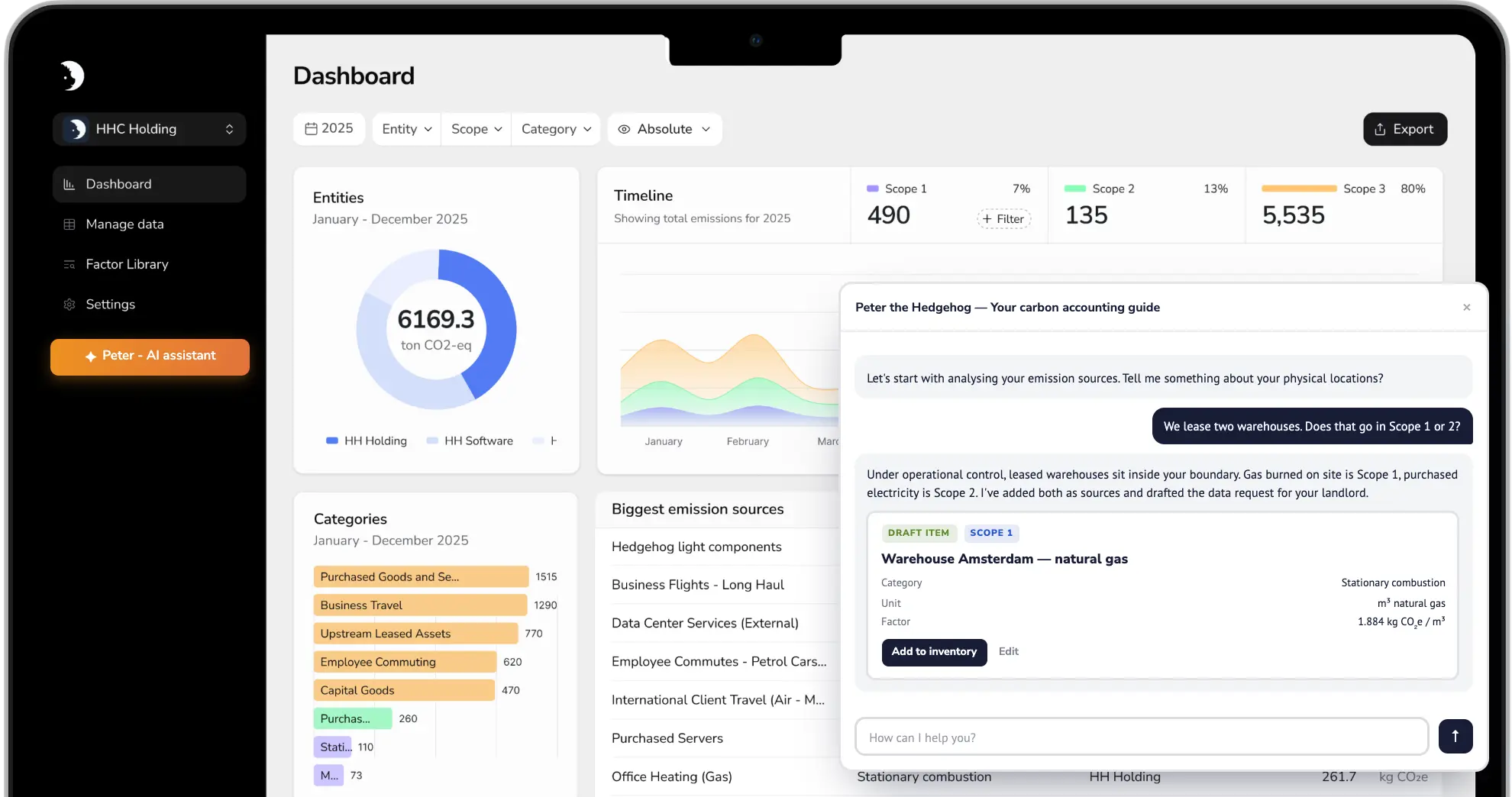
The Hedgehog platform manages multiple entities and sites with separate data owners, which maps onto a campus or a group of school boards, and reports 5,000+ users on its platform page. One limitation to weigh first: a mid-market reviewer on G2 in July 2026 noted that applied conversion factors and distance calculations are not exposed in the interface, so you cannot always trace how an input became an entry. If your governing body expects to interrogate the method behind a published figure, ask about that before you commit. Where the question is a deeper piece of analysis rather than an annual number, that is carbon footprint consulting work, and our guide to choosing carbon accounting software sets out the questions to ask any vendor.
Sources: PIANOo, inkopen door onderwijsinstellingen; Aanbestedingswet 2012 art. 1.4; PIANOo MVOI and Rbsw pages; RVO on the rapportageverplichting werkgebonden personenmobiliteit; Hedgehog platform; Hedgehog on G2. Verified 28 August 2026.
Facts on this page were last verified on 2026-09-17.