
In short
- Very few public buyers attach a number to carbon. In the Netherlands the clearest cases are Rijkswaterstaat and ProRail, both through the CO2-Prestatieladder.
- ProRail has awarded on the ladder since 1 December 2010. Nothing about it starts in 2027 except the handbook version.
- Each buyer sets its own staffel, so the same performance is worth different money at different buyers, and several reputations turn out to have no criterion behind them.
Far fewer public buyers score carbon than the conversation suggests, and the ones that do publish exactly how. In the Netherlands the two clearest cases are Rijkswaterstaat and ProRail, both through the CO2-Prestatieladder, and both with a published percentage attached to each level. The instrument is voluntary: no authority has to use it and no supplier has to certify. Its force is entirely commercial, which is also why it is worth more attention than the policy that surrounds it. This page lists who scores what, and names the places where a reputation for scoring carbon is not backed by any criterion at all.
Which public buyers actually attach a number to carbon?
| Buyer | Instrument | What it is worth | Since when |
|---|---|---|---|
| Rijkswaterstaat, GWW contracts | CO2-Prestatieladder, Handboek 4.0 | Fictitious reduction of the bid sum: 2 percent at trede 1, 4 at trede 2, 6 at trede 3 | Handboek 4.0 applied from 1 July 2026, to procurements published on TenderNed after that date |
| Rijkswaterstaat, GWW contracts | Milieu Kosten Indicator | A quality criterion inside the BPKV assessment. A lower MKI value scores better | Used on a large number of projects. Protocol 5.0 in force from 1 July 2026 |
| ProRail | CO2-Prestatieladder | Fictitious discount on the bid price, which ProRail says can run up to 10 percent | 1 December 2010 |
| ProRail, from 2027 | CO2-Prestatieladder, Handboek 4.0 | Provisional weighting of 4, 7 and 10 percent for treden 1, 2 and 3 | Intended for newly published procurements from 1 January 2027 |
| More than 300 other contracting authorities | CO2-Prestatieladder | Set individually per tender | Varies. SKAO reports use in more than 5,000 tenders |
| Dutch education institutions | None verified | Nothing | No dated CO2 procurement criterion exists for the sector |
Two things fall out of that table immediately. The same instrument is worth materially different money at different buyers, because SKAO sets no tariff and each authority writes its own staffel. And the list of buyers who score carbon with a published number is short.
What does Rijkswaterstaat score, and what is the trap in it?
Two separate things in the same assessment, which is where contractors lose money.
The CO2-Prestatieladder scores the organisation. Since 1 July 2026 Rijkswaterstaat runs it under Handboek 4.0, with a fictitious reduction of the bid sum of 2 percent at trede 1, 4 percent at trede 2 and 6 percent at trede 3, notional and applied only for ranking. Procurements published before that date stay under Handboek 3.1.
The MKI scores the project. It is a single monetised figure from a life cycle assessment, produced in a validated calculator such as Rijkswaterstaat's own DuboCalc against the agency's Protocol Berekenen en aantonen MKI waarde, and a lower value scores better. It rewards low-carbon asphalt and concrete, leaner logistics and less material.
They can appear in the same tender and they are not alternatives. An organisational carbon inventory does not produce an MKI value, and a good MKI value does not stand in for a trede. Conflating the two is the most common expensive error in this part of the market.
One change is coming that will move MKI scores across whole tender fields. From 2027 the European A2 weegset applies to projects published on TenderNed, taking the calculation from 11 to 19 environmental impact categories. Rijkswaterstaat expects MKI values to become on average roughly twice as high and says A1 and A2 results cannot be compared one to one. Rijkswaterstaat says only that it applies to projects published from 2027 and names no day, so treat any specific date you see as somebody's invention.
What does ProRail score, and since when?
The same instrument, a different number, and a much longer history than the coverage implies.
ProRail has applied the CO2-Prestatieladder in its procurement since 1 December 2010, using the tendering method SKAO recommends. A certificate gives an advantage in virtually all its tenders as a fictitious discount on the bid price, and ProRail says that discount can run up to 10 percent. Nothing about ProRail and the ladder begins in 2027.
What does change on 1 January 2027 is the handbook version. ProRail intends to use Handboek 4.0 for newly published TenderNed procurements where the ladder is an award criterion, with a stated weighting of 4 percent at trede 1, 7 at trede 2 and 10 at trede 3. ProRail's own wording is provisional throughout, it says voorlopig and voorgenomen, and it adds that a different weighting can apply to individual tenders. It also says its tender documents on TenderNed, not its website, are decisive for any given procurement.
Which buyers outside the Netherlands score carbon?
The clearest examples are British, and they work differently: they are gates rather than graded advantages.
UK central government procurement has run a carbon reduction requirement through Procurement Policy Note 006 for major contracts, and NHS suppliers face the NHS supplier roadmap and the Evergreen supplier assessment. Both are worth understanding as a pattern, because the mechanism is closer to a qualification test than to the Dutch fictitious discount. We cover each in detail separately: the PPN 006 checklist for UK suppliers and the NHS Evergreen supplier assessment. Read those before you assume a UK requirement behaves like a Dutch one.
Where is carbon not scored, despite the reputation?
Three places where the assumption is common and the criterion is absent.
Dutch education procurement. Most institutions are contracting authorities and must tender above the EU threshold values, but that duty attaches no environmental criterion. The nearest provision in the Aanbestedingswet, article 1.4 lid 2, is an open norm about delivering societal value for public money and names no environmental criterion, threshold or date.
MVOI. Maatschappelijk Verantwoord Opdrachtgeven en Inkopen is a policy agenda plus a voluntary manifest under which each signatory sets its own ambition level. It has no weighting and cannot be scored.
Public procurement generally. No Dutch authority is obliged to use the CO2-Prestatieladder, and use is a per tender choice. More than 300 contracting authorities have used it, which is a lot and is not all of them.
What do you actually have to produce?
Less at bid time than most bidders assume, and more afterwards.
You do not need to hold a certificate when you submit. You declare the CO2-ambitieniveau at which you will execute the contract, and you prove it during execution with a matching certificate or a project declaration. Rijkswaterstaat allows proof after the project finishes, or a year after award on longer projects. ProRail checks realisation during execution and accepts either project-specific evidence or a matching certificate.
The obligation is therefore back-loaded and enforced. At Rijkswaterstaat, failing to deliver the declared trede costs 1.5 times the fictitious advantage received. ProRail publishes no equivalent multiplier, and you should not assume one buyer's figure applies at another.
How do you decide what to chase?
By the increment, not the headline.
Moving up one trede is worth the difference between two rows, not the whole percentage. At Rijkswaterstaat that gap is 2 percentage points; under ProRail's provisional staffel it is 3. Weigh that against what the level costs to deliver: trede 1 wants scope 1 and 2 mapped with short-term goals, trede 2 adds quantified scope 3 and a klimaattransitieplan, and trede 3 wants a quantified route to zero by 2050 at the latest.
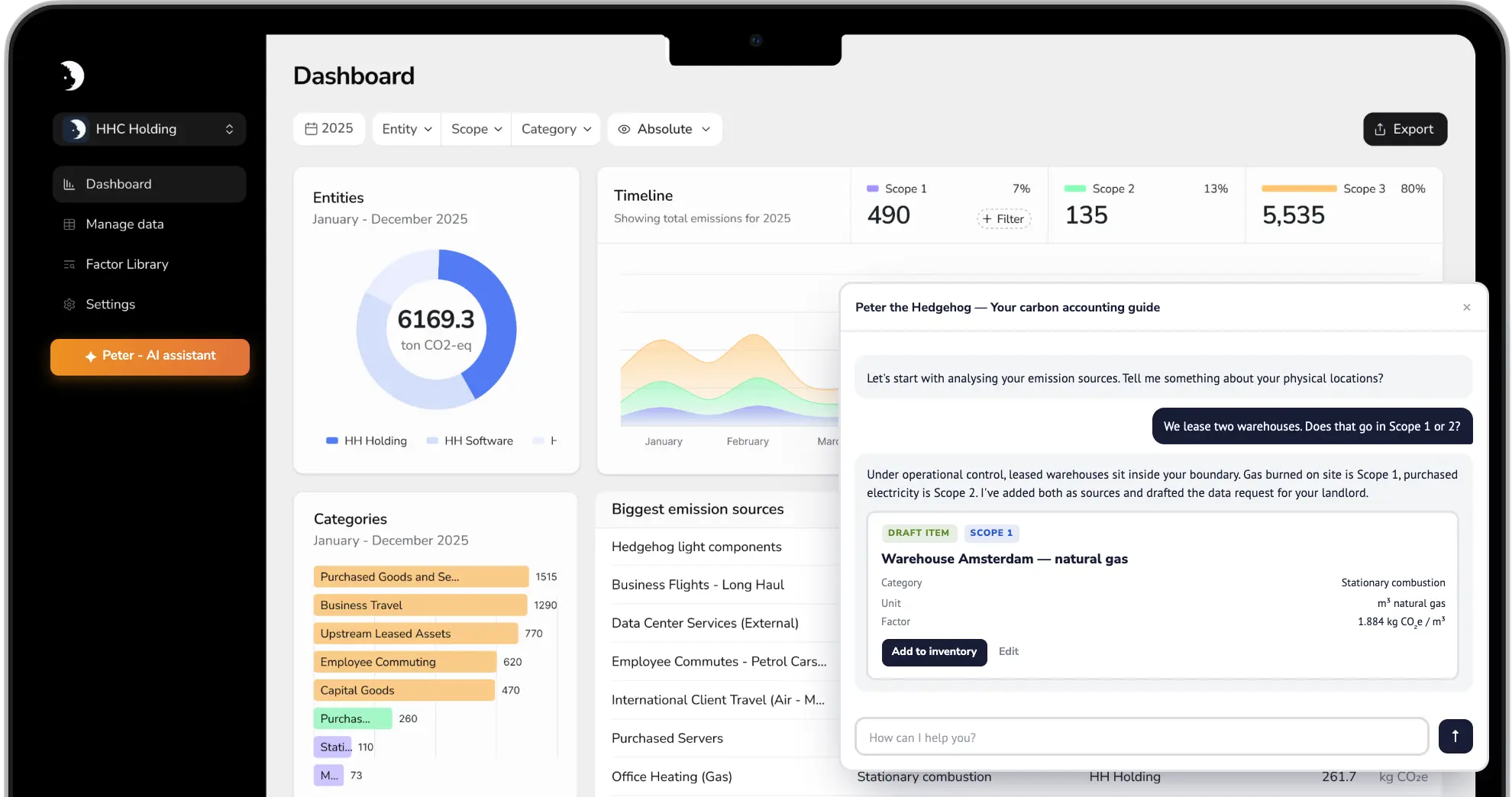
The work behind all of it is an audited organisational inventory somebody else can trace. The Hedgehog platform lists the CO2-Prestatieladder among its reporting outputs and reports 5,000+ users. One limitation to price in first: Hedgehog has few integrations with other software today, and a mid-market reviewer on G2 asked for more in June 2026, so plan for exports and manual loads rather than a feed from your project systems. Where the constraint is scope 3 for trede 2, that has a long calendar and belongs in scope 3 consulting rather than in a bid team's final fortnight, and our introduction to the CO2-Prestatieladder for SMEs covers the scheme itself.
Sources: SKAO scheme pages and Handreiking Aanbesteden 4.0; ProRail supplier page on the CO2-Prestatieladder; Rijkswaterstaat news of 18 March 2026 and 21 May 2026 and its duurzaam inkopen and DuboCalc pages; PIANOo on education procurement and MVOI; Aanbestedingswet 2012 art. 1.4; Hedgehog platform; Hedgehog on G2. Verified 18 September 2026.
Facts on this page were last verified on 2026-09-18.