
In short
- The four invalshoeken and the 90 percent weighted score are gone. You no longer pass a level by accumulating points across A, B, C and D.
- You choose a trede rather than climbing to it, which changes the conversation with your certifying body from ranking to scoping.
- What did not change is everything commercial: still voluntary, still no certificate needed to bid, and the buyer still writes the staffel.
Handboek 4.0 of the CO2-Prestatieladder, published on 14 January 2025, did not renumber the levels. It removed the machinery underneath them. Version 3.1 assessed you across four invalshoeken with a weighted score you had to clear; version 4.0 has no invalshoeken and no score. Five niveaus became three treden, and you choose the trede you certify against rather than climbing through the ones below it. It binds nobody, because the scheme is voluntary and SKAO owns it rather than the legislature. What it changes is what your certifying body asks for and how your own numbers have to be organised.
Which version is normative today?
Both, which is unusual and temporary.
Handboek 4.0 has been auditable since 14 July 2025. Handboek 3.1, published on 22 June 2020, is still a live text: audits against it are possible until 14 January 2027, and a certificate from a late 3.1 audit can stay valid until 14 January 2028. Anyone writing that the current version is 4.0 without that caveat is describing next year rather than this one.
One correction is worth making early because it distorts everything downstream. 14 January 2027 is the end of the transition period, not the publication of the handbook. Publication was 14 January 2025. The day and month are the same, which is how the error started, and the effect is to make the Dutch market look two years less advanced than it is.
What disappeared from version 3.1?
Three pieces of assessment machinery that shaped how certificate holders worked, and none of them has a successor in 4.0.
The four invalshoeken. Version 3.1 organises its requirements into A inzicht, B reductie, C transparantie and D participatie, each carrying its own weighting. Whole internal management systems were built around those four headings.
The weighted score. To pass a niveau under 3.1 you had to meet the general requirements, meet the minimum requirements for A, B, C and D at that level, and reach at least 90 percent of the weighted maximum, which is 22.5 of 25 points. That is a threshold with arithmetic behind it, and it is gone.
The climb. Version 3.1 is built on a capability maturity model. Each niveau contains the requirements of the ones beneath it, and an organisation sits at the highest niveau where it meets everything. What separated the levels was mainly scope: from niveau 3 you mapped scope 1 and 2 plus business travel and had to communicate externally, and from niveau 4 you also reported scope 3.
What replaced it?
A choice rather than a ranking.
| What changed | Handboek 3.1 | Handboek 4.0 |
|---|---|---|
| Levels | Five niveaus | Three treden |
| Model | Capability maturity. Each level contains the ones beneath it | You select the trede you certify against |
| Assessment | Minimum requirements per invalshoek plus at least 90 percent of the weighted maximum | Requirements of the chosen trede |
| Structure of requirements | Four invalshoeken: A inzicht, B reductie, C transparantie, D participatie | No invalshoeken |
| Scope at entry | Scope 1 and 2 plus business travel from niveau 3 | Scope 1 and 2 at trede 1 |
| Non-CO2 greenhouse gases | Optional | Mandatory at trede 1 |
| Scope 3 | Reported from niveau 4 | Quantitatively mandatory at trede 2 |
| Emissions outside scope 1, 2 and 3 | Not addressed | OBE, overige beinvloedbare emissies, qualitative at trede 2 and quantitative at trede 3 |
| Long horizon | None | Trede 3 requires a quantified route to zero emissions by 2050 at the latest |
Trede 1 covers reduction inside your own organisation with goals of one to three years, and SKAO says the effort is comparable to niveau 3. Trede 2 moves into the value chain and SKAO puts it at roughly niveau 5. Trede 3 has no equivalent in 3.1 at all.
The practical difference is the conversation you have with your certifying body. Under 3.1 the question was how high you could reach. Under 4.0 it is which trede you are scoping, and the answer is a decision rather than a result.
Which requirements are genuinely new work?
Four, and they are not evenly distributed across the treden.
Non-CO2 greenhouse gases at trede 1. Optional under 3.1, mandatory now. Your inventory becomes a full CO2-equivalent footprint from the entry trede up rather than a CO2-only one, which for many organisations means refrigerants and process gases entering the boundary for the first time.
Quantified scope 3 at trede 2. Under 3.1 scope 3 arrived at niveau 4 as a reporting duty. Quantifying it is a supplier data exercise with a long calendar, and it is usually the item that decides whether trede 2 is realistic this year rather than next.
The klimaattransitieplan. A climate transition plan, required at trede 2 across your core activities on a five to ten year horizon, and at trede 3 across all activities with a quantified route to zero.
The base year cap. Under 4.0 the base year at an initial audit may be no more than three years before the year of that audit, where earlier handbooks let you choose freely. Harmonisatiebesluit 3 of 1 June 2026 relaxes this only where a legal requirement demands an older base year.
Does a niveau convert into a trede?
Not as arithmetic, and this is where people get caught.
SKAO's equivalence advice exists for the transition only: where a buyer tenders on the 3.1 criterion and receives a 4.0 certificate as proof, accept trede 1 as niveau 3 and treden 2 and 3 as niveau 5. The reverse is not permitted at all. Where the criterion is 4.0, a 3.1 certificate is never acceptable proof, however long it remains valid.
Individual contracting authorities publish their own mapping and it is not always SKAO's. ProRail publishes trede 1 as equivalent to niveaus 1, 2 and 3, and treden 2 and 3 as equivalent to niveaus 4 and 5. Where a bidder is comparing, the tender documents decide.
There is also an audit-type trap sitting behind the equivalence. If you hold a valid 3.1 certificate and take a 4.0 audit for trede 1, you may continue your existing audit cycle. A 4.0 audit for trede 2 or trede 3 is always an initial audit, even for an organisation certified at niveau 5. Comparable effort does not mean comparable process.
What did not change at all?
Everything commercial, which is worth stating because the volume of writing about 4.0 implies otherwise.
The Ladder is still voluntary. It is not law, no organisation must certify and no authority must use it, and its force comes entirely from buyers attaching an award advantage to it. SKAO states it has been used in more than 5,000 tenders and by more than 300 contracting authorities. Bidders still do not need to hold a certificate to bid: you declare a CO2-Ambitieniveau and prove it during execution with a certificate or a projectverklaring. Each contracting authority still sets its own staffel, so the same trede is worth different money at different buyers. And the Ladder still certifies the organisation, not the product, so it produces no MKI value, no EPD and no product carbon footprint.
What does the change do to your own numbers?
It raises the bar on traceability rather than on ambition.
Evidence is now assembled in SKAO's online environment, Mijn CO2-Prestatieladder, the base year is constrained, non-CO2 gases are in from the first trede, and a certifying body still has to follow a reported figure back to its source. SKAO also keeps adjusting the rules after publication through harmonisatiebesluiten. The fourth, of 26 October 2026, says purchased green gas only counts at a green-gas emission factor if it meets the EU sustainability and greenhouse gas saving criteria, which the supplier shows with a Proof of Sustainability under an EU-approved scheme. That combination is what turns the Ladder from a spreadsheet exercise into a systems one.
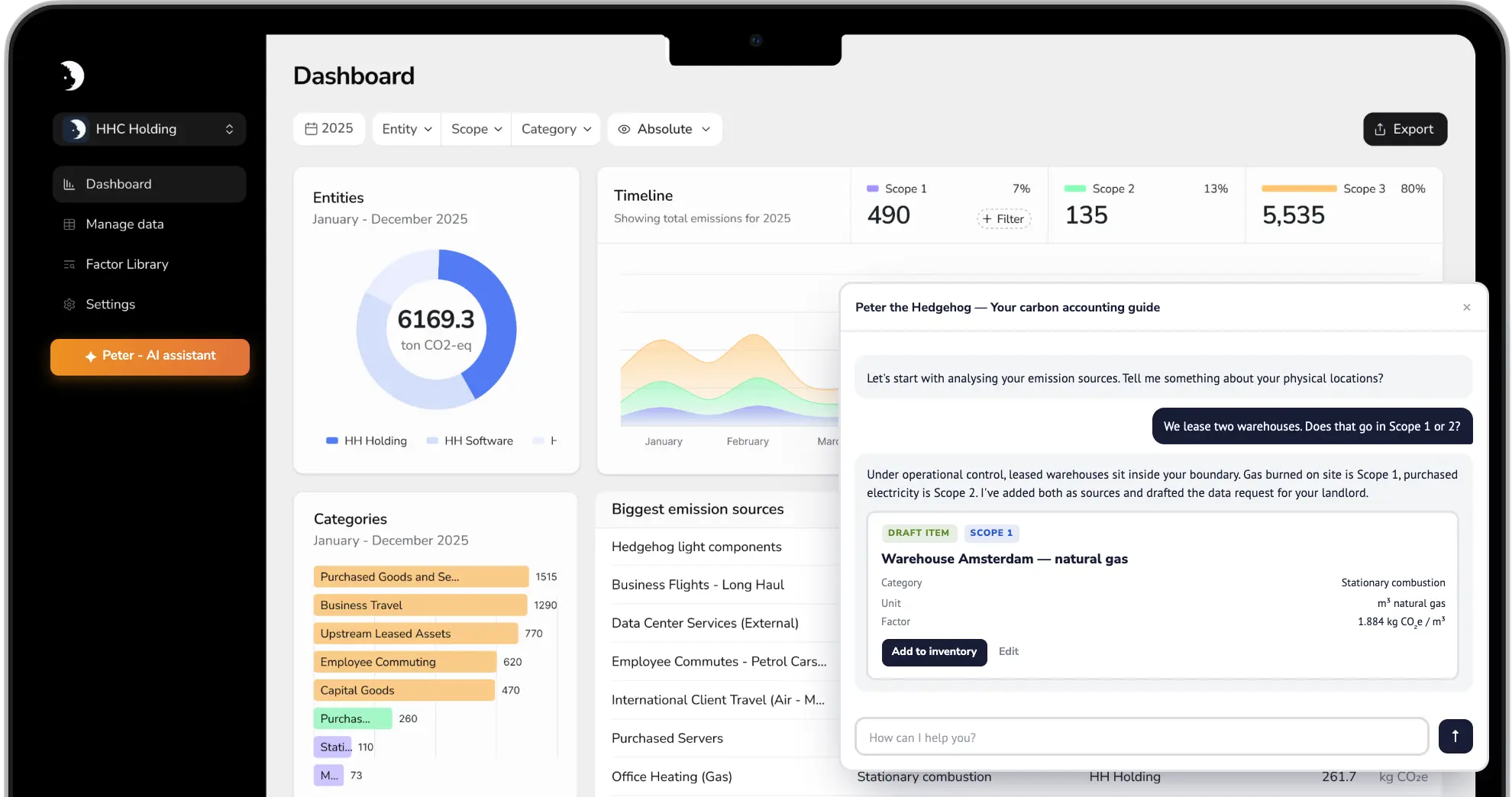
The Hedgehog platform names the CO2-Prestatieladder among its reporting outputs and reports 5,000+ users on its platform page. The limitation to test on your own data before an initial 4.0 audit rather than during one: a mid-market reviewer on G2 in July 2026 rated it 4 out of 5 and said the applied conversion factors and distance calculations are not exposed to the user, so you cannot always trace how an input became an entry.
If scope 3 quantification for trede 2 is the constraint, that is scope 3 consulting work with its own calendar. For the scheme itself from a standing start, read our introduction to the CO2-Prestatieladder for SMEs.
Sources: SKAO Overgangsregeling 3.1-4.0 v1.1 of 1 July 2025, Handboek 3.1, SKAO migration and scheme pages, Harmonisatiebesluiten 1 to 4, Handreiking Aanbesteden 4.0, Hedgehog platform, Hedgehog on G2. Verified 22 November 2026.
Facts on this page were last verified on 2026-11-22.

