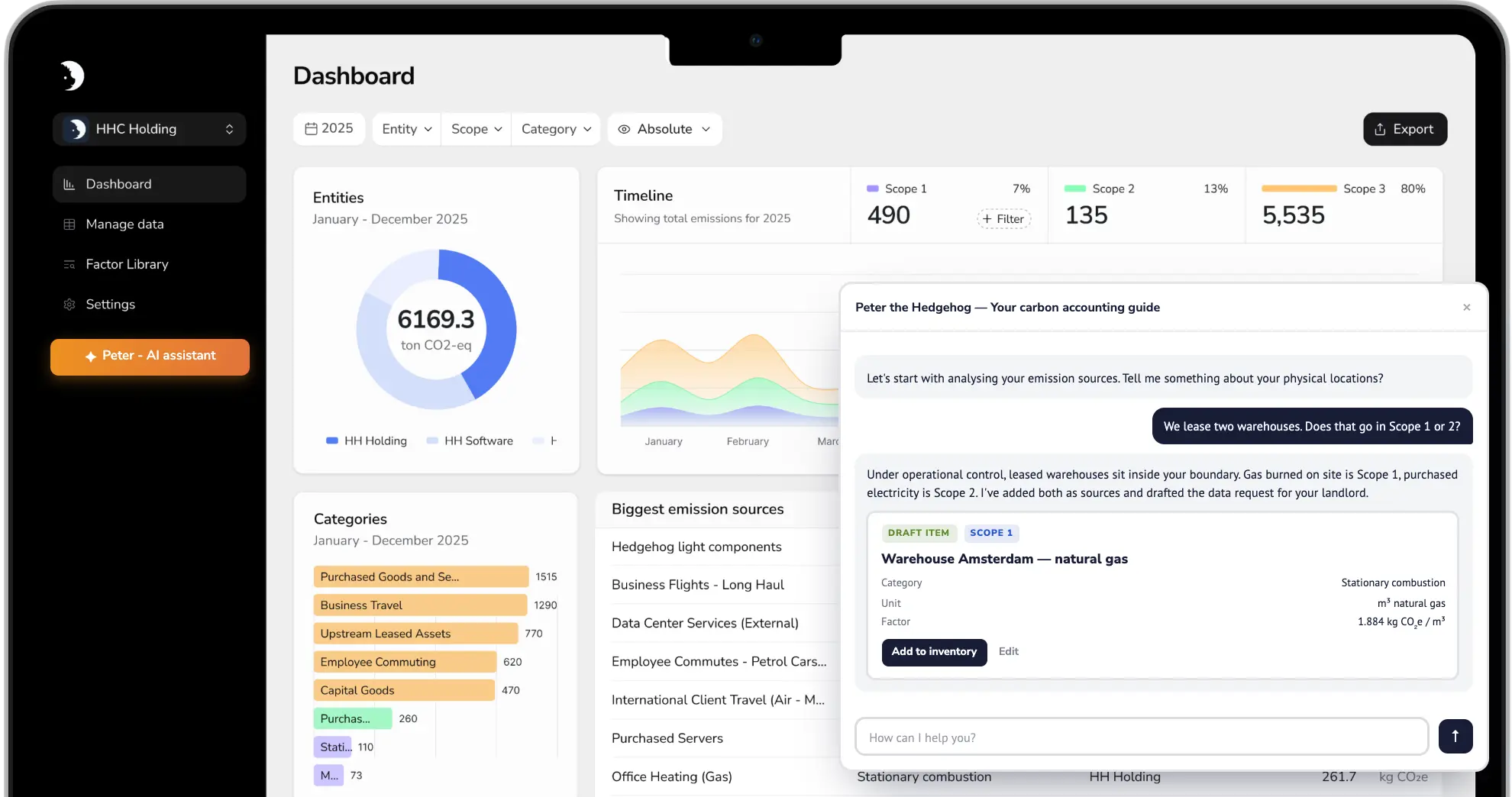

A carbon footprint calculator for business turns your energy, fuel, travel and purchasing data into kilograms of CO2e by multiplying each activity by an emission factor, and sorts the result into scope 1, 2 and 3. Hedgehog's free edition does this for your first footprint: up to five emission sources, one user and one company, with an AI guide and no sales call. The worked example below, a four-person office with four company cars, comes to 8.6 tonnes of CO2e a year for scope 1 and 2 with UK factors and 11.4 tonnes with Dutch ones.
What does a business carbon footprint calculator do?
It does three things, in this order.
It asks for activity data. How much natural gas, electricity and fuel you used, how far your cars drove, and, for a fuller picture, what you bought and how your staff travelled.
It applies emission factors. Each activity has a published factor: kilograms of CO2e per cubic metre of gas, per kWh, per kilometre driven. Good calculators use an official, dated factor set, such as the UK government conversion factors or the Dutch list at co2emissiefactoren.nl, and say which year they used.
It sorts the result by scope. The GHG Protocol, which most carbon reporting is built on, splits emissions into three scopes:
| Scope | What it covers | Typical SME sources |
|---|---|---|
| Scope 1 | Direct emissions from sources you own or control | Gas boiler, company and leased cars you run, refrigerant leaks |
| Scope 2 | Purchased energy | Electricity, district heating |
| Scope 3 | Everything else in your value chain | Purchased goods and services, transport, business travel, commuting, waste |
For most companies scope 3 is the largest part. Our guide to scope 1, 2 and 3 explains why.
How do you calculate your company's carbon footprint?
Five steps, whether you use a calculator, a spreadsheet or a platform.
- Set the boundary. Decide which sites and entities are in. Most SMEs include everything they operate.
- Pick the year. Use a full calendar or financial year, so next year compares.
- Collect the data. Gas and electricity from bills or meter readings, fuel and kilometres from fuel cards or logs, travel from expense claims.
- Apply dated factors. Use one official factor set for the whole year and record which one.
- Report and keep the workings. Total by scope, note what you left out, and keep the source of every number.
What does a worked example look like?
Take Erinaceus, a marketing agency with four employees. It has one small office on a standard (grey) electricity contract and four leased medium-sized diesel cars that it runs itself.
- Natural gas for heating: 1,500 m3 a year
- Electricity: 3,000 kWh a year
- Business driving: 7,500 km per car, 30,000 km in total
With the UK government's 2026 conversion factors:
| Source | Calculation | Emissions |
|---|---|---|
| Natural gas (scope 1) | 1,500 m3 x 2.02633 kg CO2e | 3,039 kg |
| Leased diesel cars (scope 1) | 30,000 km x 0.17209 kg CO2e | 5,163 kg |
| Electricity (scope 2) | 3,000 kWh x 0.13096 kg CO2e | 393 kg |
| Total scope 1 and 2 | 8,595 kg, about 8.6 t CO2e |
The same company calculated with the 2026 Dutch factors from co2emissiefactoren.nl comes to about 11.4 tonnes. That is not because one country is cleaner. The Dutch factors are well-to-wheel, so they include producing the fuel, and Dutch practice uses the grey-electricity factor for a standard contract (0.483 kg per kWh), which is far higher than the UK grid average. The lesson is general: say which factor set you used, and do not compare totals built on different ones.
Two choices in the example are worth flagging. Leased cars count as scope 1 here because the company operates them, and the GHG Protocol's control approach puts operations you control in your own scopes. And the example stops at scope 1 and 2: commuting, purchases and travel would add scope 3.
What does Hedgehog's free calculator cover?
The free edition of the Hedgehog Carbon Platform is a limited edition that stays free, not a trial on a timer.
| Feature | Free edition | Pro |
|---|---|---|
| Emission sources | Five | Unlimited |
| Users and entities | One user, one entity | Add colleagues, auditors, suppliers and consultants |
| Guidance | AI onboarding guide for your scope and first inventory items | AI guide plus human GHG experts in the app |
| Price | Free, no sales call | From EUR 100 a month, EUR 1,200 a year |
Five sources is enough for a first scope 1 and 2 footprint like the one above: gas, electricity and a fleet. The factor library holds more than 20,000 spend-based and activity-based factors, and Pro adds the rest of your emission sources, more users and more locations.
Our customers are open about where we fall short. A small business reviewer on G2 said in August 2026 that loading data takes effort, though it works well once loaded, and a mid-market reviewer noted in July 2026 that the conversion factors and distance calculations behind each entry are not shown to the user.
Is a free calculator enough?
For a first internal number, yes. It shows where your emissions sit and which reductions are low-hanging fruit, such as heating, the fleet and the electricity contract.
It stops being enough when someone else relies on the figure: a customer questionnaire with a deadline, a tender that asks for a prescribed document, or a second year that has to compare with the first. We go through those points in is a free carbon calculator enough? and compare plans in free vs paid carbon accounting software. If you are choosing between tools, start with our guide to carbon accounting software for SMEs.
How do you start?
Create a free account. There is no demo or sales call. The AI guide sets up your scope with you, and you can enter your first sources straight from your energy bills and fuel records.
FAQ
Is the Hedgehog carbon calculator really free? Yes. The free edition has no end date. It is limited to one user, one entity and up to five emission sources. Pro, with unlimited sources and more users, starts at EUR 100 a month.
Which emission factors does a business carbon calculator use? A good one uses an official, dated set, such as the UK government conversion factors (2026 edition published June 2026) or the Dutch list at co2emissiefactoren.nl, and tells you which year it applied.
How long does it take to calculate a business carbon footprint? A first scope 1 and 2 footprint for a small office can be done in an afternoon if your energy bills and fuel records are at hand. Scope 3 takes longer, because the data sits with suppliers.
Can I calculate scope 3 with a free calculator? Partly. A free tool can estimate a few categories such as business travel, but a full scope 3 inventory covers up to fifteen categories and usually needs spend-based estimates followed by supplier data.
Sources: UK Department for Energy Security and Net Zero, Greenhouse gas reporting: conversion factors 2026 (flat file revised July 2026); co2emissiefactoren.nl 2026 list; Hedgehog free edition and pricing from hhc.earth/platform, read 3 October 2026; Hedgehog on G2.


