
In short
- No tendering with 3.1 from 14 January 2027, and you switch at your first audit after it. Certificates can run to 14 January 2028.
- ProRail applies fictitious reductions of 4, 7 and 10 percent by tier on new tenders from 1 January 2027.
- The ladder is an audited certification, so the software has to show its working, not just a number.
The CO2-Prestatieladder is a certification scheme that buys you a discount on your bid price in Dutch public tenders, and Handboek 4.0 changes what your carbon tool has to produce. Version 4.0 was published on 14 January 2025 and replaced five niveaus with three treden. From 14 January 2027 authorities can no longer tender with 3.1 and you must have switched by your first audit after that date. Rijkswaterstaat has been on 4.0 since 1 July 2026 and ProRail follows on 1 January 2027.
If you are choosing software in the middle of that migration, three questions decide it: does it produce an auditable inventory, does it hold a comparable year-on-year series through a scheme change, and does it show its working to a certifying body.
What does the ladder actually require from a tool?
The ladder is a certification, not a report. An auditor checks your work. That changes what the software has to do.
An inventory an auditor can follow. Every figure needs a traceable route back to a source record: which invoice, which meter reading, which emission factor, which version of that factor. A dashboard number with no visible derivation is a finding waiting to happen.
A comparable base year. The ladder is about demonstrated reduction over time. If your method changes between years because you switched tools or switched factor sets, your reduction becomes unprovable. Keeping the method stable matters more than any single year's accuracy.
Scope 1, 2 and the ladder's treatment of chain emissions. How much of your value chain you have to address depends on the tier you are certifying to.
Documentation, not just data. Policy, targets, reduction measures and communication all form part of the assessment. The emissions figure is one input among several.
What changed in Handbook 4.0?
Three things matter commercially.
The deadline is fixed, and it is later than people think. Handboek 4.0 has been available since 14 January 2025 and certification against it since 14 July 2025. Audits against 3.1 run until 14 January 2027, after which authorities cannot tender with 3.1 and you must switch at your first audit. A certificate issued from a late 3.1 audit can stay valid until 14 January 2028, so the cliff edge is a transition, not a single day.
Five niveaus became three treden. SKAO puts trede 1 at roughly the effort of the old niveau 3, and trede 2 at roughly the old niveau 5, which requires quantified scope 3 and a climate transition plan. Trede 3 has no equivalent in 3.1 at all. A 4.0 audit for trede 2 or 3 is always an initial audit even if you held niveau 5, so a like-for-like comparison with your old level is misleading. Reporting greenhouse gases other than CO2 is now mandatory at trede 1, where it used to be optional.
The award advantage is set per authority, not by SKAO. Rijkswaterstaat moved to 4.0 on 1 July 2026 applying 2, 4 and 6 percent. ProRail switches on 1 January 2027 with a proposed 4, 7 and 10 percent that it calls provisional and that can differ per tender. SKAO's own worked example uses 5, 10 and 15 percent. Read the tender documents rather than any general figure, including this one. You also do not need a certificate to bid: you state the ambition level you will work at and prove it during execution.
That last point is the whole business case. A fictitious reduction is a discount applied to your bid for scoring purposes. A higher tier makes your price look lower against competitors. It is one of the few sustainability certifications with a directly calculable return.
We cover the scheme itself in more detail in our guide to the CO2-Prestatieladder for SMEs.
Where does the data actually come from?
For most organisations on the ladder, the inventory is assembled from four places.
Fuel. Fuel cards and, if you run one, fleet telematics. For contractors this is usually the largest scope 1 line, split between vehicles and plant.
Energy. Meter readings for every site. Watch the market-based and location-based distinction if you buy certified renewable electricity, because they produce different numbers and both can be asked for.
Business travel and commuting. Depending on tier, this is in scope and is usually the worst-documented category.
Purchased goods and subcontractors. For construction and infrastructure firms this dominates the total even where the tier does not require full treatment of it.
None of that is difficult in principle. It is tedious in practice, and it is the part that takes the time. One of our own customers put it plainly in a G2 review in August 2026: once the data is loaded it works perfectly, but getting it loaded is the challenging part. That is true of every tool in this market and anyone telling you otherwise is selling.
What should you check before you buy?
Ask for these specifically. Vendors answer them differently and the differences matter.
- Can I export an audit trail showing, for one figure, which source record and which factor version produced it?
- What happens to my base year when I change methodology? Can I restate prior years and keep the original alongside?
- Which emission factor set do you use, and how do you version it?
- Can the certifying auditor be given read access, or do I export documents for them?
- Does the reporting output match what the handbook expects, or is it a generic report I reformat?
That last question separates tools that support the ladder from tools that merely hold emissions data.
What does Hedgehog do here?
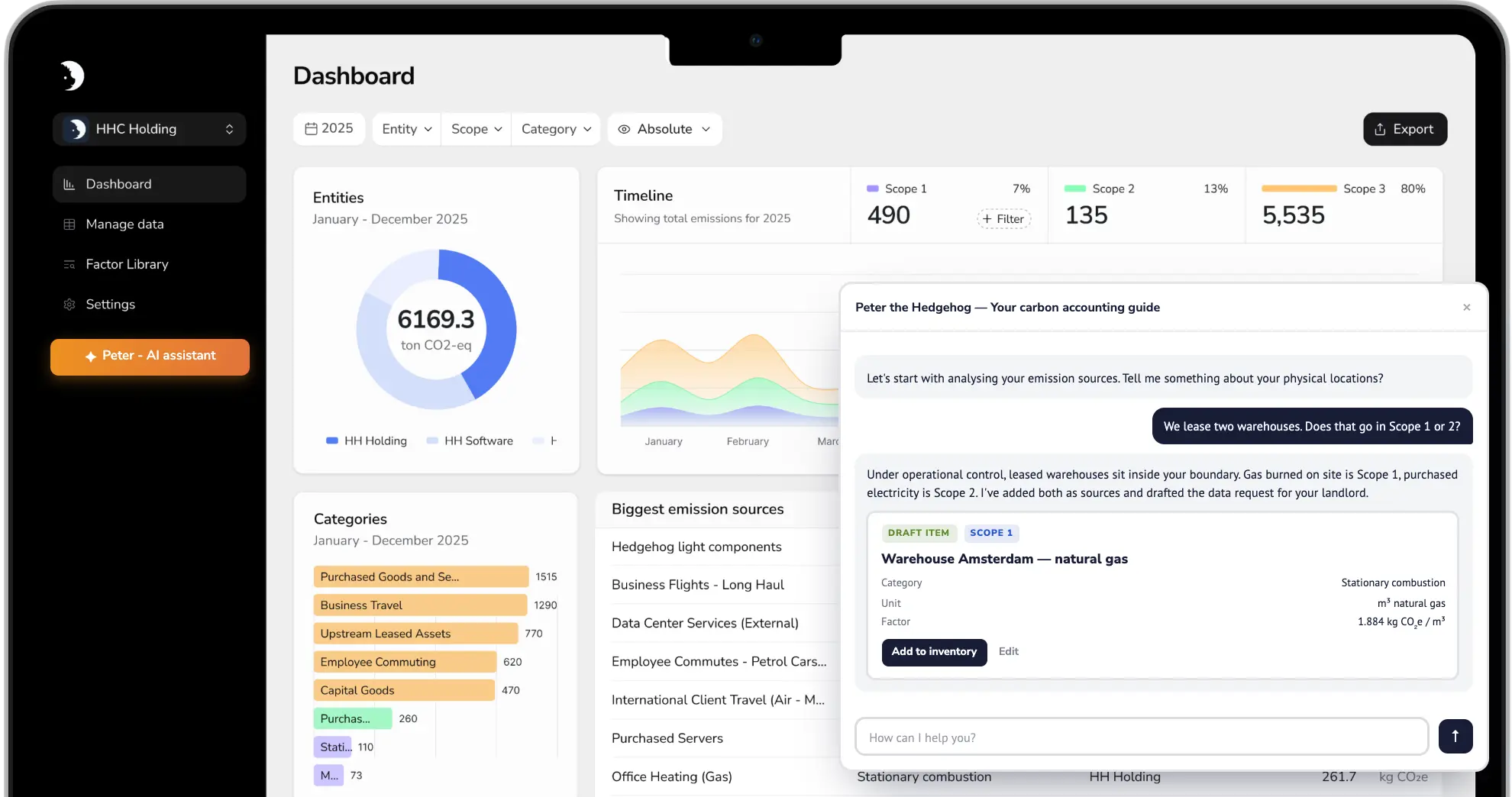
The Hedgehog Carbon Platform names the CO2-Prestatieladder as a reporting output, alongside PPN 006 for UK tenders and the GHG Protocol. The guided setup walks through the GHG Protocol, a data collection plan and the reporting framework, and human GHG experts are reachable inside the tool rather than through a support queue.
Pricing is a free account with no sales call, and Pro from EUR 1,200 per year.
Three things it does not do, which you should weigh.
It is not a broad ESG platform. If your obligation spans ESG data management and compliance reporting well beyond emissions, a customer of ours rated us 3.5 out of 5 on G2 and said exactly that. They were right.
Conversion factors are not always exposed in the interface. A reviewer asked for this in July 2026: they wanted to see which conversion factor had been applied to get from their input to the platform's entry. On a page about auditability, that is worth saying out loud. It is on the roadmap.
Product footprints are a service, not a platform feature. If you need an EPD for a material or a product carbon footprint, that is consultancy work. The platform does organisational footprints.
What should you do next?
If you are already certified, the migration to Handbook 4.0 is the forcing event and the useful first step is checking whether your current method survives it with your year-on-year series intact.
If you are not certified and you bid on Dutch public work, the tier calculation is the thing to run first. Work out which tier your competitors hold, what the fictitious reduction is worth on your typical bid value, and whether that exceeds the cost of certification. For most contractors bidding regularly it does, comfortably.
You can start a free account and build a first inventory before deciding anything, or book a call if you want the tier question worked through with someone.
Sources: SKAO Handbook 4.0, Hedgehog platform, Hedgehog on G2. Handbook dates verified 27 August 2026. Re-check against SKAO before relying on any date here.
Facts on this page were last verified on 2026-08-27.