
In short
- The 2027 NHS carbon reduction plan requirement goes further than PPN 006: global emissions and every relevant scope 3 category, published, from April 2027 -- NHS Evergreen itself is a separate, voluntary self-assessment tool.
- The footprint of a healthcare supplier sits in medical supplies and energy, with anaesthetic gases where the work is clinical.
- Build the inventory on a boundary that can widen, or you will do the exercise twice.
If you sell into the NHS, the rule that decides your software is the 2027 NHS carbon reduction plan requirement: from April 2027 suppliers publish their targets, their emissions and a carbon reduction plan covering global emissions and every relevant scope 3 category. That is a wider boundary than the UK public procurement baseline most suppliers built for. The emissions themselves sit mainly in medical supplies and purchased goods, in site and facility energy, and in anaesthetic gases where you are involved in clinical delivery. What the tool has to produce is a repeatable annual inventory across all three scopes, on a global boundary, with numbers you can publish and defend.
Which rule applies to healthcare suppliers, and when?
The 2027 NHS carbon reduction plan requirement is the one with a date on it. From April 2027, suppliers must publicly report targets and emissions and publish a carbon reduction plan that covers global emissions rather than UK operations only, and every scope 3 category deemed relevant, with a reasoned explanation for any deemed not relevant, rather than a named subset. This is a distinct obligation from NHS Evergreen, the supplier self-assessment tool that scores four maturity levels and is not itself a scored procurement requirement. Our walkthrough of the Evergreen supplier assessment sets out what the assessment actually asks for.
Alongside it, PPN 006 continues to apply to UK central government contracts above GBP 5 million a year. The plan is valid for twelve months at any given tender, but the Technical Standard tells suppliers to actually review and update it within six months of their own financial year-end, which is the tighter, binding deadline to run the business on. Many healthcare suppliers already hold one, which is exactly why the 2027 change catches them out: the plan they have is not the plan they will need. It also covers only five of the fifteen scope 3 categories, and purchased goods and services -- usually the largest single category for a device or supplies supplier -- is not one of them, so a supplier fully compliant with PPN 006 may never have calculated the number that actually dominates its footprint.
How is the 2027 NHS requirement different from PPN 006 in practice?
Four differences, and each one costs data.
| Requirement | PPN 006 | 2027 NHS CRP requirement |
|---|---|---|
| Geography | UK operations | Global emissions |
| Scope 3 | Five named categories | Every category deemed relevant, reasoned exclusion for the rest |
| Targets | Reduction targets in the plan | Targets published, alongside emissions |
| Trigger | Contracts above GBP 5m a year | Same GBP 5m/yr threshold, plus all new NHS frameworks regardless of value |
The geography change is the one that surprises manufacturers. If your plant is in Poland and your sales office is in Manchester, a UK-only plan captured the smaller half of your business. A global boundary means consolidating entities you may never have consolidated for this purpose before.
The scope 3 change is the one that costs the most hours. Moving from five categories to a full assessment means screening all of them, deciding which are material, and evidencing the ones that are. That is a scoping exercise before it is a calculation, and it is what scope 3 work is mostly about.
If you are also bidding for non-health public contracts, the PPN 006 checklist covers the narrower requirement you still have to keep current.
In the Netherlands the equivalent pressure is not a rule. The Green Deal Samen werken aan duurzame zorg, usually called Green Deal Duurzame Zorg 3.0, was signed in November 2022 and runs to 31 October 2026. It is a voluntary covenant between four ministries and the healthcare sector, and its own article 14a states that its commitments are not enforceable at law. Roughly 650 care organisations had signed it as of December 2025. It asks providers with more than 100 staff to map the CO2 of employee travel and draw up a mobility plan, and asks the parties to help those providers map indirect emissions from other hotspots where possible. Its targets are sector level: 55 percent less direct CO2 by 2030 against 2018, and climate neutral by 2050.
For a supplier that matters commercially rather than legally. It is why Dutch care customers ask you for data, and it is the opposite of the 2027 NHS carbon reduction plan requirement, which is a procurement condition with a date on it. If you sell into both markets, treat the Dutch side as a customer expectation you want to answer well and the English side as a gate you have to clear.
Where do healthcare emissions actually sit?
In three places, weighted differently depending on what you sell.
Medical supplies and purchased goods. For a distributor, a device manufacturer or a supplier of consumables, this is the bulk of the footprint and almost all of it is scope 3. Single-use items, packaging and sterile barrier materials add up quietly across millions of units.
Energy. Cleanrooms, sterilisation, cold storage and controlled environments make healthcare facilities energy-dense compared with ordinary commercial space. This is your scope 1 and 2, it is measurable, and it is where reduction projects are easiest to evidence.
Anaesthetic gases, where the work is clinical. For providers and for suppliers involved in clinical delivery, anaesthetic and medical gases are a distinct scope 1 line with a very different profile from fuel combustion. If they are in your operations at all, they need their own data stream rather than a line in the energy tab.
Where does the data come from?
Three sources, and the first one carries most of the weight.
Procurement spend. The purchase ledger, categorised. Start spend-based because everyone does, then replace your largest categories with supplier data. A spend-based inventory alone cannot demonstrate a reduction, because buying the same volume of lower-carbon product at the same price shows no movement.
Energy meters. Site by site, including any facility outside the UK now that the boundary is global.
Supplier data. Your own suppliers, asked for the same things the NHS is asking you for. Prioritise by spend and start with the top ten, not the top hundred.
What does the software have to produce?
Four outputs, and none of them is a dashboard.
A published document. The carbon reduction plan is a public artefact. Getting numbers out cleanly into your own document matters more than how they look in the product.
A boundary that can widen without a restatement crisis. If you built UK-only, you need a route to global that keeps a comparable base year. Ask any vendor exactly how a boundary change is handled before you commit.
Full scope 3 screening, then depth where it matters. All fifteen categories assessed, evidence collected for the material ones.
A stable annual method. Public reporting is a series. A method change between years reads as a reduction that is not one, and that is the failure mode a stable, published series is designed to catch.
What does Hedgehog do for NHS suppliers?
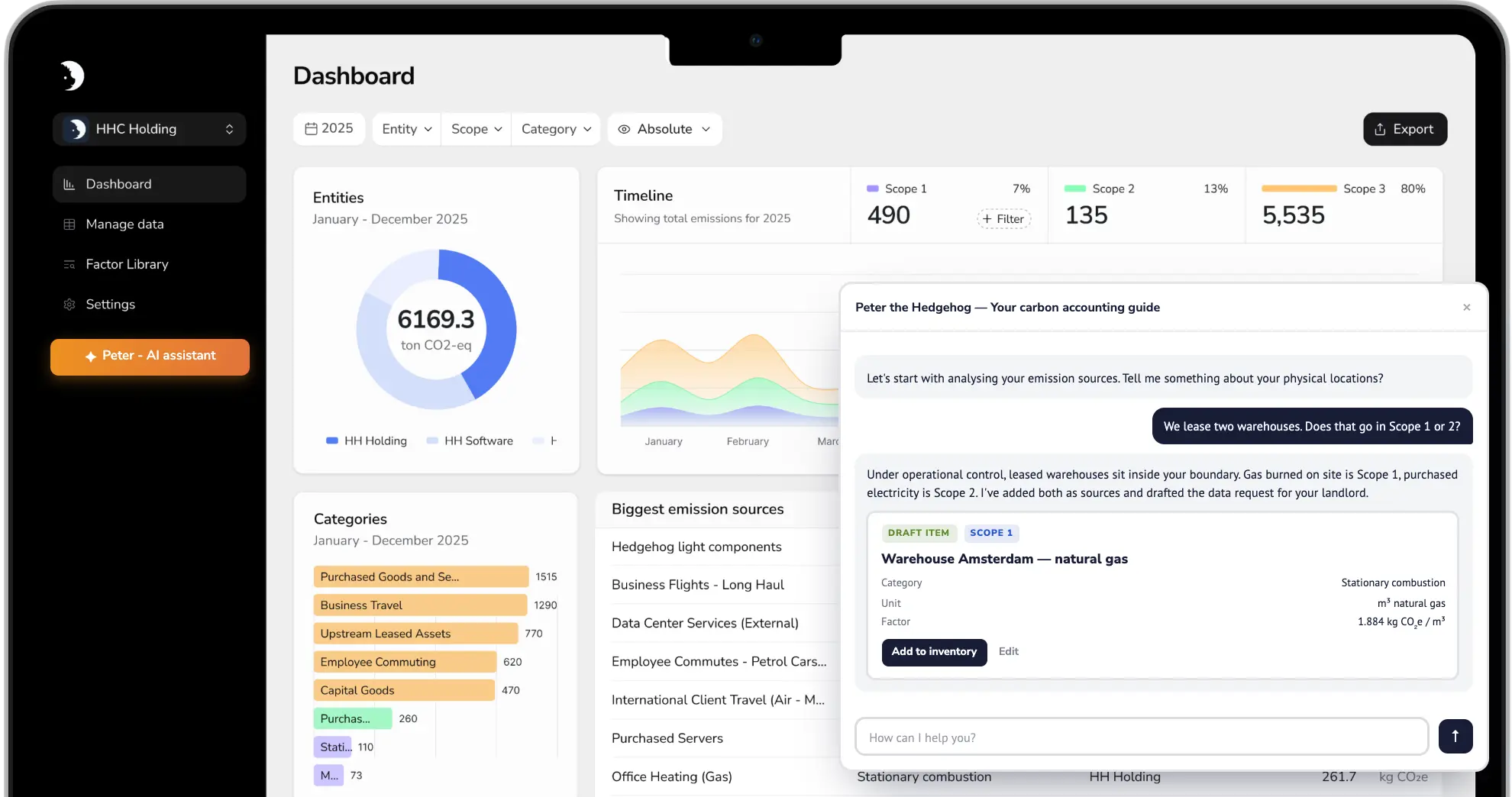
The platform names PPN 006 as a reporting output alongside the GHG Protocol and the CO2-Prestatieladder, and covers named legislation including CSRD, SECR and SB253. It guides you through GHG Protocol setup, inventory building, data upload and reporting with an AI assistant. It holds more than 20,000 spend-based and activity-based factors and lets you add organisation-specific or supplier-specific data, which is how procurement spend becomes something better than a proxy. Entity management across locations and sites, with roles for data owners, auditors and managers, is what a global boundary needs.
A free account needs no sales call. Pro starts at EUR 1,200 per year, priced on user seats and business entities.
Two limits worth knowing before you buy for the 2027 requirement specifically.
Target monitoring is not in the product. A mid-market customer rated us 3.5 out of 5 on G2 in June 2026 and said the platform is less complete for broader ESG reporting, with no data source management feature and no decarbonisation target monitoring. The 2027 CRP requirement asks you to publish targets as well as emissions, so plan for the target trajectory to live in your own document rather than expecting the platform to track it.
Loading the data is the work. A small business customer said on G2 in August 2026 that once the data is loaded everything works perfectly, and getting it loaded is the challenging part. For a supplier consolidating several countries for the first time, that is the honest shape of year one.
One scope note. The platform calculates organisational footprints. If a trust or a tender asks for a footprint per device or per product, that is LCA, EPD or PCF work, delivered as consultancy rather than as a platform feature.
What should you do first?
Check the boundary of whatever plan you already hold. If it says UK operations, list every entity and site outside the UK and estimate their share of turnover. That single figure tells you how much of the 2027 gap is a data collection project rather than a reporting exercise.
Then run a scope 3 screen across all fifteen categories at a coarse level to find out which four or five actually matter to you. Depth everywhere is not the goal, and it is not what the assessment is looking for.
You can build a first global inventory on a free account, or start with carbon footprint consulting if April 2027 is closer than your data is.
Sources: NHS England's 2027 NHS carbon reduction plan requirements and Evergreen sustainable supplier assessment, UK Cabinet Office Procurement Policy Note 006 and its Technical Standard, GHG Protocol Corporate Standard, Hedgehog platform, Hedgehog on G2. NHS and PPN 006 facts verified 17 September 2026; G2 and platform facts verified 27 August 2026. Due for re-check before any 2027 refresh.
Facts on this page were last verified on 2026-09-17.