
In short
- You get pulled in through your customers' value chain reporting long before any rule names you directly.
- CBAM has fixed dates for importers above 50 tonnes a year: definitive regime from 1 January 2026, certificate sales from 1 February 2027, first report and surrender 30 September 2027.
- Purchased goods and energy carry the footprint, and the bill of materials is the bridge between them.
Two things pull a manufacturer into carbon accounting. Customers in CSRD scope have to report on their value chain, so they send data requests down to their suppliers, and that happens whether or not any rule names you directly. CBAM runs on its own calendar: the definitive regime started on 1 January 2026, certificate sales open on 1 February 2027 for 2026 imports, and the first report and surrender fall on 30 September 2027. Your emissions sit in purchased goods and energy, with process emissions where your production creates them. The software has to build that from ERP purchase data rather than from meters.
Which rules actually apply to a manufacturer, and when?
Customer requests, continuously. Companies in CSRD scope must report value chain data, and the only way they can is by asking suppliers. This is the trigger for most manufacturers we speak to. It arrives as a questionnaire from a key account with a return date, not as a letter from a regulator, and the commercial consequence of ignoring it is a scoring penalty at the next tender.
CBAM, on fixed dates, and only above a threshold. The definitive regime has applied since 1 January 2026, for imports of cement, iron and steel, aluminium, fertilisers, electricity and hydrogen. Certificate sales for 2026 imports begin on 1 February 2027, and the first report and surrender are due by 30 September 2027. Those dates only bind you if your imports clear the threshold: an importer whose cumulative iron and steel, aluminium, fertiliser or cement imports do not exceed 50 tonnes a year is outside the regime entirely (there is no tonnage threshold for electricity or hydrogen). The Commission's own estimate is that the threshold exempts roughly 90 percent of importers while keeping about 99 percent of embedded emissions in scope, so weigh your annual tonnage before you chase a supplier for data. If you sell into a CBAM importer, they will be asking you for embedded emissions data regardless of your own exposure. Our CBAM explainer covers the mechanism.
The two obligations want different artefacts. A customer questionnaire wants an organisational footprint, ideally in a recognisable reporting format. CBAM wants embedded emissions for specific goods. Treating them as one job is the mistake that produces a number nobody can use twice.
Where do manufacturing emissions actually sit?
Purchased goods first, energy second, process emissions where relevant.
For most manufacturers the plant is the visible part and the smaller part. You can meter the compressors and the ovens precisely, and that precision buys you a modest share of the total. The material coming in through goods receipt, sitting in the ledger as thousands of purchase lines with a supplier, a value and a description, is where the footprint lives, and it has no carbon attached to any of it.
Process emissions are a separate matter. If your production chemically releases greenhouse gases rather than merely consuming energy, those emissions are scope 1 and they are yours. They are also the ones an auditor probes hardest, because they cannot be sourced from a supplier's factor and have to come from your own process data.
What data do you already have, and what is missing?
Four systems hold nearly everything. The gap is not data, it is structure.
| System | What it gives you | What it is missing |
|---|---|---|
| ERP purchase data | Every material line, supplier and value | A carbon category on each line |
| Energy meters | Site electricity, gas and heat | Split by production line or by product |
| Production volumes | The denominator for intensity | A link to the inputs that made it |
| Bill of materials | Material mass per product | Emission factors per material |
The bridge between the top row and the bottom row is the piece of work. Once purchase lines are mapped to material categories, and the bill of materials carries mass rather than only cost, a company footprint and a per product estimate come out of the same dataset. Skip the mapping and you are stuck with a spend-based total that will never demonstrate a change, because buying lower-carbon material at the same price shows up as no movement at all.
What does the software have to produce?
Five outputs, in the order customers ask for them.
An organisational footprint in a recognised format. Scope 1, 2 and the scope 3 categories that matter for you, in a form that maps onto whatever spreadsheet the customer sends.
A supplier-specific override. When a supplier hands you a real figure for a material, you need to swap it in for the generic factor and keep the old value visible for comparison.
Energy split you can defend. Market-based and location-based scope 2 give different answers, and questionnaires increasingly ask for both.
Year-on-year comparability. Factors update. Ask directly what happens to your base year and whether you can restate a prior year while keeping the original.
An export you can hand over. Every large customer has its own template. Test that with a real one during the trial.
If your customers are pushing specifically on value chain emissions, scope 3 support is the shape of that project, and what VSME is and what a customer may ask for sets the boundary on what they can reasonably require.
Company footprint or product footprint: which are you being asked for?
Read the question before you buy anything. Manufacturers get both requests and they need different work.
A company footprint answers how much your business emitted in a year. A product footprint answers how much one unit of what you sell carries with it, and it is an LCA exercise with its own rules, its own data depth and its own review. A platform that gives you an excellent company number will not produce a defensible product declaration, and vice versa.
What does Hedgehog do for manufacturers?
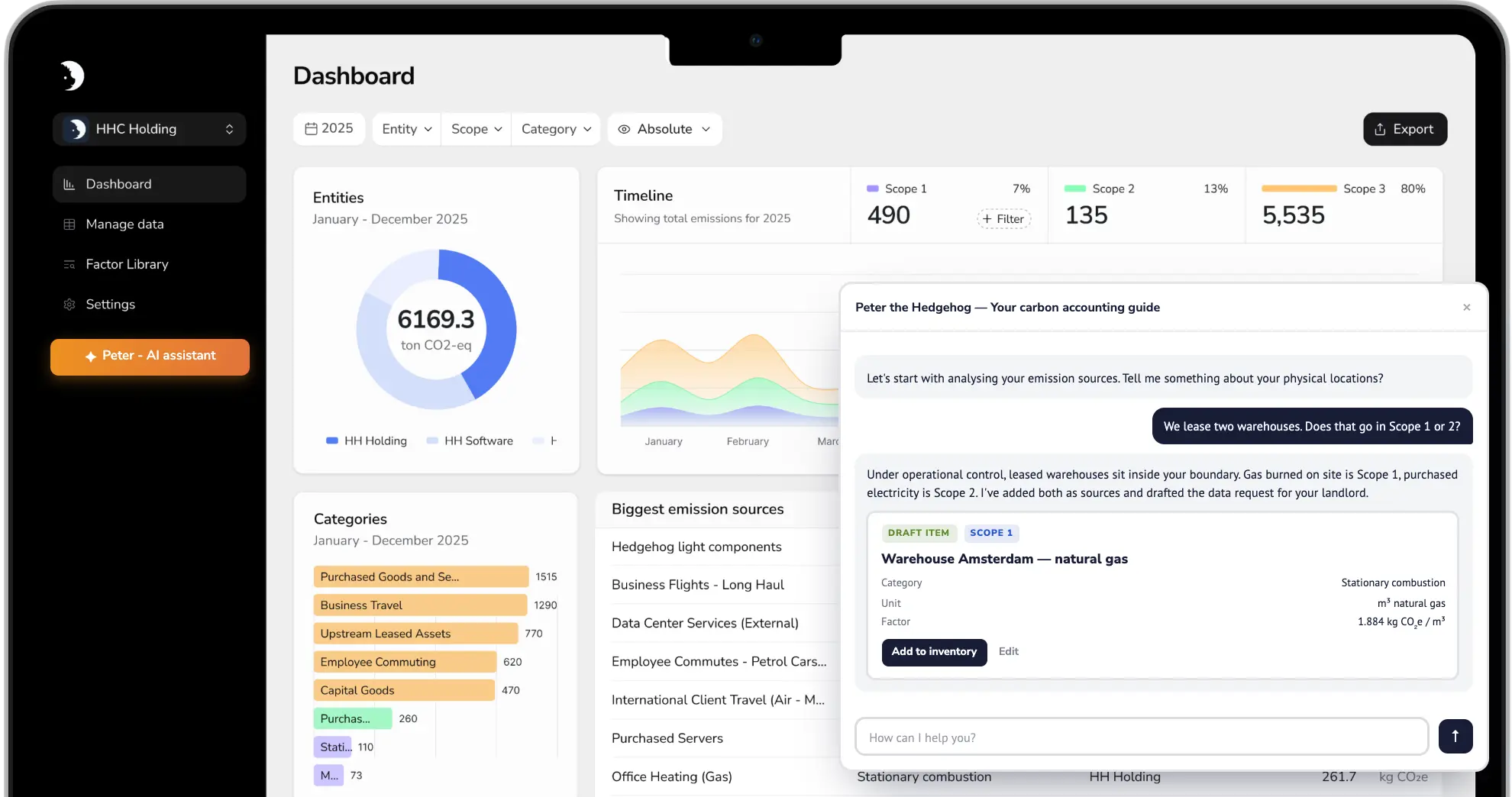
The platform guides you through GHG Protocol setup, data collection planning and inventory building, with an AI assistant for setup and human GHG experts reachable in the product. It carries more than 20,000 spend-based and activity-based factors and lets you add organisation-specific or supplier-specific CO2 data, which is the mechanism for replacing generic material factors as real supplier figures arrive. Named legislation support covers CSRD, SECR and SB253, and reporting outputs include the GHG Protocol, PPN 006 and the CO2-Prestatieladder. Multi-entity management handles several plants or operating companies. Free account with no sales call, Pro from EUR 1,200 a year.
Three limits, all stated by our own customers on a public page.
Getting the ledger in is the real project. A reviewer on G2, small business segment, said in August 2026 that once the data is loaded everything works perfectly and getting it in is the challenging part. With thousands of purchase lines, that is the first month.
It is not a broad ESG suite. A reviewer on G2, mid-market segment, rated us 3.5 out of 5 in June 2026 and said that for a broader ESG data and reporting platform this one is less complete, with no data source management feature and no decarbonisation target monitoring. If you need one system for all of CSRD, that is a fair reason to look wider. The distinction is covered in ESG reporting software versus carbon accounting.
Product footprints are a service. LCA, EPD, MKI and PCF work is consultancy, not a platform feature. The platform does organisational footprints.
What should you do first?
Find out whether your CBAM exposure is real. If you import more than 50 tonnes a year of iron and steel, aluminium, fertilisers or cement, or any electricity or hydrogen, the 2027 dates are fixed and they set your calendar. If you do not, drop it and move on.
Then pull twelve months of purchase data out of the ERP and look at the top fifty suppliers by value. That short list usually covers most of the footprint, and it tells you whether the mapping job is a week or a quarter.
You can start a free account and get a scope 1 and 2 figure out of your meters before you touch the ledger.
Sources: Hedgehog platform, Hedgehog on G2, Hedgehog industry fact base, Regulation (EU) 2023/956 as amended by Regulation (EU) 2025/2083. Verified 27 August 2026. CBAM dates are due for re-check before any 2027 refresh.
Facts on this page were last verified on 2026-09-17.