
In short
- Nothing forces a consultancy or agency to measure. Clients do, through tenders and procurement questionnaires.
- Travel, offices, purchased services and IT are the whole footprint. Purchased services is the line people forget.
- Report intensity alongside absolutes, or growth will read as a failure and headcount cuts will read as a success.
Almost nothing in law obliges a consultancy, agency or accountancy firm to measure its carbon footprint. Clients do it instead, through procurement questionnaires and tender criteria, and in UK central government consultancy contracts above the value threshold a published Carbon Reduction Plan under PPN 006 is a condition of participation. The emissions themselves are travel, offices, purchased services and IT, and the absolute number is small. What the software has to produce is not a reduction story but a defensible one: a repeatable inventory, an intensity figure, and an export that fits whatever template the client sends.
Which rule actually applies to a professional services firm?
Two, and only one of them is a rule in the ordinary sense.
Client procurement requests. Large clients ask professional service suppliers for carbon data in tenders. This is a commercial requirement, not a legal one, which makes it easier to ignore and more expensive when you do. There is no deadline until there is, and it is the tender date.
PPN 006. This applies to UK central government departments, executive agencies and non-departmental public bodies, not the whole public sector: local authorities and universities are not in scope, though many use equivalent wording of their own accord. On a contract above GBP 5 million a year including VAT, it is a condition of participation, checked pass/fail rather than scored: a published Carbon Reduction Plan covering scope 1, scope 2 and five named scope 3 categories, board-approved and director-signed, valid for twelve months from the plan's sign-off and publication but best kept current by reviewing it within six months of your financial year-end. If you bid for in-scope government advisory work above the threshold, this is a gate and there is no partial credit. The detail is in our PPN 006 checklist for UK suppliers.
Between those two sits the more common case: a client that is itself a large reporting company and needs value chain data from its suppliers. If you are on the receiving end of one of those and it is asking for far more than seems proportionate, there are limits on what can reasonably be demanded from a smaller supplier, which we cover in the value chain cap and the ESG questions you can decline.
Where do the emissions actually sit?
Travel, offices, purchased services and IT. There is no fifth thing, and there is no process to decarbonise.
| Source | Where the data lives | How hard it is |
|---|---|---|
| Business travel | Travel booking system, expense claims | Easy if you book centrally, painful if people book their own |
| Offices | Energy bills, landlord service charge | Easy when you have a meter, awkward in a serviced or shared office |
| Purchased services | Procurement spend | Easy to calculate, easy to forget entirely |
| IT and devices | Device inventory, cloud dashboards | Moderate, and mostly a boundary question |
| Commuting and homeworking | Headcount and a staff survey | Optional, political, and worth deciding once |
Two lines deserve attention because they behave differently from the rest.
Purchased services is the one that gets missed. A firm buying subcontracted specialists, print, events, software licences and legal advice is buying somebody else's emissions. It is calculated on spend, so it moves when fees move, and it is often larger than the travel line people assume dominates.
The office boundary needs a decision, not a calculation. In a serviced office with no separate meter you are estimating from floor area, and the honest thing is to say so in the method note.
Why is a small footprint harder to report than a large one?
Because the scrutiny does not scale down with the tonnes.
A manufacturer answering a client questionnaire has an obvious story: here are our processes, here is our energy, here is what we are doing about it. A forty-person consultancy has a footprint dominated by flights and a landlord's electricity bill, and a client questionnaire that asks the same fifty questions regardless.
That produces three specific difficulties.
Percentages swing wildly. One international project with heavy travel can move your total by a visible fraction. Reporting a rise in year two is normal for a growing firm and reads badly if you present absolutes alone.
Reductions are mostly other people's decisions. Your landlord's electricity contract, your client's insistence on being visited, your cloud provider's grid. There is real work available here, but it is procurement and policy work rather than engineering.
The comparison is unflattering by design. Clients frequently benchmark suppliers on absolute tonnes without normalising for size, so a firm that grew looks worse than one that shrank.
What does intensity do to your numbers when you grow?
It is the difference between a report that survives a growth year and one that does not.
Pick one denominator and hold it. The usual candidates for professional services are emissions per full time employee and emissions per unit of revenue. Per FTE is the more intuitive one internally and the one most staff can act on. Per revenue is the one clients and questionnaires tend to ask for.
Report both alongside the absolute figure, and state the denominator explicitly. A firm that adds thirty people and holds emissions per FTE flat has done real work. Presented as absolutes only, it looks like a firm going backwards.
The corollary is worth saying plainly: a headcount reduction is not a carbon reduction, and presenting it as one is the kind of claim green claims rules exist to catch. For the underlying mechanics, carbon accounting from scratch walks through them.
What does the software have to produce?
Four outputs. Everything else is convenience.
Scope 1 and 2 from bills you already receive. For most firms scope 1 is a short list or empty, and scope 2 is one or two meters. This should take days, not weeks.
The scope 3 categories clients actually ask about. Business travel, purchased goods and services, employee commuting, upstream transport where relevant. Not all fifteen.
An intensity figure with a stable denominator. So that the year-on-year story is about your firm rather than about your headcount.
An export into somebody else's template. Every client questionnaire is a different spreadsheet, and the value of measuring once depends entirely on handing the same numbers to each of them in the shape each one wants. Test that with a real client template before you buy.
What does Hedgehog do for professional services?
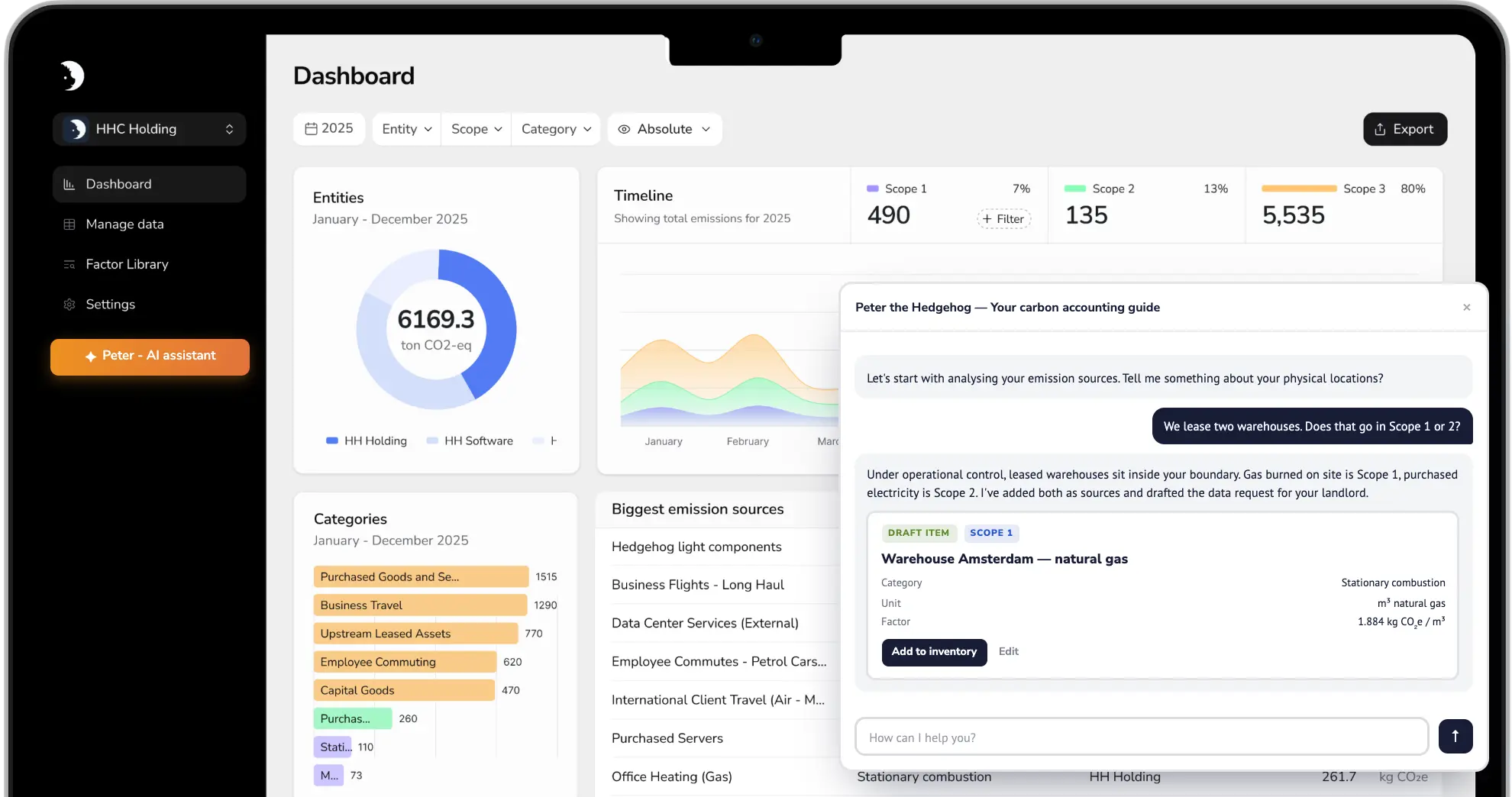
The platform guides you through GHG Protocol setup, a data collection plan and inventory building with an AI guide, with human GHG experts reachable in the product. It covers more than 20,000 spend-based and activity-based emission factors, which matters for a firm whose purchased services line is calculated on spend, and lets you add your own organisation-specific or supplier-specific data. Reporting outputs include the GHG Protocol, PPN 006 and the CO2-Prestatieladder, and there is support for SBTi, B-Corp and EcoVadis workflows. Entity management handles multiple offices with roles for data owners, auditors and managers.
Free account, no sales call. Pro from EUR 1,200 per year.
Three honest limits.
Loading the data takes real effort. A G2 reviewer said in August 2026 that once the data is in, everything works perfectly, and that getting it in is the challenging part. For a professional services firm the awkward part is usually travel: expense-claim travel has to be reconstructed line by line in a way that centrally booked travel does not.
It is not a broad ESG reporting suite. A mid-market reviewer rated us 3.5 out of 5 on G2 in June 2026 and said exactly that, noting no data source management feature and no decarbonisation target monitoring. Client questionnaires often ask about governance, diversity and policy alongside emissions, and those parts of the answer are yours to write.
Product footprints are a service. The platform does organisational footprints. Where a client wants a footprint for a specific engagement, event or product, that is LCA work, and it is delivered through carbon footprint consulting rather than in the tool.
What should you do first?
Do scope 1 and 2 this month. For most firms it is two bills and an afternoon, and it gives you a number to put in the next questionnaire rather than a blank.
Then pull twelve months of travel and twelve months of purchased services spend and see how far they get you. That combination usually accounts for most of a professional services footprint, and it tells you whether your gap is data or method.
If a tender is already live, the constraint is availability rather than analysis. Start a free account, load what you have, and be honest in the submission about which categories are estimated.
Sources: UK Cabinet Office Procurement Policy Note 006, GHG Protocol Corporate Standard, Hedgehog platform, Hedgehog on G2. PPN 006 facts verified 17 September 2026; G2 and platform facts verified 27 August 2026.
Facts on this page were last verified on 2026-09-17.