
In short
- A trede is worth a percentage off your bid price. ProRail has awarded on the ladder since 2010, so this is a live criterion, not a 2027 one.
- Materials and heavy plant are the footprint. Project cost breakdowns and plant hours are where the data already lives.
- Long project cycles wreck year-on-year comparability. Normalise against something, and decide what before your first report.
For Dutch rail and infrastructure contractors the rule that bites is the CO2-Prestatieladder, and it bites through the bid price. This is not a 2027 development: ProRail has awarded on the ladder since 1 December 2010 and Rijkswaterstaat moved to version 4.0 on 1 July 2026 at 2, 4 and 6 percent. What 2027 brings is the version change, when ProRail moves to 4.0 and authorities can no longer tender with 3.1. The emissions are materials and heavy plant, with the data sitting in project cost breakdowns, plant hours and material take-offs rather than in a utility bill. What the software has to produce is a certifiable organisational inventory, project-level visibility underneath it, and a number that survives a year in which your project mix changed completely.
Which rule actually bites, and when?
One rule, the CO2-Prestatieladder, and these are the dates that matter.
| Date | What changes |
|---|---|
| 1 December 2010 | ProRail has awarded on the ladder since this date. It is not new |
| 1 July 2026 | Rijkswaterstaat moved to version 4.0, applying 2, 4 and 6 percent |
| 1 January 2027 | ProRail switches to version 4.0. Its proposed staffel is 4, 7 and 10 percent, which ProRail calls provisional and which can differ per tender |
| 14 January 2027 | Authorities can no longer tender with 3.1, and you must switch by your first audit after this date |
| 14 January 2028 | The latest a 3.1 certificate issued before the cutover can still be valid |
A fictitious reduction is a discount applied to your bid for scoring purposes only. You do not lower your price; the evaluator treats it as lower. So a competitor one trede above you is, at an identical price, effectively cheaper by the difference between the two percentages, not by the full figure attached to their trede. On ProRail's proposed staffel that gap is three percentage points. ProRail says the ladder applies to almost all of its tenders rather than to every one.
Everything else about the ladder follows from that. The certification, the audit, the documented system and the reduction measures exist because a tier is worth money on the bid, and the tier is what is actually being bought. Our introduction is the CO2-Prestatieladder for SMEs.
What is a tier worth on your bid price?
Take your annual bid volume with ProRail and other awarding bodies that use the ladder, and apply the difference between your tier's fictitious reduction and the tier above. That is the annual value of moving up, against certification cost, audit cost and internal time.
For a contractor bidding regularly on Dutch infrastructure work, this arithmetic is usually not close. It is one of the very few places in carbon reporting where the return is a specific number rather than an argument about risk and reputation.
Two things temper it, and both are timing rather than value.
Certification is not fast. Moving up a tier involves an external certifying body and an audit. ProRail and Rijkswaterstaat do not ask for the certificate at bid time: you declare the tier you will execute at and prove it later, with a certificate or project-specific evidence. So a tier you offer but do not yet hold is one you must reach during or after the contract. Start well before the bids you want to offer it on.
The higher tiers ask for more than a number. They expect a documented system, evidenced reduction measures and, at the top, engagement beyond your own organisation. The inventory is the entry ticket, not the exam.
Where do rail and infrastructure emissions actually sit?
Materials and heavy plant. Offices and staff travel are rounding errors next to a season of piling, ballast and asphalt.
The practical consequence is that your data is project data, and it lives in systems built for cost control rather than for carbon.
Project cost breakdowns. Your best single source. Spend by material category converts to a usable first estimate quickly, and it is complete because nothing gets built without being costed.
Plant hours. Machine registers, hire invoices and fuel deliveries to site. This is where scope 1 concentrates, unusually large for a scope 3 dominated sector.
Material take-offs. The accurate route for the categories that matter. Concrete, steel, ballast and asphalt tonnages beat spend, because spend moves with commodity prices and tonnes do not.
Start on cost breakdowns for coverage and move the top three or four material categories onto take-offs. That gets you a defensible number in weeks rather than a perfect one in a year, and the categories you upgrade are the ones an auditor will look at anyway.
Why is year-on-year reduction so hard for a project business?
Because your reported footprint moves with what you happened to be building, not with how well you built it.
A year with a large tunnelling package shows far higher emissions than a year of track renewal, regardless of every decision your team made in between. Long project cycles make that worse: a three-year contract puts its materials into whichever year they were bought. Meanwhile the ladder and your customers both want a reduction trend.
Three practical responses, and you should choose before your first report rather than after your second.
Normalise against activity. Emissions per euro of revenue, per tonne of material placed, or per unit of output where your work is uniform enough to define one. Whatever you choose, define it precisely and never quietly change it.
Report the mix alongside the total. A note explaining that an increase came from a specific package is credible when written in advance and unconvincing when it appears only in the year the number rises.
Hold the baseline still. Every future comparison anchors on the base year. If you restate it, restate it visibly and keep the original alongside.
What to avoid entirely is presenting a quiet year as a reduction. It is not one, and describing it as one is the kind of environmental claim now squarely in regulatory scope.
What does the software have to produce?
Five outputs, in the order a tender manager needs them.
A CO2-Prestatieladder reporting output. In the format the certifying body expects, not a dashboard you transcribe by hand.
Scope 1 from plant and fleet. Fuel deliveries, hire records and machine hours, detailed enough to attribute fuel to sites.
Scope 3 from purchased materials. Spend-based for coverage and activity-based where you have tonnages, in one inventory, with the transition visible.
Project-level breakdown under the organisational total. The ladder is organisational, but your reduction measures and bid narratives are project-based. You need both views from one dataset.
A traceable audit trail. An assessor will sample entries and ask where each came from.
What does Hedgehog do for rail and infrastructure?
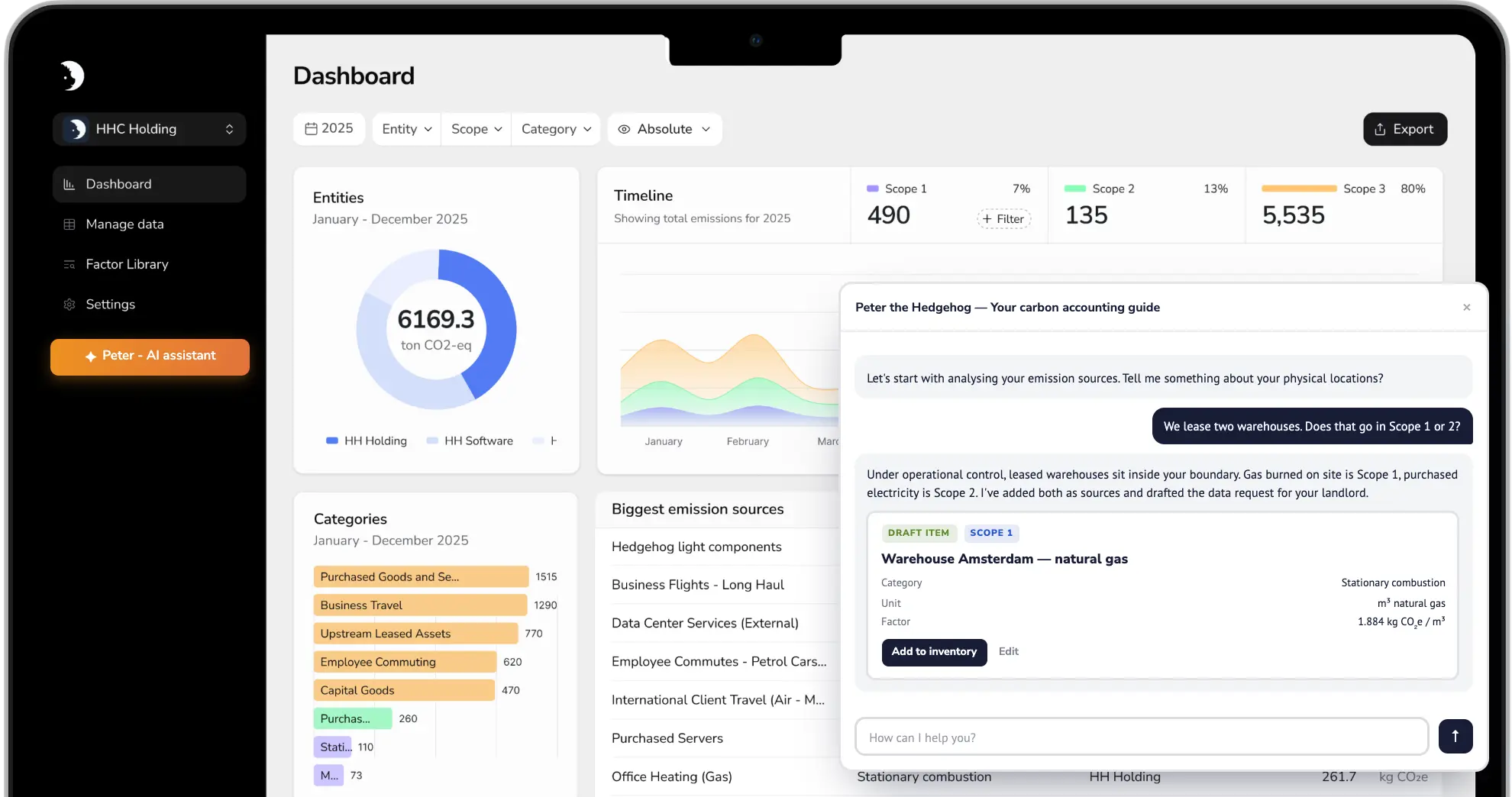
The platform names the CO2-Prestatieladder as a reporting output alongside the GHG Protocol and PPN 006. It guides you through GHG Protocol setup, the data collection plan and inventory building with an AI guide, with human GHG experts reachable in the product. Over 20,000 spend-based and activity-based emission factors let you run cost breakdowns spend-based and upgrade material categories to activity data, and you can add your own organisation-specific or supplier-specific CO2 data, which is what you need when a concrete supplier gives you their own figure. Entity management across locations and sites with roles for data owners, auditors and managers.
Free account, no sales call. Pro from EUR 1,200 per year.
Three honest limits for a contractor.
The first inventory is the work. A G2 reviewer said in August 2026 that once the data is loaded everything works perfectly, and that getting it loaded is the challenging part. With cost breakdowns and plant records across multiple sites, that is a real line in the plan. If your audit is in six weeks, this will not rescue it.
There is no forecasting. A small business reviewer said so on G2 in August 2026 and noted that Hedgehog had told them it is on the development list. Modelling a trajectory against a target date happens outside the tool today.
Product footprints are a service. The platform does organisational footprints. ECI (MKI in Dutch) values, EPDs and product carbon footprints for a specific material or design are LCA work, and they come through LCA consulting or carbon footprint consulting rather than as a feature. For infrastructure work that distinction matters, because a tender can ask for both an organisational tier and a project-level material calculation in the same document.
What should you do first?
Work out the money before the method. Take your infrastructure bid volume for the coming year, apply the difference between your tier and the one above, and put that figure in front of your commercial director. It either justifies the programme immediately or tells you to hold your tier and spend the effort elsewhere.
If it justifies it, pull one completed project's cost breakdown and one year of plant fuel and see how far they get you. That is a week of work, and it tells you whether your systems can support a certifiable inventory or whether the gap is in cost coding rather than in carbon.
Start a free account to test that with real project data, or book a call to work through the tier arithmetic against your bid pipeline first.
Sources: SKAO CO2-Prestatieladder, ProRail tender policy, GHG Protocol Corporate Standard, Hedgehog platform, Hedgehog on G2. Verified 27 August 2026.
Facts on this page were last verified on 2026-09-17.