In short
- Handboek 4.0 was published on 14 January 2025 and certification against it opened on 14 July 2025. 14 January 2027 is when the old version leaves, not when the new one arrives.
- Five niveaus became three treden, and a 4.0 audit for trede 2 or trede 3 is always an initial audit even if you held niveau 5.
- A 3.1 certificate from a late audit can stay valid until 14 January 2028, so the cut-off is a transition rather than a cliff.
Handboek 4.0 of the CO2-Prestatieladder was published on 14 January 2025, and accredited certifying bodies have been able to audit against it since 14 July 2025. What happens on 14 January 2027 is the reverse of an arrival: it is the last date a 3.1 audit may be performed and the date from which contracting authorities can no longer tender with version 3.1. A great deal of English-language writing has this backwards and presents 2027 as the year the new handbook lands. If you hold a certificate, the date that actually governs you is your own first audit after 14 January 2027.
Why does the 2027 date keep getting reported wrong?
Because two dates share a day and a month. The overgangstermijn, the transition period, runs from publication on 14 January 2025 to 14 January 2027, which is 24 months. A source that has only seen "14 januari" and "2027" in the same document reports a handbook taking effect in 2027, and everything downstream inherits the error.
The consequence is that the market looks two years less mature than it is. Rijkswaterstaat has been awarding on Handboek 4.0 since 1 July 2026, though only for procurements published on TenderNed after that date, so tenders opened earlier still run under 3.1. ProRail, which has used the Ladder as an award criterion since 1 December 2010, intends to follow on 1 January 2027.
Two versions are live today and both are current. Handboek 3.1, published on 22 June 2020, is still valid for audits until 14 January 2027 and for the certificates that come out of them for a while after that. Anyone who writes "the current version is 4.0" without that caveat is describing next year.
Which dates actually bind a certificate holder?
| Date | What it means |
|---|---|
| 14 January 2025 | Handboek 4.0 published for trede 1, 2 and 3 with the certificatieregeling. Start of the 24 month transition |
| 14 July 2025 | First date on which an accredited certifying body may audit against 4.0 |
| 14 January 2026 | Earliest date SKAO advises an authority to use the 4.0 award criterion. Use before this was advised against outright |
| 14 January 2027 | Last date a 3.1 audit may be performed. From this date authorities can no longer tender with 3.1 |
| 14 January 2028 | Latest date a valid 3.1 certificate can still exist, 36 months after 4.0 was published |
The row people misread is the fourth one. It does not invalidate a 3.1 certificate: one issued from an audit performed shortly before that date stays valid until the next annual audit, which is why the last row exists. What closes is the ability to be audited against 3.1 and the ability of a buyer to tender on it. Your obligation is to have switched to 4.0 by your first audit after 14 January 2027, not before it.
What replaced the five niveaus?
Three treden, meaning rungs, each of which an organisation chooses to certify against rather than climbing through in sequence.
Trede 1 covers CO2 reduction inside your own organisation: short-term goals of one to three years, scope 1 and scope 2 emissions mapped, energy use reduced, key roles identified. SKAO says the effort is comparable to niveau 3 of version 3.1.
Trede 2 moves into the value chain. Scope 3 becomes quantitatively mandatory, a klimaattransitieplan (climate transition plan) covering your core activities over a five to ten year horizon is required, active participation in an initiative is required, and OBE (overige beinvloedbare emissies, emissions outside scope 1, 2 and 3 that you can still influence) must be investigated qualitatively. SKAO says the effort is comparable to niveau 5.
Trede 3 has no equivalent in 3.1 at all. It asks for a klimaattransitieplan across all activities with a quantified route to zero emissions in scope 1, 2 and 3 by 2050 at the latest, quantitative OBE insight, a dialogue with independent external experts about the plan, and a leading role in a collaboration. That 2050 horizon is a trede 3 requirement, not a scheme-wide net zero deadline.
What is genuinely new in the requirements?
Four changes are the ones that hit a working management system rather than the org chart.
Non-CO2 greenhouse gases are mandatory at trede 1. They were optional under 3.1. Your inventory is now a full CO2-equivalent footprint from the first trede up, not a CO2-only one.
Scope 3 becomes quantitative at trede 2. Under 3.1 the scope 3 obligation arrived at niveau 4 as a reporting duty. Quantifying it is a supply chain data exercise with a long calendar time, and it is the item most likely to decide whether trede 2 is realistic this year. That is Scope 3 consulting territory rather than arithmetic.
The base year is capped. Under 4.0 the base year at the initial audit may be no more than three years before the year of that audit, where earlier handbooks let organisations pick freely. Harmonisatiebesluit 3 of 1 June 2026 relaxes this where a legal requirement demands an older base year.
Evidence lives in SKAO's online environment. Proof is assembled in Mijn CO2-Prestatieladder rather than in a folder you hand an auditor.
SKAO calls 4.0 the largest revision of the Ladder so far and names four headline changes: the new structure, a stepped route to zero emissions by 2050 at the latest, closer alignment with the Paris Agreement and the CSRD, and deeper anchoring of CO2 reduction in policy, processes and culture. The CSRD alignment is why the base year rule tightened, so if you are also inside CSRD scope, CSRD consulting and the Ladder work should be scoped together rather than run twice.
What does the transition do to your audit cycle?
This is where the version change becomes a scheduling problem.
An organisation with a valid 3.1 certificate that takes a 4.0 audit for trede 1 may continue its existing 3.1 audit cycle, including any reduction in audit time it already had. An audit for trede 2 or trede 3 is always an initial audit, even for an organisation certified at niveau 5. If you sit at niveau 5 and assume trede 2 is a formality because SKAO calls the effort comparable, the audit type says otherwise.
Equivalence during the transition is advice, not arithmetic. Where an authority tenders on the 3.1 criterion and receives a 4.0 certificate as proof, SKAO advises accepting trede 1 as niveau 3 and treden 2 and 3 as niveau 5. The reverse is explicitly not allowed: where the criterion is 4.0, a 3.1 certificate is not acceptable proof. Individual buyers also publish their own mapping, and ProRail's differs from SKAO's. Read the tender documents.
Has anything changed since 4.0 was published?
Yes, three times, and harmonisatiebesluiten are normative from publication rather than at the next handbook release.
| Besluit | Date | What it does |
|---|---|---|
| Harmonisatiebesluit 1 | 23 October 2025 | Business travel targets and Well-to-Tank emissions at trede 1 |
| Harmonisatiebesluit 2 | 11 December 2025 | Corrective action plan due within 3 months of a minor non-conformity, not by the next annual audit |
| Harmonisatiebesluit 3 | 1 June 2026 | A less recent base year is allowed where legal requirements demand it |
Harmonisatiebesluit 2 is the one to put in a calendar. A minor non-conformity you would once have folded into next year's work is now a three month clock.
What should a certificate holder do next?
Work backwards from your own audit date, not from 14 January 2027. Find your first audit after that date, decide which trede you are certifying against, and check whether it is a continuation or an initial audit. Then check whether the inventory behind it carries the new demands: non-CO2 gases from trede 1, quantified scope 3 from trede 2, and a base year still inside the three year window on the day of an initial audit.
Certification is not what earns the money. The award advantage does, and each contracting authority sets its own staffel rather than SKAO setting one. You also do not need to hold a certificate to bid: you state a CO2-Ambitieniveau and prove it during execution with a certificate or a projectverklaring, a project declaration. SKAO states the Ladder has been used in more than 5,000 tenders and by more than 300 contracting authorities.
Where does the accounting work sit?
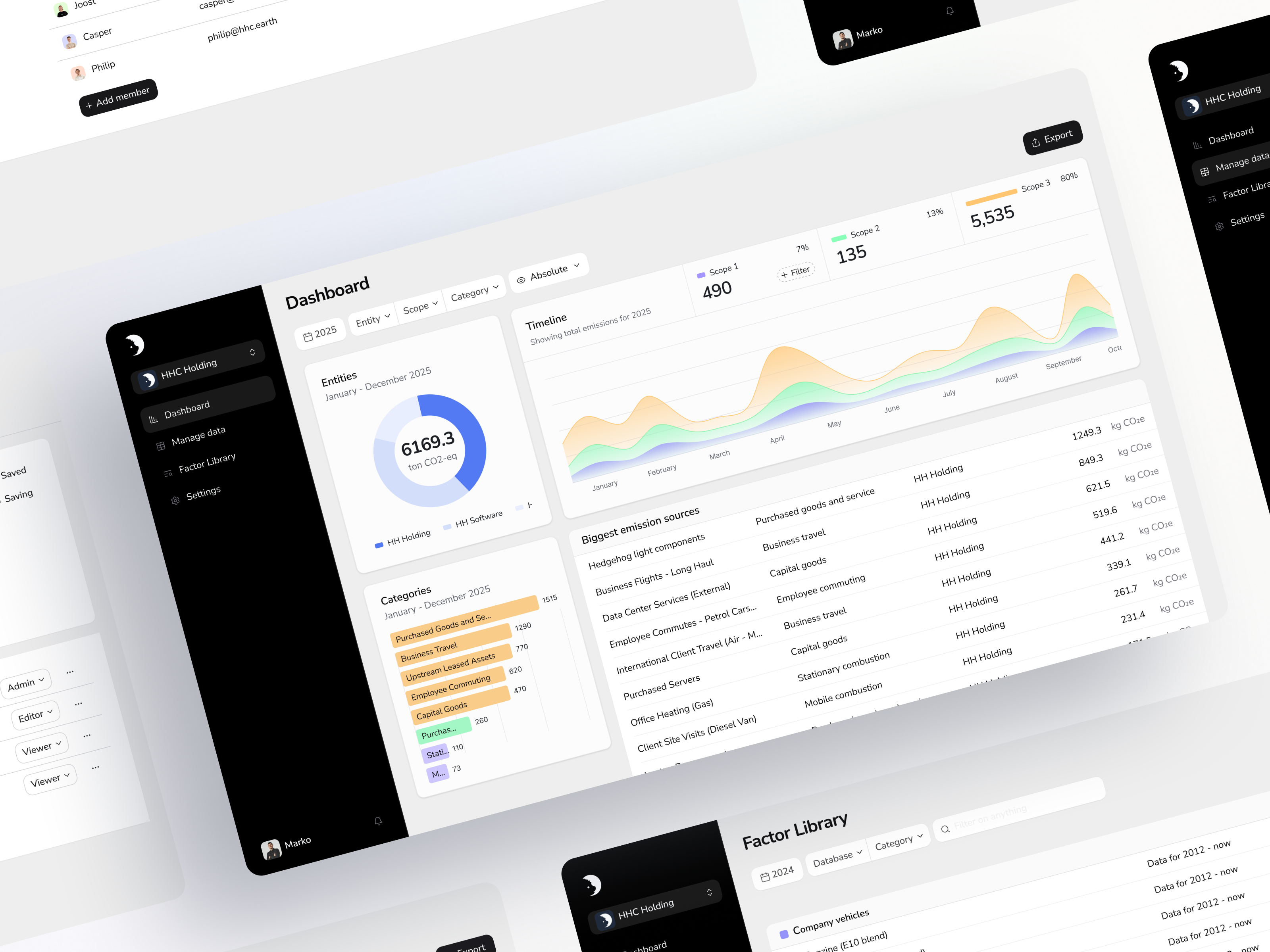
The Ladder is an audited management system, so the inventory has to survive someone tracing it. The Hedgehog platform names the CO2-Prestatieladder as a reporting output alongside the GHG Protocol, carries over 20,000 spend-based and activity-based factors you can supplement with your own supplier-specific data, and handles entity management across locations and sites with roles for data owners, auditors and managers. The platform page reports 5,000+ users.
The limitation to state plainly, because an auditor will find it before you do: a mid-market reviewer on G2 in July 2026 rated the platform 4 out of 5 and said the applied conversion factors and distance calculations are not exposed to the user, so you cannot always trace how an input became an entry. On a scheme where the certifying body follows your numbers back to source, test that on your own data before your first 4.0 audit rather than during it.
If the base year cap, the trede choice or the scope 3 quantification is where you are stuck, that is carbon footprint consulting work rather than a software question. A useful starting point on the scheme itself is our introduction to the CO2-Prestatieladder for SMEs, and you can schedule a meeting to talk through your own audit calendar.
Sources: the dates and the transition rules come from SKAO's Overgangsregeling 3.1-4.0, version 1.1 of 1 July 2025; the trede requirements and the effort comparisons from SKAO's migration guidance; the award mechanism from the Handreiking Aanbesteden 4.0 of September 2025; and the niveau structure from Handboek 3.1 of 22 June 2020. Harmonisatiebesluiten 1 to 3 and the Rijkswaterstaat and ProRail positions were read on the same sites. Platform facts from the Hedgehog platform page and customer reviews on our G2 profile. Verified 28 August 2026.
Facts on this page were last verified on 2026-08-28.