
In short
- ProRail has applied the CO2-Prestatieladder as an award criterion since 1 December 2010, across virtually all of its tenders.
- There is no published minimum ladder level as a suitability requirement. You can bid without any ambition level; it simply earns you nothing.
- The 2027 change is a version switch, not an arrival. The mechanism you already know stays the same.
If you bid for ProRail work, ProRail's CO2 award criterion already applies to you, and it has since 1 December 2010. ProRail applies the CO2-Prestatieladder using the tendering method SKAO recommends, and says a CO2-bewust certificate delivers an advantage in virtually all of its tenders as a fictieve korting, a fictitious discount on the bid price, which can run up to 10 percent. Nothing about this begins in 2027. What happens then is a change of handbook version. The test below takes a minute and turns on your pipeline, not on your certificate.
What is the test, stated exactly?
| # | Question | Where you answer it | If yes | If no |
|---|---|---|---|---|
| 1 | Do you bid, or intend to bid, on ProRail procurements? | Your own pipeline on TenderNed | Go to 2 | It does not reach you directly |
| 2 | Is the CO2-Prestatieladder named as an award criterion in those procurements? | The tender documents for each procurement | It applies to your bid price | Rare, but check each time |
| 3 | Was the procurement published before or after 1 January 2027? | The publication date on TenderNed | After: version 4.0 and its treden. Before: version 3.1 and its niveaus | Nothing to decide |
Question 2 will almost always answer yes. ProRail's published position is that the advantage applies to virtually all of its tenders, and its 2027 change applies wherever the Ladder is an award criterion. That is not the same as every contract, and the honest reading is that it is close to universal without being a rule.
Question 3 is the only one where the answer moved recently, and it moves the version rather than the answer.
Is there a minimum level you have to hold to bid?
No. There is no published minimum ladder level as a suitability requirement anywhere on ProRail's supplier page, and none should be assumed.
This is worth stating flatly because the assumption is common and it stops firms bidding. A bidder without any CO2-Prestatieladder position can submit a bid to ProRail. It simply earns nothing from that criterion, and competes against bidders who do. The criterion is a way of ranking bids, not a gate that excludes them.
Nor do you need a certificate at bid time even if you do want the advantage. You declare the CO2 ambition level at which you will execute the contract. ProRail checks during execution whether the declared level is actually delivered, and you prove it in one of two ways: project-specific evidence, or a CO2-bewust certificate matching the level you offered. A certificerende instelling, a certifying body, has a role in both routes. ProRail confirms that this stays true after the 2027 version change.
Does it apply to every ProRail contract?
Close to it, and the precise wording matters if you are planning around it.
ProRail says the certificate gives an advantage in virtually all of its tenders. The switch to Handboek 4.0 from 1 January 2027 is stated as applying to all newly published TenderNed procurements in which the Ladder is an award criterion. Both formulations leave room for procurements where it is not used, so the reliable answer for any specific opportunity comes from that opportunity's documents.
ProRail is explicit about this itself: it states that its tender documents on TenderNed, not its website, are decisive for the exact arrangement applied to a given procurement. Treat everything on the supplier page, including the percentages, as orientation rather than as the rule for your bid.
What if you are not the main bidder?
Then the criterion does not score you, and the fact base has nothing published that says it reaches down the chain automatically.
ProRail's published arrangement is about bidders and the contracts they win. It says nothing about obligations flowing to subcontractors or suppliers, so if a demand reaches you from a main contractor it is a contractual demand from that contractor, on their terms, not a ProRail requirement you can look up. Ask which of the two you are being handed. The answer changes who you negotiate with and what evidence is actually needed.
What if you already hold a certificate under version 3.1?
It keeps working at ProRail through the transition, and ProRail publishes its own equivalence mapping.
For tenders started before 1 January 2027 in which the Ladder is an award criterion, version 3.1 remains the basis and a version 4.0 certificate is also accepted as proof. ProRail treats trede 1 of 4.0 as equivalent to niveaus 1, 2 and 3 of version 3.1, and treden 2 and 3 of 4.0 as equivalent to niveaus 4 and 5. It applies the same equivalence to running contracts, which matters because an organisation can end up holding only a 4.0 certificate part way through a ProRail contract once 3.1 audits stop on 14 January 2027.
One warning: this is ProRail's mapping, not the scheme's. SKAO advises a different one in its own transition arrangement, treating trede 1 as niveau 3 and treden 2 and 3 as niveau 5. If you are comparing what your certificate is worth across two buyers, the tender documents decide, and the two buyers may not agree.
What changes for you on 1 January 2027?
The version and the shape of the staffel. Not the mechanism, and not whether you are in scope.
From that date ProRail intends to use Handboek 4.0 in newly published TenderNed procurements where the Ladder is an award criterion. Because 4.0 has three treden where 3.1 had five niveaus, the ladder of advantages is redrawn: ProRail's stated provisional weighting is a fictitious reduction of the bid sum of 4 percent for trede 1, 7 percent for trede 2 and 10 percent for trede 3.
Read that as an intention rather than a tariff. ProRail's own wording is conditional throughout, and it warns that a different weighting can apply to individual tenders. It also publishes no per-level staffel for the five niveaus it uses today, only the up-to-10-percent ceiling, so there is no clean before-and-after comparison to make.
Tenders started before 1 January 2027 keep the existing arrangement, so for a while you will be running bids under both.
What do you do if you are in?
Decide which ambition level you intend to declare, and then work out whether you can deliver it.
The work behind each level is an organisational carbon inventory that gets deeper as you climb: scope 1 and 2 at trede 1, quantified scope 3 and a klimaattransitieplan, a climate transition plan, at trede 2, and a quantified route to zero emissions by 2050 at trede 3. Because ProRail does not require the certificate at bid time but does check delivery during execution, a firm can bid at a level it does not hold yet and then has to build the accounting system that proves it, under contract, on a deadline. That is either a clever use of the rules or a trap, depending on how honest the internal estimate of the data work was.
The arithmetic to run first: the gap between adjacent treden in ProRail's provisional staffel is 3 percentage points, not 4, 7 or 10. What moving up buys you is the increment, and that is the number to weigh against the cost.
What do you do if you are out?
Nothing, and keep it that way deliberately. Re-check question 1 when your pipeline changes, since a first ProRail bid brings the criterion with it on day one rather than after a grace period.
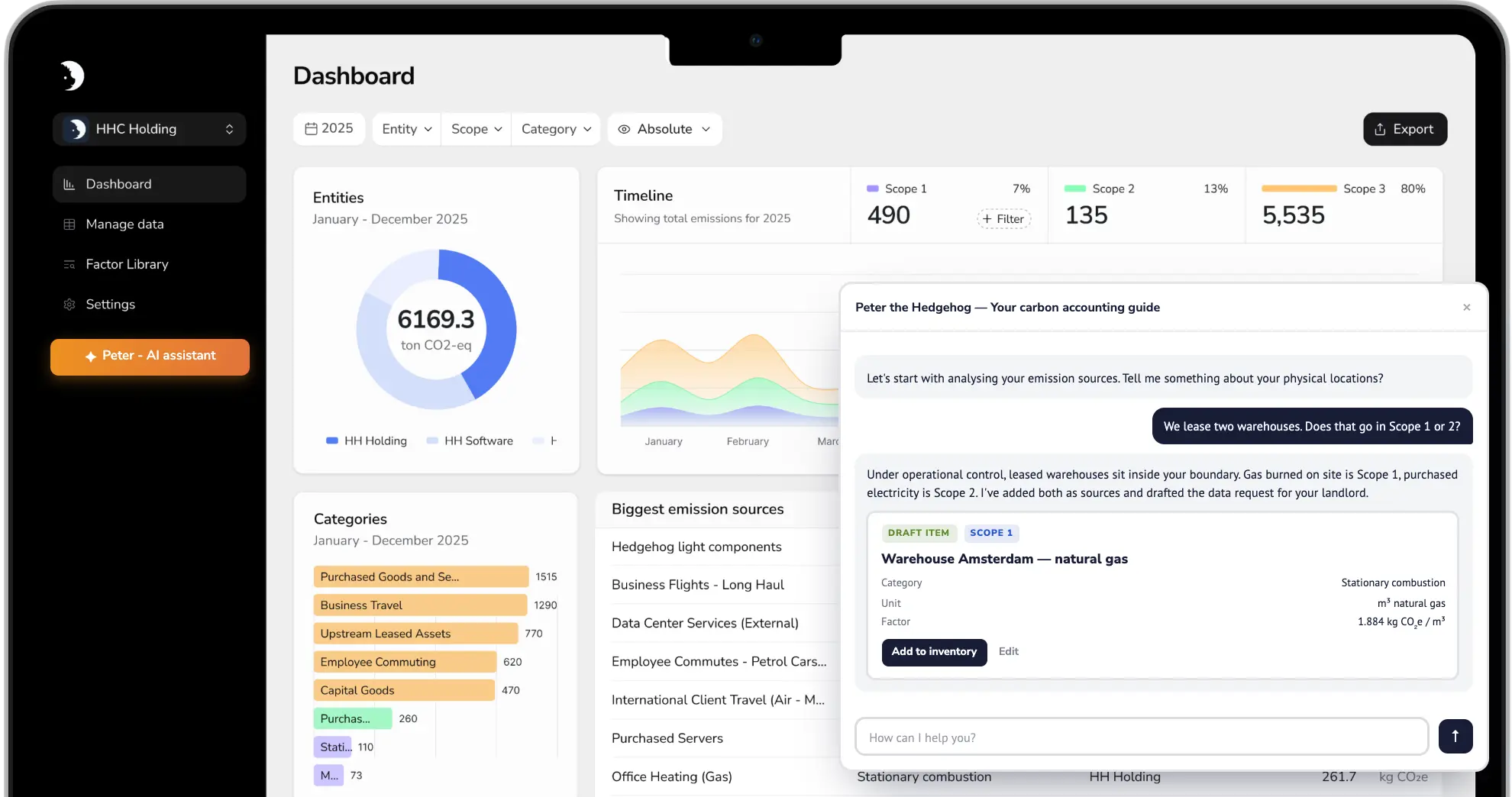
If you are in, the accounting work is where the schedule risk sits. The Hedgehog platform names the CO2-Prestatieladder among its reporting outputs, handles entity management across locations and sites with roles for data owners, auditors and managers, and reports 5,000+ users on its platform page. Set expectations honestly on the effort: a small business reviewer on G2 in August 2026 gave it 5 out of 5 and still said getting data in is a manual job that takes work, with the payoff coming afterwards. If you are declaring an ambition level you do not yet hold, that front-loaded effort lands inside your delivery window.
Where quantified scope 3 is the blocker for trede 2, treat it as scope 3 consulting work with a long calendar rather than a bid-week task. For the underlying scheme, our introduction to the CO2-Prestatieladder for SMEs is the starting point, and scoping help sits with carbon footprint consulting.
Sources: ProRail supplier page on the CO2-Prestatieladder, SKAO news item of 4 June 2026 reporting ProRail's announcement, Hedgehog platform, Hedgehog on G2. Verified 28 August 2026, re-checked 17 September 2026 with no changes needed.
Facts on this page were last verified on 2026-09-17.