
Two and a half years ago, The European Pizza Company (TEPC) knocked on Hedgehog's door. They had a clear ambition, but not yet a clear idea where to start. Now, they are in a completely different position. We spoke with Valentin Lohff, Global ESG Manager, about their journey towards clarity in their sustainability.
TEPC bakes pizzas and comprises 4 entities and more than 800 restaurants across several countries. The company wanted to become more sustainable—or more specifically, build a foundation for their journey towards net-zero across the entire value. They want to show their customers, franchisees, and employees that doing the right thing is possible: baking pizzas with a future, and for the future.
Although some brands within the company were already taking steps towards sustainability, for the most part, it was uncharted territory, Valentin explains. The willingness was there, but a clear path was missing. So TEPC set out to find a down-to-earth partner who understood where they were coming from. "I think Hedgehog understood that from start to finish and really grasped our specific needs in the franchise business and received great guidance." says Valentin.
Now, two and a half years later, Hedgehog has worked alongside them to complete two company-wide carbon footprints, set up a data collection system, conducted LCAs, and—perhaps most importantly—developed a clear climate strategy applicable to all franchises and brands.
At the end of this partnership, Valentin points out that TEPC now talks about its sustainability ambitions with greater confidence—about where they stand and where they want to go, all backed up by real numbers. That is something to be genuinely proud of.
How did we do this?
Company carbon footprint:
"First and foremost, we wanted to know where our business stood. What are TEPC's total greenhouse gas emissions and, above all, what is driving them?" says Valentin. “With that in mind, we started with a carbon footprint calculation, examining the entire value chain in detail.”
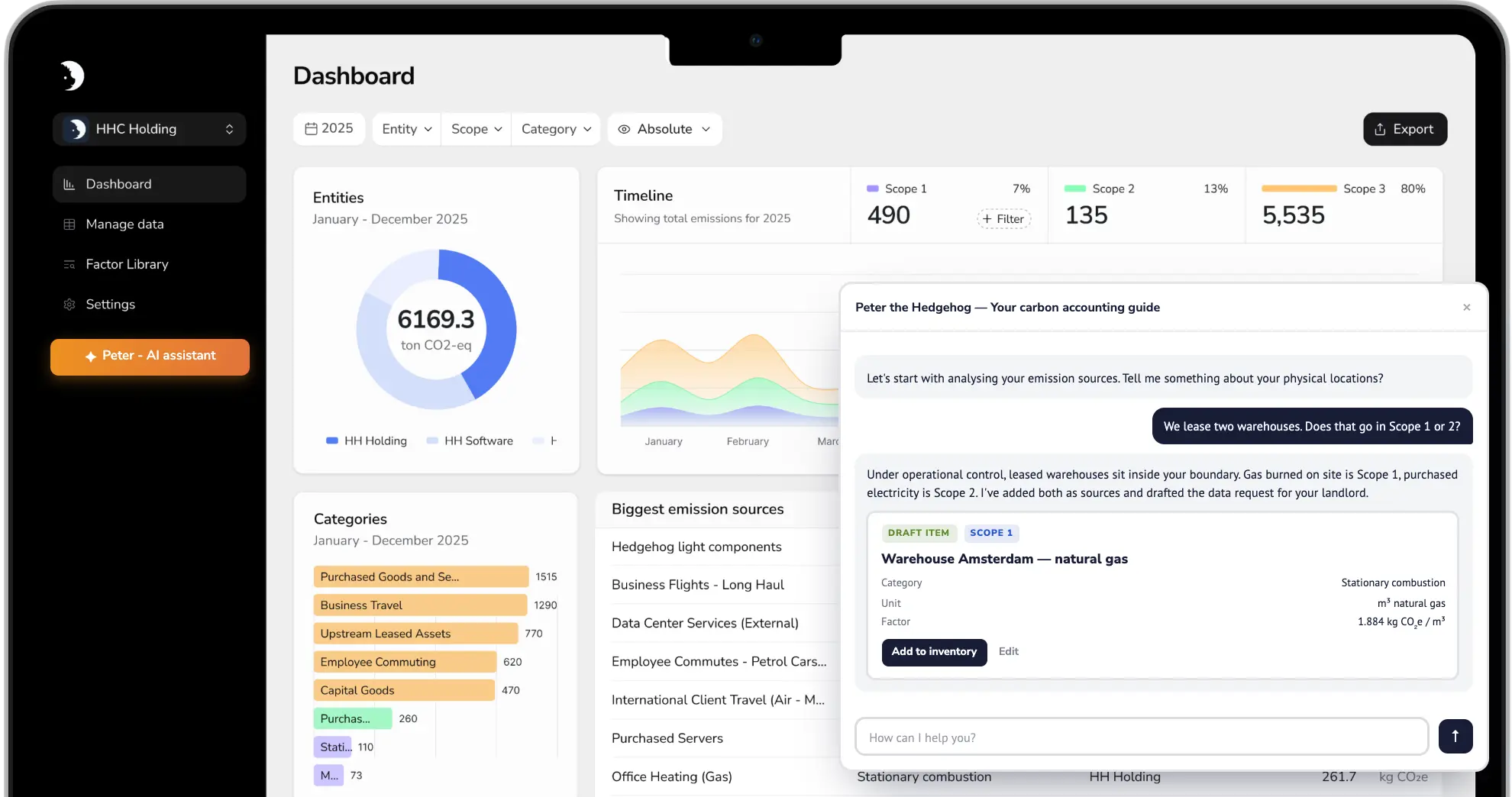
This gave them a comprehensive view of overall emissions, as well as those attached to each stage of the production process. It revealed that 80% of total emissions stem from purchased goods (Scope 3), with meat and dairy products accounting for 38%.
Life Cycle Assessment:
Another highlight of the collaboration was the life cycle assessment of the pizza dough, according to Valentin. Hedgehog and TEPC set to work gathering data to calculate the total impact of the dough making process.
At the Amsterdam dough factory, data was collected on ingredients and the entire production process was mapped out. The Hedgehog team then analysed the data, turning insights into immediate action. For instance, switching to electric freezers in the dough factory saved already 3,822 tonnes of CO₂ in 2024.
Valentin: "I think it helped that you visited the dough factory. It gave you an insight into the dough production process. Gathering the data was still a major challenge for us, but we managed it in the end with Nata's excellent guidance."
Streamlining Processes:
Tracking total emissions across restaurants, factories, properties, and product purchases for four entities and over 800 restaurants is a major operation in itself.
Therefore, to continue tracking climate impact and monitoring progress in the future, an advanced data collection system was established. TEPC uses tools such as Sweep for their carbon accounting, enabling them to log all data efficiently, save significant time, and prevent errors.
Valentin describes this as a substantial challenge: "...going from zero to a structured process required a lot of change. Above all, we had to get used to the standardised data collection system."
All in all, these were crucial steps towards a robust climate strategy. The first year focused on plugging data gaps. We then worked on a carbon roadmap and various scenario analyses, which TEPC subsequently used to set CO₂ targets for their different branches.
Future plans
From here, Valentin Lohff will focus on training the various business units to use Sweep, ensuring everyone is comfortable working with an operational carbon footprint system by the start of the year.
The current carbon footprints will then serve as the foundation for a comprehensive net-zero transition plan featuring targets for 2030 and longer term.
This partnership proves that with commitment and the right mindset, you can achieve a great deal in sustainability. TEPC has shown that in just two and a half years, you can move from scratch to strategy and implementation—gaining a firm grip on sustainability and confidently communicating your actions to customers and partners.
For Hedgehog, the priority was bringing clarity to the complex world of sustainability and data—and we think we succeeded pretty well! We wish TEPC a long and sustainable future!