
In short
- The CO2-Prestatieladder is the rule that matters, because installers bid into the same Dutch public works chains as contractors.
- Van fleet fuel is usually the largest scope 1 line, and the fuel card statement is already a near complete dataset.
- Wholesaler purchase data gets you materials quickly, but a euro total will never demonstrate a reduction.
For a Dutch installation company the rule that decides your software is the CO2-Prestatieladder, because installers bid into the same public works chains as the contractors they work for, and a ladder certificate carries an award advantage in those tenders. The emissions sit in two places: your van fleet, which is normally the largest scope 1 line you have, and the materials you buy through wholesalers. The tool has to turn fuel card statements and wholesaler purchase data into an audited annual inventory, and produce the actual ladder submission rather than a dashboard.
Which rule applies to installation firms, and when?
The CO2-Prestatieladder, if you bid for or subcontract on Dutch public work. It is a certification of your organisation and it is scored in procurement rather than enforced by an inspector, which means the deadline is a tender date rather than a statutory one.
Two dates are worth putting in the calendar now.
14 January 2027. From that date contracting authorities can no longer tender with version 3.1, and a certified organisation must have switched to Handboek 4.0 by its first audit after it. Your existing 3.1 certificate is not void on the day: audits against 3.1 run until 14 January 2027 and a certificate from one of them can stay valid until 14 January 2028. If you are already certified, the switch is still your nearest piece of work.
1 January 2027. ProRail switches to version 4.0 on that date. It is worth being clear that this is a version change and not an arrival: ProRail has awarded on the ladder since 1 December 2010 and Rijkswaterstaat moved to 4.0 on 1 July 2026, applying 2, 4 and 6 percent. ProRail's proposed staffel for 4.0 is 4, 7 and 10 percent, which it describes as provisional and which can differ per tender. If your work reaches those chains through a main contractor, the requirement arrives through them and it is already there today.
Our introduction to the CO2-Prestatieladder for SMEs covers what certification involves and what each tier actually asks of a smaller firm.
Where do installation emissions actually sit?
Fleet fuel and purchased materials dominate, and the split is unusual for a services business.
Van fleet fuel is normally your largest scope 1 line. A firm with sixty service vans doing engineer visits across a region burns a lot of diesel, and unlike most sectors that fuel is directly yours: your vehicles, your fuel cards, your scope 1. It is genuinely measurable and it is the number you can move.
Purchased materials are the largest total. Cable, pipe, ducting, boilers, heat pumps, switchgear and fittings, nearly all bought through one or two wholesalers, all of it scope 3. Bigger than the fleet, and far less visible, because it arrives as invoice lines in euros with no carbon attached.
That contrast is the whole planning problem. The part you can measure precisely is the part you can reduce; the part that dominates the total is the part sitting in a purchase ledger you have never looked at this way.
Why are fuel cards the best dataset you already own?
Because a fuel card statement is close to a complete activity dataset and almost nobody realises it. Litres, date, vehicle or driver reference, and often the site. That converts to scope 1 with a fuel factor and no estimation at all.
Three things to check before you rely on it.
Litres, not euros. Some statements report spend only. Ask your card provider for the volume file. Fuel prices move and a euro series will show a reduction in a year when prices fell.
Fuel type per card. Diesel, petrol, HVO and electric charging need different treatment, and mixed fleets often have all four on one account.
Private mileage and home charging. Decide once whether a van charged at an engineer's house is in scope and how you evidence it, then keep that decision stable.
Telematics adds kilometres per vehicle, which is what lets you show an efficiency improvement rather than a volume change. It is worth having, but the fuel card is the number that has to be right first.
What does wholesaler data give you, and what does it not?
Speed, mainly. One or two wholesalers will typically cover the majority of your material spend, and they can usually export twelve months of transactions by product group. That is a scope 3 category 1 estimate in an afternoon, which for a first ladder inventory is a reasonable place to start.
| Data source | What it covers | Effort | Limit |
|---|---|---|---|
| Fuel card statements | Scope 1 fleet fuel, the largest direct line | Low | Needs litres, not euros |
| Fleet telematics | Kilometres, for efficiency metrics | Low to medium | Optional in year one |
| Wholesaler purchase export | Most of scope 3 category 1 | Low | Spend based, cannot show a reduction |
| Site energy invoices | Scope 2, workshop and offices | Low | Small share of the total |
| Supplier and product data | Replaces proxies on your biggest lines | Ongoing | Only worth it for your top categories |
What wholesaler spend does not give you is a reduction story. If you switch to a lower carbon product at the same price, a spend based calculation shows no change whatsoever. Moving your top three or four product groups from spend to product specific data is what turns your inventory into something you can build a target on.
What should an installer's tool actually do?
Five things, and only the last is about presentation.
Ingest a fuel card file without manual retyping. Ask to see it done with your own export, not a sample.
Handle multiple entities and depots if you run several companies or regions, and roll them up without double counting.
Show its working. The ladder is audited. Every figure needs a route back to a source record and a factor version.
Survive a methodology change. Handbook 4.0 is a live example. Ask what happens to your base year when the method underneath it changes.
Produce the submission. The ladder needs documents, not a screen. Ask to see a real example output before you sign.
If you are weighing options generally, choosing carbon accounting software as an SME covers the criteria that hold up in a procurement review.
What does Hedgehog do for installation companies?
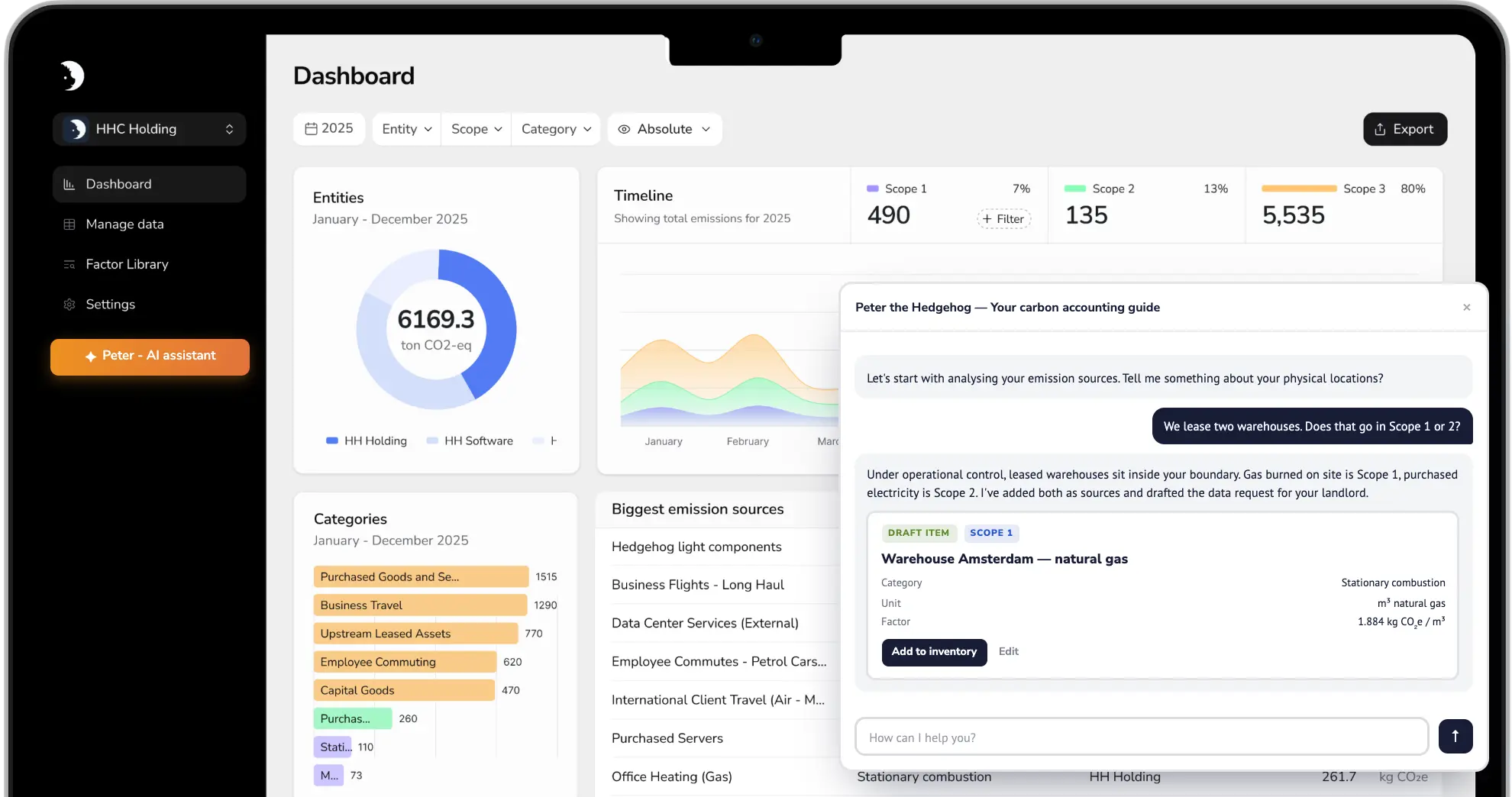
The platform names the CO2-Prestatieladder as a reporting output alongside the GHG Protocol and PPN 006. It guides you through GHG Protocol setup, inventory building, data upload and reporting with an AI assistant. It holds more than 20,000 spend-based and activity-based factors and lets you add organisation-specific or supplier-specific CO2 data, which is the route from a wholesaler spend line to a real product figure. Entity management across locations and sites, with roles for data owners, auditors and managers, covers multiple entities and gives an auditor their own access. It is available in Dutch, English and French.
A free account needs no sales call. Pro starts at EUR 1,200 per year, priced on user seats and business entities.
Two limits to weigh.
Integrations are limited today. A mid market customer on G2 in June 2026 asked for more integrations with other software. If your plan assumes an automatic feed from a telematics or fleet management system, ask about that specific system before you buy rather than assuming it works.
Loading the data is the work. A small business customer said on G2 in August 2026 that once the data is loaded everything works perfectly, and getting it loaded is the challenging part. With a year of wholesaler transactions to categorise, that is the realistic shape of the first inventory.
One scope note. The platform produces organisational footprints, which is what the ladder needs. A product level figure, meaning an LCA, EPD, ECI (MKI in Dutch) or PCF, is delivered as consultancy.
What should you do first?
Ask your fuel card provider for a twelve month volume export, in litres, split by fuel type. That is one email and it gives you most of your scope 1 in a form nobody can argue with.
Then ask your main wholesaler for a twelve month transaction export by product group. Between those two files you have a defensible first inventory before you have touched anything harder.
You can load both on a free account and see where you stand, or bring in carbon footprint consulting if a ladder audit is already booked.
Sources: SKAO CO2-Prestatieladder, ProRail and Rijkswaterstaat procurement documentation, Hedgehog platform, Hedgehog on G2. Verified 27 August 2026 and due for re-check before any 2027 refresh.
Facts on this page were last verified on 2026-09-17.