In short
- Purchased goods dominate. Last-mile delivery and returns are visible to customers but smaller in the number.
- EmpCo has applied to product claims and on-site green claims since 27 September 2026.
- A category-level footprint is buildable from your purchase ledger. A per-product figure is a different exercise.
Carbon accounting software for a retailer is a tool that turns your purchase ledger, your delivery volumes and your store or warehouse energy into a company footprint you can report and defend. You need it if a large customer, a marketplace, a lender or a CSRD-reporting partner is asking, or if you are making sustainability claims on a product page. The first step is mapping your purchase categories, because that is where most of your emissions and most of the work sit.
Where does a retail footprint actually come from?
Purchased goods dominate. Everything else is a rounding error by comparison.
That is counterintuitive for most retail teams, because the emissions your customers see and complain about are the ones in the van. Last-mile delivery and returns are visible, they generate correspondence, and they are genuinely worth reducing. They are also not where your tonnes are. The tonnes are in the things you bought to sell.
Practically this means the shape of a retail carbon project is decided by your merchandising data, not your logistics data. If your purchase ledger records supplier, value and a category code, you can build a defensible first footprint quickly. If it records supplier and value and nothing else, category mapping is your project.
| Source | Share of a typical retail footprint | Where the data lives |
|---|---|---|
| Purchased goods for resale | Dominant | Purchase ledger, merchandising system |
| Store and warehouse energy | Small but precise | Utility invoices, per site |
| Outbound delivery and returns | Visible, smaller than expected | Carrier volumes and invoices |
| Packaging and consumables | Small | Purchase ledger |
Who actually needs this in retail?
Three groups, and they want different things.
Retailers being asked by someone larger. Marketplaces, department store groups and wholesale customers push data requests down. Larger retailers remain in CSRD scope and have to assemble value chain data, so their suppliers get questionnaires. If you sell into another retailer, this reaches you.
Brands making claims. EmpCo has applied since 27 September 2026, and it puts product claims and on-site green claims squarely in scope. If your product detail page says a product is climate neutral, low carbon or better for the planet, that claim now needs to stand up. Our claims checklist covers what is required.
Retailers with lenders or investors. Financing conversations increasingly want an emissions figure with a method behind it, not a percentage on a slide.
If none of those apply to you yet, you probably do not need software this quarter. You will need it within a year or two, and knowing what your ledger looks like before the first request lands is worth an afternoon.
What does EmpCo change for a webshop?
It moves the risk from marketing to evidence.
The practical effect is that a claim on a product page is only allowed if you can demonstrate it, which in practice means a calculation you can show. That is a change in kind, not in degree. A generic sustainability page is one thing. A specific claim attached to a specific SKU is another, and the second one is what a webshop makes hundreds of times a day.
Two things follow for the software decision.
An organisational footprint is not a product footprint. Carbon accounting platforms calculate company emissions. A per-product figure that supports a claim on a product page is a product life cycle assessment, which is a different exercise with a different method and a different cost.
The safest claims are the ones about your own operations. A statement about your own measured emissions, with a method and a year attached, is much easier to evidence than a statement about a product you bought from a supplier who has never measured anything.
What should a retail tool actually do?
Five things worth testing on your own data before you commit.
Ingest a purchase ledger and map categories. This is the core job. Ask to import a real export of yours during evaluation, not a sample file.
Let you replace generic factors with supplier data. You will start spend-based, which is correct and normal. You need a path to swapping in real supplier figures for your largest categories, or you will never be able to show a reduction. Buying the same volume of a lower-carbon product at the same price shows no change at all in a spend-based model.
Handle multiple sites. Stores, a warehouse, an office. You want site-level energy and a clean company total.
Cover the scope 3 categories your customers ask about. Usually purchased goods first, then upstream transport. Scope 3 is where the questionnaires go.
Export into someone else's template. Every large customer sends its own spreadsheet. Getting the numbers out cleanly matters more than the dashboard.
One decision worth making early: whether you need a carbon accounting tool or a broader ESG reporting suite. They are not the same product and the overlap is smaller than the marketing suggests. We compare them in ESG reporting software versus carbon accounting.
What does Hedgehog do for retail and e-commerce?
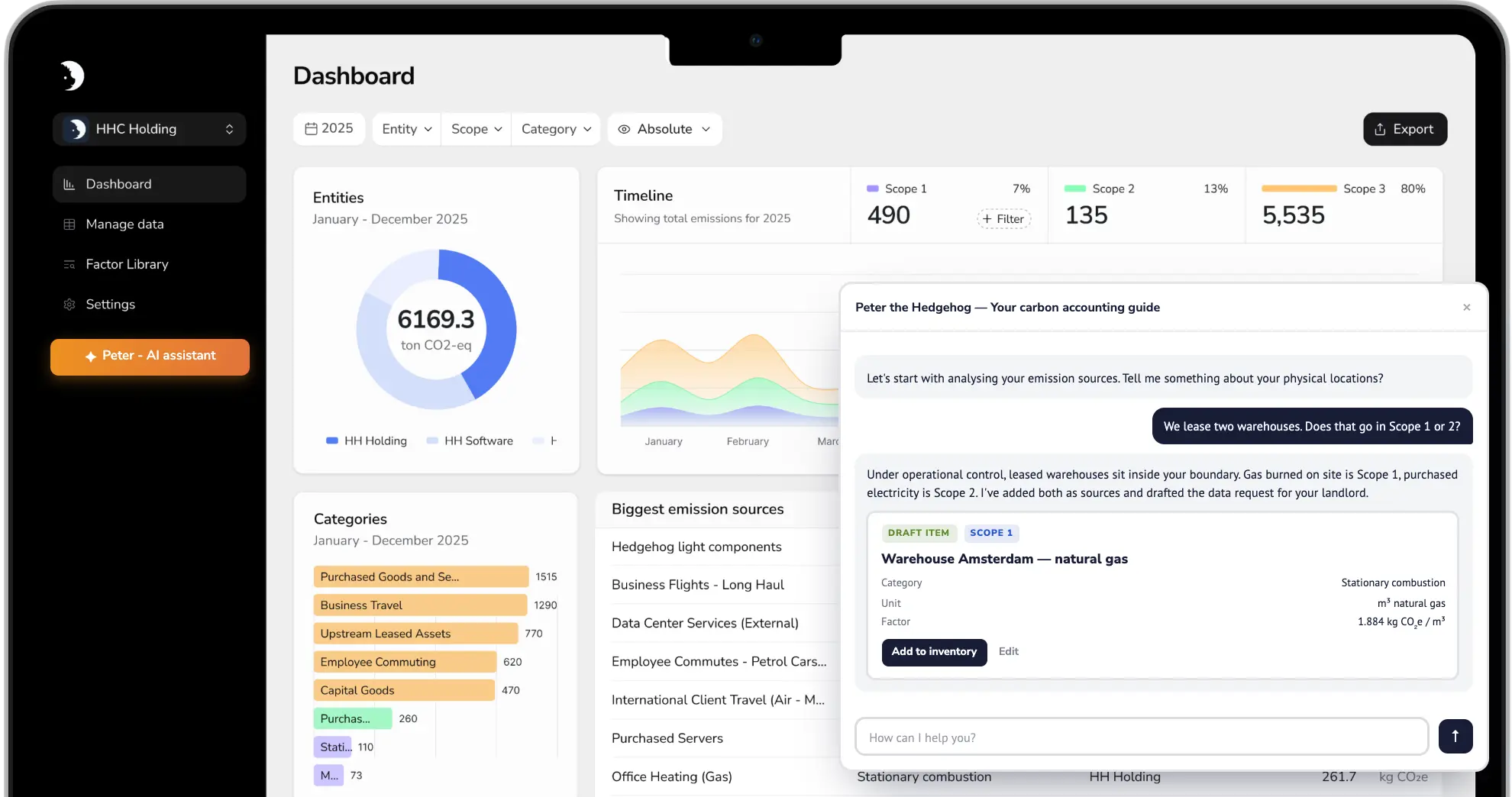
The platform guides you through the GHG Protocol, building a data collection plan and a GHG inventory, with an AI guide for setup and human GHG experts reachable in-app. It holds over 20,000 spend-based and activity-based factors, which is what makes a first pass at a purchase ledger practical, and it lets you add organisation-specific or supplier-specific CO2 data as your larger suppliers start producing real numbers. Entity management covers stores, warehouses and multiple legal entities, with roles for data owners, auditors and managers.
Free account with no sales call. Pro from EUR 1,200 per year. That is deliberate: of eleven competitor pricing pages we checked on 27 August 2026, only one published a number at all.
Two limits to weigh, both stated openly.
Loading the data takes real work. A Small-Business reviewer said so on G2 in August 2026: once the data is in, everything works perfectly, and getting it in is the challenging part. For a retailer with thousands of ledger lines and no category mapping, that is the honest shape of the first month.
Product footprints are a service, not a feature. LCA, EPD, ECI (MKI in Dutch) and PCF work is delivered as consultancy. The platform does organisational footprints. If you need a per-product figure to support a product page claim, that is a different engagement and you should price it separately.
What should you do first?
Pull a twelve month purchase ledger export and look at it honestly. If it has usable category codes, you can have a first footprint inside a month. If it does not, category mapping is your project and everything else waits on it.
Then audit your own product pages against the claims you are actually able to evidence. That exercise is free, it takes a morning, and it usually reorders the whole priority list.
You can start a free account and load store energy first to see how the tool behaves before you commit to the ledger work.
Sources: EU Empowering Consumers Directive as transposed, CSRD as amended, Hedgehog platform, Hedgehog on G2. Verified 27 August 2026.
Facts on this page were last verified on 2026-09-17.